Community Corner
Thousands of Dead Bunker Piled 2 Feet High in Shinnecock Canal After Massive Fish Kill
The kill could worsen, with piles of rotting fish on local beaches, more expected to die overnight and state of emergency called.


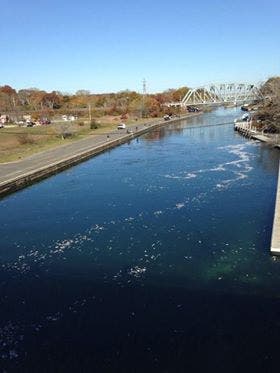
HAMPTON BAYS, NY — Hundreds of thousands of dead bunker fish — a wall of fish up to two feet deep on the bay bottom — stunned residents in Hampton Bays Monday who flocked to the Shinnecock Canal to stare at a massive fish kill that may worsen on Tuesday, according to town officials.
"There are hundreds of thousands, if not a million, dead bunker," said Southampton Town Supervisor Jay Schneiderman.
The massive bunker kill took place in the Shinnecock Canal and in Shinnecock Bay, he said. The die-off is believed to be caused by the sheer number of bunker in one small area, Schneiderman said. "They ran out of oxygen."
Find out what's happening in Westhampton-Hampton Baysfor free with the latest updates from Patch.
This is pretty disturbing...this was the Shinnecock canal this morning pic.twitter.com/02pvd8lCKy
— Rude Gyal (@JustineAiko) November 14, 2016
The fish kill drew crowds and traffic to Hampton Bays Monday as stunned spectators lined the bridge to witness the piles of dead fish.
"Everyone has the same, sad look on their face," said Bob Walsh.
Find out what's happening in Westhampton-Hampton Baysfor free with the latest updates from Patch.

"We fear it's going to get worse tonight, because there are a lot of live bunker still in the Shinnecock Bay. They're going to run out of oxygen. There's just not enough of a water column, when you have that many fish in a small, concentrated area," Schneiderman said.
The bottom of the inlet, Schneiderman said, "looks paved in silver. There's solid dead fish, all across the bottom."
According to Stonybrook University Professor Christopher Gobler, "Menhaden or bunker are migrating south and schooling densely in our bays and coastal ocean. There was a large school in the canal last night. The sun went down and the locks closed at the same time both of which lead to low oxygen individually. The fish also create a large oxygen demand."
He added that the unseasonably warm water also leads to slightly lower oxygen. "When the locks closed, oxygen levels dropped, probably to zero, killing the menhaden. In the bigger picture, fishing restrictions in some southern states have allowed menhaden populations to grow in the past two years during which kills have become more common locally."
Some, Schneiderman said, have estimated that there are possibly two feet of dead fish and possibly more at the bottom, the supervisor said.
Schneiderman said he's been working with the New York State Department of Environmental Conservation to come up with a plan.
"The New York State Department of Environmental Conservation is investigating a large fish kill in Shinnecock Canal," The DEC said in a statement.
"The closing of the Shinnecock Canal at 3:00 a.m. on November 14 trapped within the canal a large, dense school of bunker, or Atlantic menhaden, and other bait fish. The large school of fish was most likely chased into the canal by other predatory fish, and the fish kill does not suggest any impacts to the health of Shinnecock Bay."
Preliminary field analysis suggests the trapped fish died due to a lack of dissolved oxygen and the high density of fish, the statement said.
DEC staff have collected additional samples for further analysis; the canal and locks are operated by the Suffolk County Department of Public Works. The canal locks and gates were reopened at 10 a.m. Tuesday, allowing the live and dead bunker to enter Shinnecock Bay, a release said.
"As a precaution, the Suffolk County Health Department has also collected water samples, as well as a phytoplankton sample, to test for pathogens, nutrients, and pesticides," the DEC said.
Local fishermen and the DEC have said that in 24 hours, those decomposing fish, filled with hydrogen sulfide gas, are going to rise to the surface; Tuesday's expected stormy weather could pose even more problems, and the tide gates closing could mean even more fish pushed into the Shinnecock Bay, Schneiderman said.
The high tide with Monday night's Supermoon will mean thousands of fish could disperse and be piled on the shorelines, Schneiderman said.
"It's going to be really smelly," he said.
Schneiderman said options include dredging the bottom, setting up containment boons, using nets and marshaling town assets, such as highway trucks, to tackle the problem.
The supervisor has convened a meeting for Tuesday morning to look at solutions.
"I'm preparing to issue a very localized state of emergency, just because of the public health aspect," he said.
A line of dead fish is already visible on area beaches, he said.
While some have suggested just letting nature take its course, Schneiderman said the DEC has urged the town to find a way to pick up all the fish.
"Not a bad thing"
Schneiderman said, though, that the fish kill is not a sign of unhealthy waters — just too many bunker in a small space.
"This is not a bad thing. This is not a sign that the bay is unhealthy. If anything, it's very healthy," he said.
Bunker feed the striped bass, crabs and other fish and are good for the food chain, he said.
"The fish didn't die because the water was toxic, the fish died because they ran out of oxygen," Schneiderman said.
The DEC tested the water on both sides of the canal, Schneiderman said, and deemed it "fine."
In fact, the die-off was a boon for some business; commercial fishermen pulled out 60,000 pounds of bunker Monday to be sold as lobster bait in Maine. "Some people made money off this, for sure," Schneiderman said. "But it's a one-day event. Tomorrow the fish may not be fresh."
However, the DEC has given the town permission to compost the fish on Jackson Avenue, Schneiderman said; the highway department will help to transport the bunker, he said.
Kevin McAllister of Defend H20 agreed that the die-off was likely caused by the sheer number of fish in the small area. "They presumably depleted their own oxygen," he said.
In recent years, rust tides and nitrogen loading have brought massive fish kills of both natural and caged populations of fish and shellfish on eastern Long Island, the release said.
“We have identified climate change and specifically warm summer temperatures as a trigger for these large, widespread rust tides," said Professor Christopher Gobler of Stony Brook University.
Patch photos courtesy of Bob Walsh
Get more local news delivered straight to your inbox. Sign up for free Patch newsletters and alerts.