Politics & Government
Update: Gedney Association Holds Informational Meeting on FASNY
A town planner from Greenburgh was the featured speaker on Wednesday night as the Gedney Association met to discuss the French-American School's plans for the former Ridgeway Country Club site.


- Update: According to the city clerk's office there is no meeting scheduled for FASNY to make a presentation on Tuesday, Sept. 20.
At an informational meeting held at Ridgeway School on Wednesday night, a town planner employed by Greenburgh gave a presentation on the State Environmental Quality Review (SEQR; pronounced “seeker”) process and special-permit process that the French-American School of New York (FASNY) will be required to complete before moving ahead with its plans for the former Ridgeway Country Club property in White Plains.
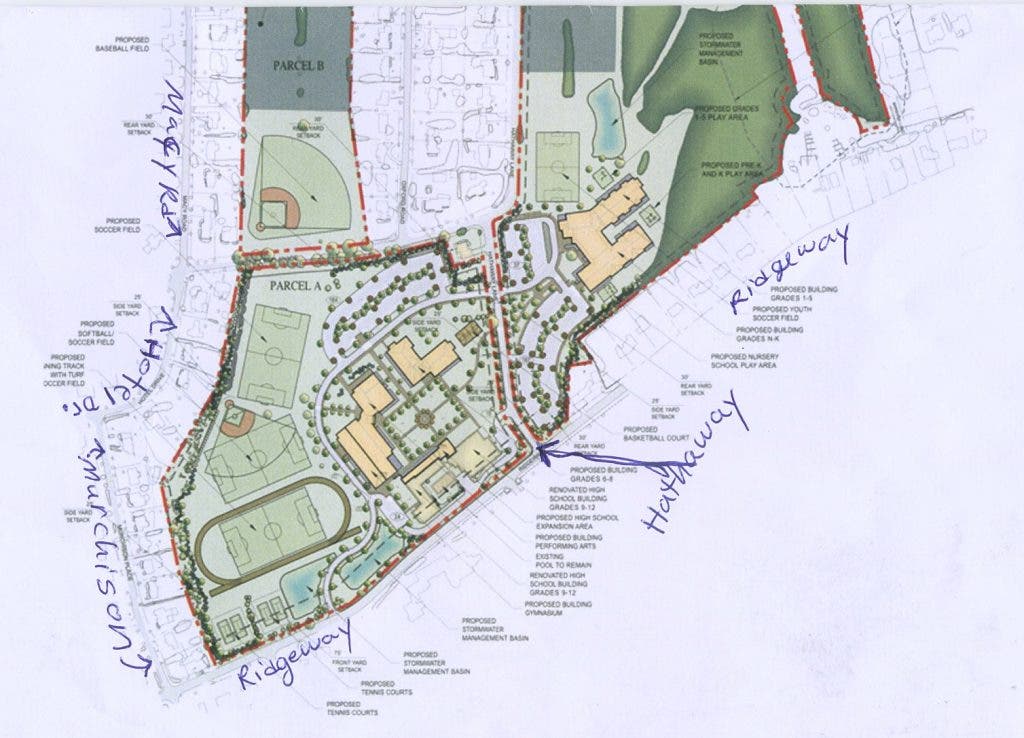
FASNY, which bought the Ridgeway property in January, hopes to unite its three current campuses—currently located in Larchmont, Mamaroneck, and Scarsdale—on the site. The plan would bring 1,200 students to the 129-acre property.
During a question-and-answer session after the presentation given by Garrett Duquesne, several residents expressed their continuing concerns with FASNY’s plans, as well as a newer concern regarding a pond and earthen dam on the property.
Find out what's happening in White Plainsfor free with the latest updates from Patch.
The SEQR process, a requirement under New York State law, begins with a scoping document that identifies areas of concern; later, a Draft Environmental Impact Statement is prepared, followed by a Final Draft Environmental Impact Statement. A Findings Statement is then prepared by the lead agency (in this case, the Common Council), and the project is declared “approvable” or “unapprovable.” If the project is deemed approvable, the special permit is then considered.
Duquesne provided timeframes for each of the steps—for example, the scoping process must take at least 60 days—but he stressed that these are minimum timeframes and are likely to be extended at each step of the process. Public comment is accepted throughout the process, he added, often though not necessarily through public hearings.
Find out what's happening in White Plainsfor free with the latest updates from Patch.
Terence Guerriere, president of the Gedney Association, said Duquesne was approached after Guerriere was told that White Plains’ own planning department thought it would be inappropriate for them to present to the association.
Gedney Association Vice President John Sheehan spoke about maintenance of the property, which he said was exemplary under Ridgeway Country Club but a problem under FASNY’s ownership.
Sheehan mentioned a pond that was created in the 1970s as a water source for the golf course. Now that the course is closed, he said, there is no need for the water source, and he expressed concern that if the earthen dam holding the water is breached, a preschool at Ridgeway Alliance Church could be affected, along with other property owners.
However, he added of FASNY, “they are responding to concerns raised by neighbors and others in the city,” especially in terms of cutting the grass and providing security on the grounds.
Padraic Lee, a vocal opponent of FASNY’s plans whose Hathaway Lane home abuts the property, said later in the meeting that the lake—“it’s no pond,” he said; “it’s 12-some-odd acres”—is “huge” and “potentially devastating.” An aerial image of the property was passed around, with arrows showing the flood path if the dam was breached.
Michael Zarin of Zarin & Steinmetz, a White Plains-based law firm representing FASNY, said on Thursday that the dam issue is a “red herring,” saying that there “has never been a question as to its structural integrity.”
“There is no issue,” he added. “We will continue to comply with any applicable regulations.”
Lee also questioned FASNY’s promise of creating the Gedney Preserve, which it has described as “a passive natural area with public trails for walking, jogging, and bicycling.”
“We will never, ever be given open space,” Lee said, adding that the city “will never be deeded that land.” The most the city will get, he said, “is a land-use permit that could, under very complicated legal conditions, be revoked.” It would be a temporary-use permit, Lee said, “with the emphasis on ‘temporary.’”
Zarin said that he and FASNY are “on the record in any forum we’ve spoken in” that the Gedney Preserve would be “permanent, irrevocable open space” and that whatever apparatus for maintaining the preserve is decided upon will be “written into the deed.” Mischa Zabotin, chairman of the FASNY board of trustees, told White Plains Patch last month that the preserve will be maintained “at no cost to the city,” and Zarin repeated that contention on Thursday.
FASNY is in discussions with the Cornell Cooperative Extension and others. It is also seeking ways to manage the preserve, Zarin said.
Zarin also said that the preserve will likely be closer to 80 acres than the previously reported 60-plus acres.
“It’s not only going to double the open space in White Plains,” Zarin said, “but it’s going to be an asset and resource to the neighborhood.”
FASNY will be making a presentation to the Common Council in the Common Council chambers at City Hall. FASNY may appear at a special meeting on Monday, Sept. 26, though agenda items aren't finalized and subject to change .
Public comments will not be heard, but the public is permitted to attend. Councilwoman Milagros Lecuona noted at the meeting that all members of the Common Council would welcome questions and comments before or after the work session.
You can view FASNY's scoping and application documents on the City's website at www.cityofwhiteplains.com.