Politics & Government
New York State Economy Will Feel Pain as a Result of Federal Healthcare Cuts
NYS Assemblymember Amy Paulin speaks to nonprofit, healthcare, higher education and business leaders at Nonprofit Westchester forum.
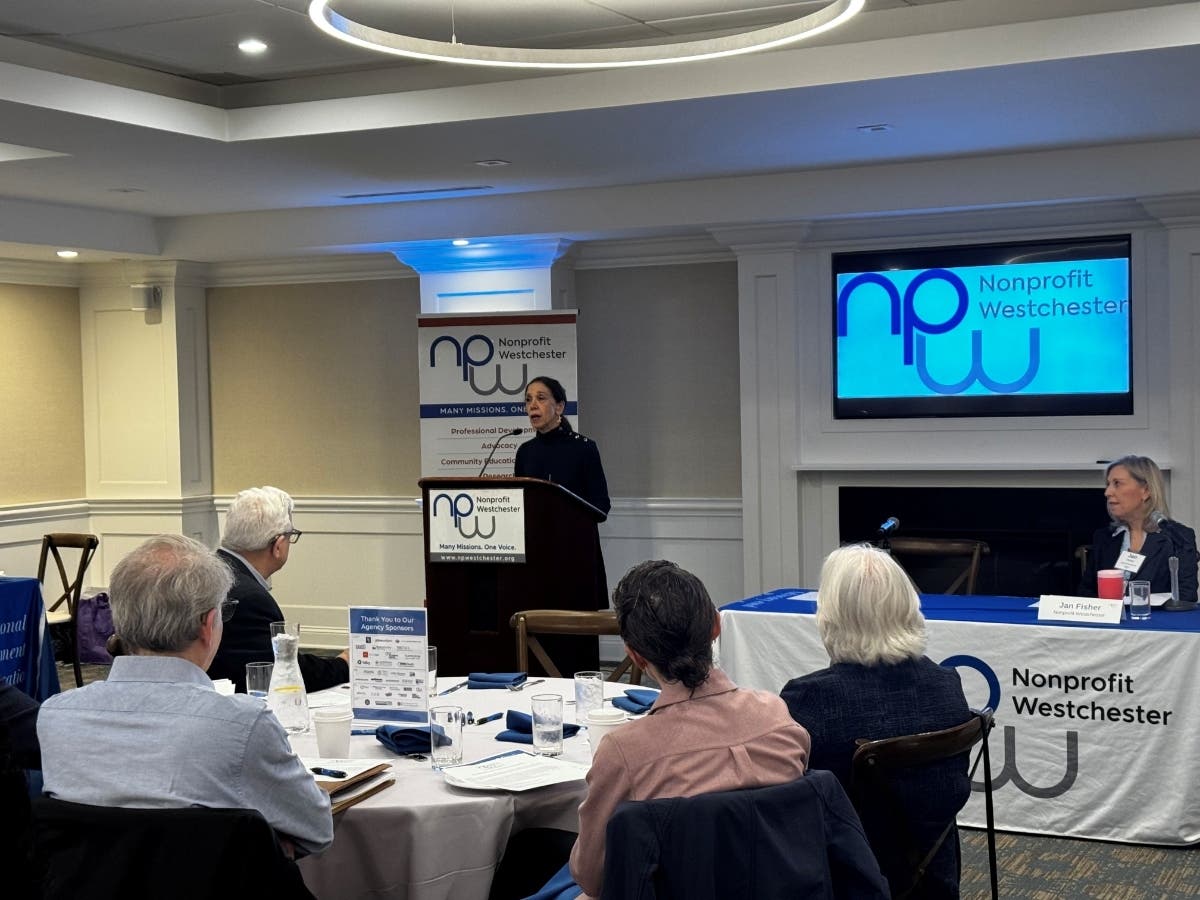
White Plains, NY – April, 2026 – Young people and the poor will not be the only ones to suffer from federal healthcare cuts in the One Big Beautiful Bill Act (OBBBA), according to New York State Assemblymember Amy Paulin.
Paulin, who Chairs the Assembly’s Health Committee, addressed nonprofit, healthcare, higher education and business leaders at a forum sponsored by Nonprofit Westchester on April 10 to explain the impact of the cuts on the state’s 2026 budget, which has still not been finalized.
“Assembly Member Paulin, you are a true champion of our sector. We know that Federal changes will mean Medicaid Coverage losses, rising numbers of uninsured people, provider instability, economic instability and major state budget pressures,’ said Jan Fisher, Executive Director of Nonprofit Westchester. “What do you want people in this room to understand right now about the impact of Federal cuts to Medicaid generally and particularly about how serious the expected 2027–2029 cliff is.’’
Find out what's happening in White Plainsfor free with the latest updates from Patch.
Paulin told the audience of about 80 leaders who gathered at Sam’s of Gedney Way in White Plains, that the state was grappling with ways to soften the blow of cuts that threaten to do significant damage to the state’s economy, particularly to hospitals, healthcare providers and nonprofits.
Most of the cuts will not take effect till January 1, 2027, giving the state some breathing room to propose legislation to blunt the effects. Paulin said the continued availability of revenue from a tax on insurers (MCO tax) was another offset, but that support might be withdrawn in the future. One thing is clear, said Paulin: The state cannot make up for the loss in its budget and will have to find creative ways to save money while still serving New Yorkers.
Find out what's happening in White Plainsfor free with the latest updates from Patch.
Paulin said that one of the major blows is to workers who make between 200% and 250% of the poverty level (FPL), which is as low as about $31,000 for a single person. These people just became eligible for free health insurance via the New York State Essential Plan (EP) two years ago and now will no longer be eligible. This group represents approximately 470,000 New Yorkers, and were just notified on April 1 that they will lose EP coverage starting on July 1, 2026. This group will have to either get health insurance through their employers or on the marketplace. However the OBBBA also eliminated federal premium tax credits and cost-sharing reductions for a significant number of lawfully present immigrants, effective January 1, 2027, which will make it difficult for these New Yorkers to afford healthcare coverage outside of the EP, said Paulin.As a result, Paulin worked with the Community Service Society of New York (CSS), and has introduced a bill, along with State Senator Rivera in the Senate, to offer insurance to this group of New Yorkers. This bill is part of the budget negotiations currently happening in Albany.
Paulin said that another blow of the OBBBA will fall on those in the lowest income brackets who may not be able to satisfy the work requirements imposed by the OBBBA, potentially threatening Medicaid recipients’ Medicaid eligibility. This, coupled with changes to the Affordable Care Act which have caused premiums and deductibles to skyrocket, have already forced people to lose insurance and destabilized the entire system. Hospitals and healthcare providers, who rely on income from Medicaid to support their budgets, will suffer and face an additional burden of treating more uninsured in emergency rooms.
“Simply giving the hospitals additional money is not the answer,’’ said Paulin. “We want to see that some of this funding goes to the people.’’
Several nonprofits asked questions about a new requirement that will take effect in 2028 that will require those on Medicaid to re-enroll every six months instead of annually. Paulin acknowledged that this would cause more people to lose Medicaid.
Judith Watson, CEO of Westchester Community Health Centers, and a member of the NPW Board who opened the program, said, “We stand firmly behind our core belief that health care is a right for all, not a privilege for some. Over fifty percent of our more than 46,000+ registered patients are underinsured or uninsured.Our centers face daunting challenges daily and federal changes to Medicaid augment those concerns significantly.”
Paulin said that her office was working to pass legislation she authored to streamline the state’s reimbursement processes to ensure that nonprofits and hospitals are paid on time for services already rendered. In addition, she has proposed legislation to allow healthcare providers to practice at the top of their licenses, allowing them to evaluate, test, diagnose, manage treatments, prescribe medications and other services, to make more services available to patients.
About Nonprofit Westchester (NPW): Nonprofit Westchester is the county’s only membership organization solely dedicated to advancing the needs and interests of Westchester’s nonprofit sector, the people and populations served, and the nonprofit workforce. With a membership of more than 380 organizations. NPW provides a unified voice for the sector through advocacy, professional development, and the promotion of cross-sector collaboration to build a more equitable and resilient Westchester.