Community Corner
Brightest Comet Of 2018 Streaking Toward Charlotte
Weather conditions permitting in NC, you should be able to see Comet 46P/Wirtanen making an unusually close approach to Earth.

CHARLOTTE, NC — Most comets — about a dozen a year — pass Earth without notice, but the brightest of 2018 is headed toward Charlotte. Comet 46P/Wirtanen will come within 7 million miles of Earth on Sunday, Dec. 16, and, at least theoretically, will be visible without binoculars or a telescope.
But if you have either of those devices, all the better. And you’ll want to get as far away from city lights as possible. The comet is rather small, and you’ll need to know exactly where to look — on the border between the constellations Cetus and Eridanus. It will be slightly green in color, with a fuzzy glow surrounding it, and should be visible anytime after dark, weather permitting.
The weather forecast in Charlotte seems to be cooperating with your skywatching pleasure. Sunday night, skies will be mostly clear, according to the National Weather Service. (For more news like this, find your local Patch here. If you have an iPhone, click here to get the free Patch iPhone app; download the free Patch Android app here.)
Find out what's happening in Charlottefor free with the latest updates from Patch.
Wirtanen, a mile-wide piece of ice, orbits the sun once every five and one-half years. And while 7 million miles may seem far, far away, it’s actually quite close in cosmic terms. Sky & Telescope explains Wirtanen — named for Carl Alvar Wirtanen, a senior observing assistant at California’s Lick Observatory who discovered it on Jan. 15, 1948 — will be among the 10 closest comet approaches to Earth since 1950, and the 20th closest approach of a comet since the 19th century.
For perspective, the sun is about 93 million miles away from Earth.
Find out what's happening in Charlottefor free with the latest updates from Patch.
See Also: Spectacular Geminid Meteor Shower: Peak Dates, How To See It
The moon, which is approaching full status, will be problematic. Still, Wirtanen and its coma — that’s the fuzzy-looking area around the comet — will be about two or three times larger than the diameter of the moon. But don’t expect anything as dramatic as Haley’s Comet or Comet Hale-Bopp.
Sky & Telescope’s Joe Roa explains that the comet will be “unusually large in angular size” and will appear as “very diffuse” — that is “almost ghostly.”
“Remember,” he wrote, “you’re not looking for a sharp star-like object, but rather something which is spreading its light out over a relatively large area.”
Roa said that while a number of different predictions have been made about the brightness of the comet as it brushes Earth, he tends to favor the predictions of Japanese comet expert Seiichi Yoshida, who predicts a magnitude of no fainter than +4 (to understand this, the smaller the magnitude, the brighter the object). The Smithsonian Astrophysical Observatory’s Minor Planet Center forecasts a peak magnitude of +8.
The comet should be visible for the next several weeks, through the end of January.
While you’re looking up this weekend, you may see some leftover Geminid meteors. The Geminid meteor shower peaks Thursday and Friday, Dec. 13-14, but its fast, brightly colored falling stars continue through Dec. 17.
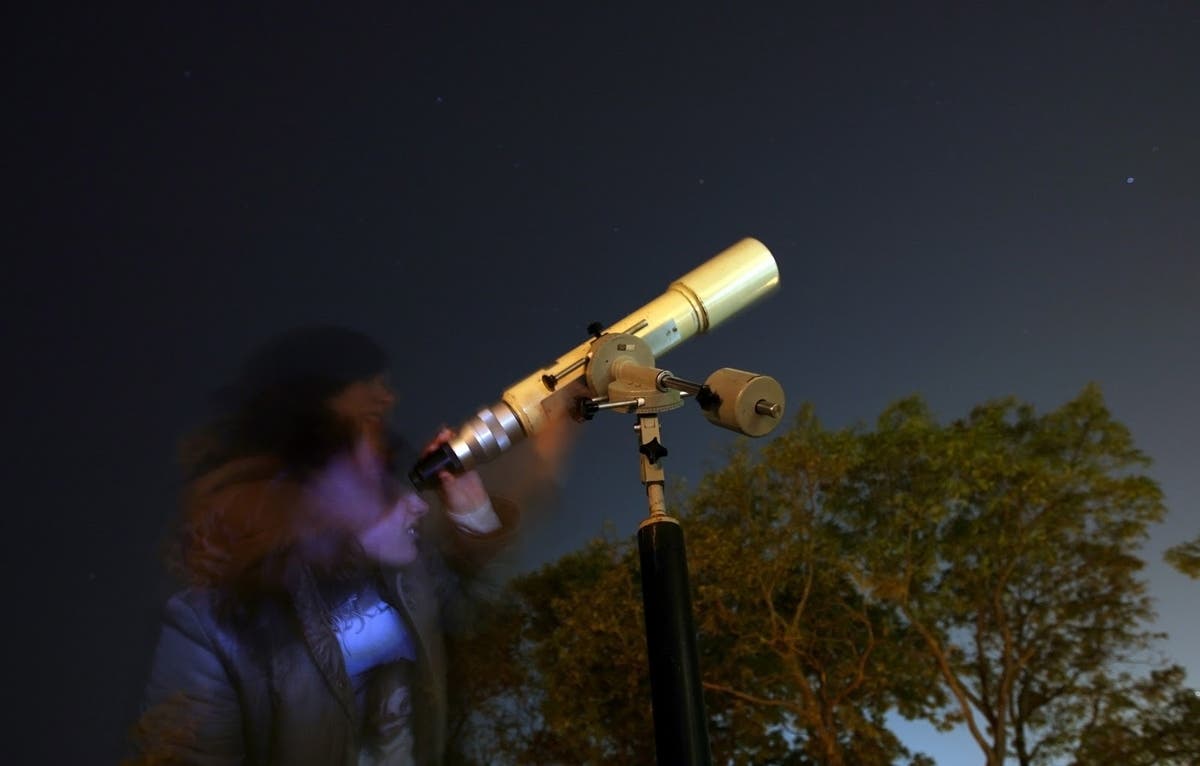
Image: You won’t necessarily need a telescope or binoculars to view Comet 46P/Wirtanen, but it will improve your chances of seeing the mile-wide piece of ice that orbits the sun every five and one-half years. (AP Photo/Petar Petrov)
Get more local news delivered straight to your inbox. Sign up for free Patch newsletters and alerts.