Weather
Tropical Storm Gert Expected Make Waves For N.C. Beaches
The National Hurricane Center is monitoring Tropical Storm Gert and a disturbance that is showing the potential for development.


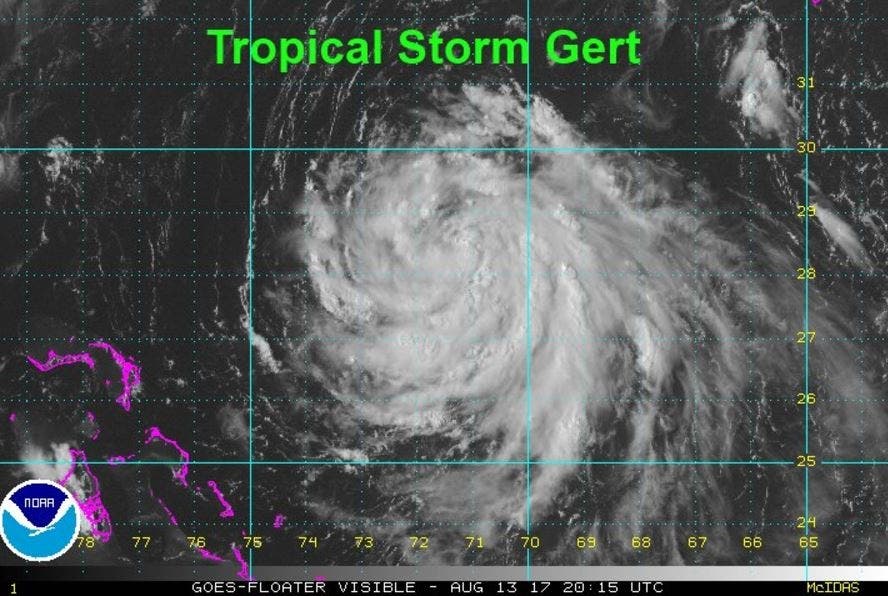
CHARLOTTE, NC -- While Tropical Storm Gert is staying well offshore as it makes its way north, the storm is gaining strength and threatening North Carolina beaches with rough surf and rip currents, the National Weather Service said Monday afternoon.
Tropical Storm Gert, the 2017 Atlantic hurricane season’s seventh named storm, was located several hundred miles west-southwest of Bermuda, according to the National Hurricane Center’s 5 p.m. Aug. 14 update. The system was packing maximum sustained winds of 70 mph while moving north at 8 mph.
Gert continues to build strength over the Atlantic Monday and is expected to become a hurricane Monday evening, the National Weather Service said Monday afternoon. (Get Patch real-time email alerts for the latest news in Charlotte — or other neighborhoods. And iPhone users: Check out Patch's new app.)
Find out what's happening in Charlottefor free with the latest updates from Patch.
Meanwhile, another disturbance is under watch off the coast of Africa, located a few hundred miles west-southwest of the Cabo Verde Islands as of Monday afternoon. That system is expected to encounter conditions that are “generally conducive for development” over the next few days, the center wrote in its 2 p.m. Tropical Weather Outlook report.
#Gert continues to strengthen & expected to become hurricane tonight. Will stay well offshore but rough surf & rip currents along East Coast pic.twitter.com/efWiIxjSIE
— NWS Eastern Region (@NWSEastern) August 14, 2017
That system is on a current projected path that could make it a concern for the Caribbean and Florida should its course hold.
Find out what's happening in Charlottefor free with the latest updates from Patch.
The storm was moving west at 15 mph over the tropical Atlantic Monday afternoon. Forecasters have given the storm a 30 percent chance of developing more over the next 48 hours. Those chances rise to 60 percent over the next five days.
Should the disturbance develop enough to earn a name, it will be called Harvey. What, if any impact, the disturbance may have on Florida or the United States remains too soon to tell.
The arrival of the two storms follows last week’s adjusted hurricane season forecast issued by the National Oceanic and Atmospheric Administration. The organization upped its predictions for the year as the traditional peak of the season neared. That peak has officially arrived.
Back in May, NOAA forecast a 45 percent chance of an above-normal season. Last week, that number rose to a 60 percent chance.
“The season has the potential to be extremely active, and could be the most active since 2010,” NOAA warned in issuing its revised forecast. That season gave birth to such named storms as Hurricane Alex, Tropical Storm Hermine and Hurricane Danielle. All told, there were 19 named storms, according to NOAA records.
NOAA forecasters now say there is a strong chance for 14 to 19 named storms to crop up this season. This is compared with the projection of 11 to 17 issued in May. Of those storms, two to five of them are expected to be major hurricanes, which is an increase from May’s projection of two to four. Major hurricanes are those that have maximum sustained winds of at least 111 mph. The estimate of five to nine hurricanes in total issued in May remains unchanged, forecasters say.
“We’re now entering the peak of the season when the bulk of the storms usually form,” Gerry Bell, lead seasonal hurricane forecaster at NOAA’s Climate Prediction Center, said in announcing the updated predictions. “The wind and air patterns in the area of the tropical Atlantic and Caribbean where many storms develop are very conducive to an above-normal season. This is in part because the chance of an El Nino forming, which tends to prevent storms from strengthening, has dropped significantly from May.”
Warmer-than-predicted water in the tropical Atlantic Ocean also prompted the adjusted forecast.
The Atlantic hurricane season runs from June 1 to Nov. 30 each year. Average seasons produce about 12 named storms, of which six become hurricanes. Three of the hurricanes are generally deemed major.
Residents readying for the ongoing season can get tips and advice on the federal government’s Ready.gov website.
» Patch Editor Sherri Lonon contributed to this report.
Graphic courtesy of the National Weather Service
Keep up with more local news by liking Charlotte Patch on Facebook:
Get more local news delivered straight to your inbox. Sign up for free Patch newsletters and alerts.