Community Corner
'The American Nightmare': Fear Grips Cleveland's Immigrant Community After Donald Trump's Election
Many are worried their friends and family will be deported or will end up in prison.


CLEVELAND, OH — Leticia Ortiz was in a walking haze. She had never paid attention to a presidential election with this much vigilance. She had listened to the talking heads and read all the polls. She was confident Hillary Clinton would become the next president of the United States. When Nov. 8 went the other way, Ortiz said she was left with a feeling as if she was "trapped in a bad dream."
"I just felt like there was so much hate directed towards me and my community," Oritz told Patch. "I thought America would never elect this man. Now I feel like the hate won, the racists won. This is so tough. There's so much open hate. I don't know how we all come together."
Ortiz wasn't alone in her terror. "Surreal." "A dream turned into a nightmare." "A shock." That was how many in Cleveland’s immigrant community described the election of Donald Trump.
Find out what's happening in Clevelandfor free with the latest updates from Patch.
The growing immigrant population constitutes roughly 5 percent of Cleveland residents or about 19,500 people. That figure does not include undocumented immigrants. The growth of the immigrant community is the only thing offsetting near-constant population decline in native born Americans in both Cleveland and Cuyahoga County. And that growing faction of Northeast Ohioans is scared.
They're scared Trump's rhetoric will become policy. They're scared they will be reduced to memes and forgotten as people. They’re scared they may lose their jobs, that their friends and family members may be deported or imprisoned, that the economy is on the precipice of disaster, and that they live in a nation that not only wants them gone, but hates them.
Find out what's happening in Clevelandfor free with the latest updates from Patch.
Why They’re Scared
Their anxiety is grounded in two things: Trump’s campaign rhetoric and the policy proposals laid out in his plan for the first 100 days.
First, the rhetoric. At a campaign rally, Trump said: "[Mexico] is sending people that have lots of problems, and they’re bringing those problems with us. They’re bringing drugs. They’re bringing crime. They’re rapists. And some, I assume, are good people."
He made similar comments in July and August.
Second, the 100-day plan.
In his plan, Trump said he plans to deport 2 million "criminal illegal immigrants" and cancel visas to foreign countries that won't take those immigrants back. He also said he would suspend immigration from terror-prone regions and that all vetting of immigrants would now be considered "extreme vetting."
Trump also wants to propose a piece of legislation that would fund his much talked-about wall along America’s border with Mexico and institute mandatory prison sentences of two to five years for immigrants who are deported and attempt to come back into the country.
How They’re Responding
Ortiz has lived in Cleveland since 2000. She’s the owner and founder of La Bamba Tortilleria, a tortilla maker located in the Ohio City neighborhood. Her company has been growing steadily since 2009, when it was founded, and Ortiz supplies restaurants like Nuevo Acapulco, West Side Market's Orale!, Don Tequila and El Jalapenos. The Latin Post reported that La Bamba’s 2015 sales eclipsed $2 million.
Ortiz is an immigrant. She was born in Mexico. She has friends who are undocumented immigrants. The Trump campaign’s rhetoric hit close to home, for her.
“We are here to work and make things better for the country and for ourselves,” she said. “We just want the opportunity to do so.” She added that she hopes the rhetoric of the campaign was mostly bluster designed to appeal to white voters. “They can’t really deport 2 million people at once, I think," she said.
Many in Cleveland’s immigrant community have expressed confusion and outrage over the election. In interviews with Patch, most simply said they feel as if they’re living in a dream of some kind and that none of the past few days have felt real. They’re also trying to figure out how their friends and families are going to react.
“There are undocumenteds that have lived their entire lives in the United States,” said Jenice Contreras, the executive director of the Hispanic Business Center. “What happens to them? What happens to their families? They don’t have any ties to another country. They’re Americans. They grew up here.”
Contreras said that she had never considered the possibility of Trump winning. She had assumed, like many political pundits, that Clinton would roll to an easy victory on Nov. 8. The results of Election Day left her in shock. She said her staff meetings the next day were filled with tears and rage and people left nearly comatose with fear.
“We need to process this moment,” she said. “There’s just a sense of uncertainty. We don’t know how much of his rhetoric was just an appeal to his base. Honestly, I don’t think it’s a bluff.”
Contreras and other members of the immigrant and Latino community feel there’s a contradiction to Trump’s plan. On one hand, they said, he accuses immigrants (particularly Mexican immigrants) of being a drain on America’s resources. On the other, he plans to drastically increase the incarceration of undocumented immigrants, thus adding to the bill that Americans will have to pay for their care.
“I’m not even sure if we have the capacity in our prison system to do this,” Contreras said. She noted that she visited prisons in Arizona and the California-Mexico border in the past 12 months to get a feel for the situation.
It is worth noting here that there is no evidence that the majority of immigrants are felons or are prone to committing crimes. For example, a study in Psychiatry and Psychiatric Epidemiology found that immigrants were less likely to engage in criminal behavior than native-born Americans. The American Immigration Council found that even as America's immigrant population tripled, crime continued to fall.
“We need to start creating safeguards for immigrants in the United States,” she said. “Right now, this is a community in fear.”
Concern for Institutions
Contreras is also worried because the Hispanic Business Center and the Hispanic Chamber of Commerce rely partly on federal and state funding to operate. She figures a Trump presidency almost certainly means steep cuts, if not the total dissolution, of that income. Both organizations aid microbusinesses and small businesses led by Hispanic Americans in their efforts to get off the ground.
“We know the president-elect is not a fan of government funded programs,” she said. “There’s certainly an alarmed feeling in our community.”
She notes that the Business Center works with more than 400 clients who are interested in launching their small businesses. The Hispanic Chamber of Commerce has more than 300 member companies.
Patrick Kearns, the executive director of Refugee Response, which helps immigrants adjust to life in Northeast Ohio, said there’s a similar feeling of unease at his organization. “We’re waiting to see where the leaves settle on this one,” he said.
He noted that there was a growing anxiety among those his organization helps. Many feared they would be deported, even if they were legal citizens. Contreras echoed a similar sentiment, saying many feared that their families would be broken apart.
Fear for the Economy
Another aspect that frightens the immigrant business community is what they view as the inevitable decline in the economy. Ortiz thinks her business may be insulated from the downturn, but she’s convinced that immigrants will stop contributing to local spending.
“They’re going to think twice, or three times, before they open their wallet and buy that car or buy that house,” she said.
That could represent a frightening squeeze for Ohio’s economy. The 2014 purchasing power of Ohio’s Latinos totaled $8.8 billion—an increase of 470 percent since 1990, according to the Selig Center for Economic Growth at the University of Georgia.
Latino business owners also represent a significant chunk of statewide spending power. According to the US Census Bureau, there were 9,722 Latino owned businesses in Ohio and they generated $2.3 billion in sales and receipts in 2007.
“My belief is that cities like Cleveland, New York, and Chicago make America great. To be great, they need newcomers,” said Joe Cimperman, president of Global Cleveland and former Cleveland city councilman.
In Cuyahoga County, immigrants total more than 99,000 strong. From 2000 to 2013, the New American Economy says Ohio’s immigrant population grew 33.7 percent. The majority of those immigrants come from India, China and Mexico. In Northeast Ohio, there is also a strong Puerto Rican community.
While Global Cleveland, an organization that tries to attract immigrants to Cleveland, is non-partisan, Cimperman said that for Cleveland to continue to grow, the city will need more newcomers. “Native borns just aren’t growing the population,” he said.
Since America is actively moving toward a post-industrial economy, it’s also important to look at how Ohio’s Science, Technology, Engineering and Match programs (STEM) are staffed. Nearly half of all students in a college STEM program are foreign-born. About 60 percent of engineering PhDs are temporary residents. A quarter of the state’s doctors graduated from foreign medical schools, according to the American Immigration Council.
“This election will be negative for everyone, not just immigrants,” Ortiz said. “There is so much open hate and people will be afraid to come here or afraid to stay. I don’t know how we work together after this.”
Looking Forward
Cimperman believes Cleveland’s newcomer population will continue to grow, despite changes to the nation’s immigration policy. He believes it’s necessary to preserve any growth within the region.
“We’re starting to hear more concern from our community as we go on,” he said. “We’re going to keep working hard though. We’re going to keep doing our jobs. I believe that Cleveland knows how to welcome people into its arms.”
Ortiz and Contreras are holding on to hope that Trump’s rhetoric may have just been an appeal to his base and there won’t be wide party support for the President-elect’s immigration platform.
“There’s not much we can do now,” Ortiz said. “I’m just hoping the Republicans do a better job than I think.”
She added that she doesn’t have any ill feelings toward Republicans, just Trump.
Contreras said the community needs to rally together, more than ever before. She said there needs to be a hyper-local focus on protecting immigrant-owned businesses and immigrant families.
While she’s holding onto hope, Contreras also thinks she has to be realistic. “Undocumented families come to this country looking for the American dream. They have found the American nightmare, instead.”
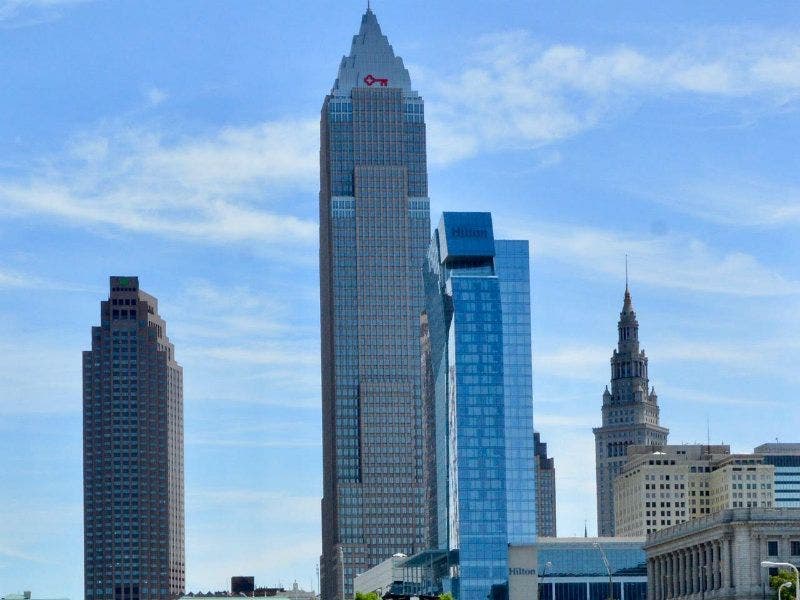
Photo from Rick Uldricks, Patch
Get more local news delivered straight to your inbox. Sign up for free Patch newsletters and alerts.