Politics & Government
Army Funding Large Drone Research At Kent State University
An engineering professor will be discovering how big a drone can get — and how much it can carry.


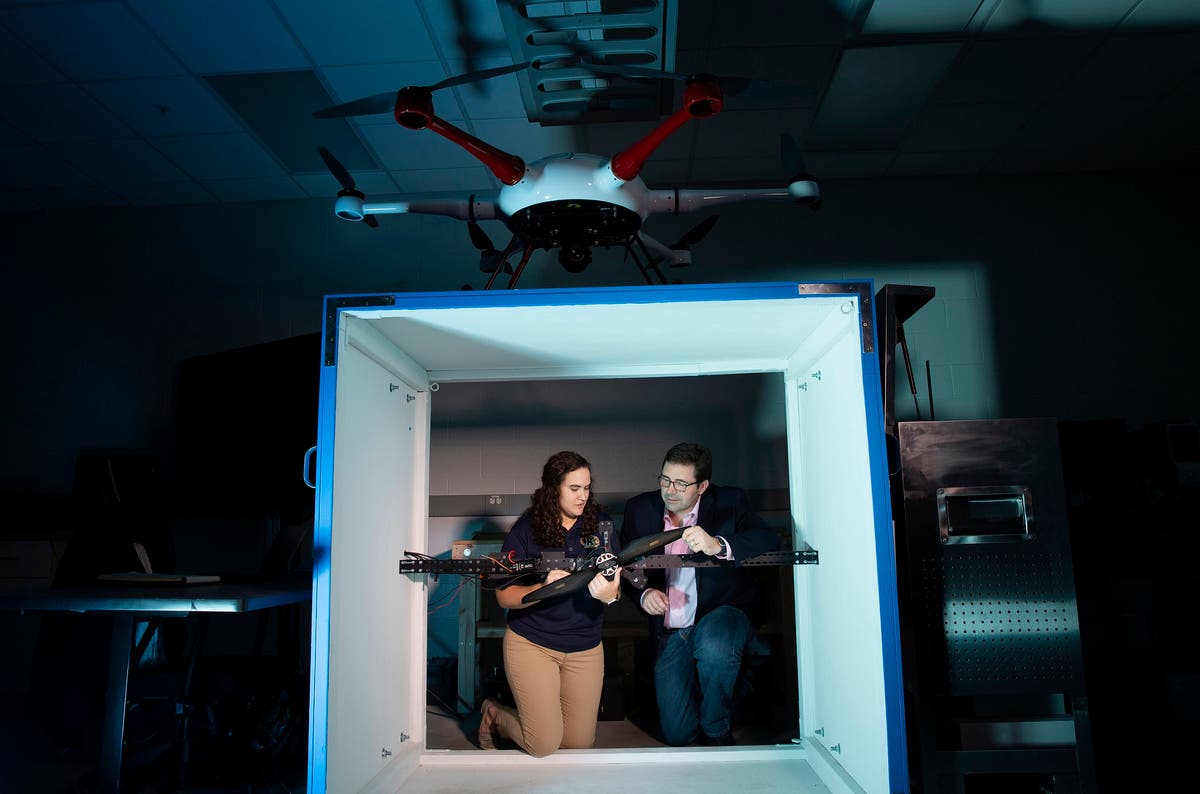
KENT, OH — The Army Research Laboratory wants to know how big drones can become and still be operational. For answers, they're willing to give a $130,000 grant to a Kent State University professor.
The money will go to Professor Blake Stringer, an assistant professor of aerospace engineering at Kent. He's being asked, specifically, to study propulsion systems for a new generation of larger unmanned aircraft systems (UAS), more commonly known as drones.
“I would say that unmanned aircraft systems are becoming the disruptive tech of the 21st century in the aerospace and aviation industries,” Stringer said. “This technology is really changing the way we function as a society. So how do we control them? How do we implement them? How do we use them? How big can they be?”
Find out what's happening in Clevelandfor free with the latest updates from Patch.
Most drones are small in size, typically large enough to serve as cool cameras or occasionally move a package for Amazon. The military wants to be able to move people and large-scale supply crates through the air on drones, rather than airplanes and helicopters.
“We’re taking something between zero and 55 pounds, and trying to make it 1,000 pounds,” Stringer said. “We want to make it so it’s able to drop supplies off or perform some mission.”
Find out what's happening in Clevelandfor free with the latest updates from Patch.
Stringer comes with a unique background — he spent two decades in the Army himself before becoming a professor. He believes intermediate-sized drones could serve a wide-variety of functions for his old employer.
“Maybe you have soldiers in an urban area clearing a building and they need to be extracted from a top floor on a high-rise building, or you’re looking for something that can send supplies to a more remote area,” he said.
Testing and Building
The biggest obstacle to creating a larger drone is creating sufficient power for the craft.
“How do we efficiently produce power that’s not around a gas turbine or a piston engine?” he wondered. “Is it going to be some kind of hybrid propulsion system? Will you have a fuel cell that feeds into a battery and uses the battery for surge moments? There are a lot of different questions.”
To experiment with larger drones and revamped propulsion systems, Stringer is building an experimental test stand.
“We’ll put different sized electric motors and different sized rotors on it, and measure things like thrust, speed, thermal efficiency, acceleration, deceleration and vibration data,” he said. “From that, we’ll be able to determine how big is too big before we have to change the way we’re constructing things. When you go to scale these things from this small arrangement to something big, the dynamics of the rotor change.”
Stringer's grant is for a one-year project, but he's hoping to be successful enough to warrant a second phase of support from the Army.
(For more news like this, find your local Patch here. If you have an iPhone, click here to get the free Patch iPhone app; download the free Patch Android app here. And like Patch on Facebook!)
Photo from Kent State University
Get more local news delivered straight to your inbox. Sign up for free Patch newsletters and alerts.