Health & Fitness
Meet The Mako: Cleveland Clinic Toys With New Surgical Tool
Knee replacements could become much easier with this new technology doctors are experimenting with


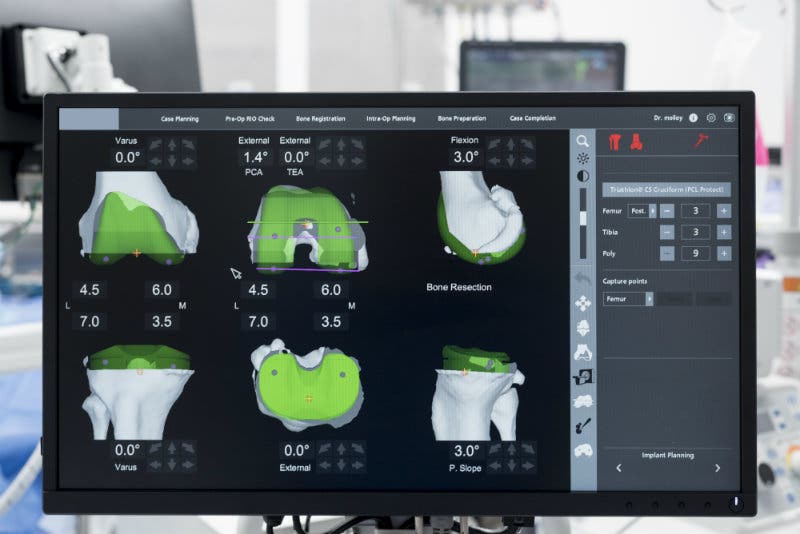
CLEVELAND, OH — Digital models of a bone are illuminated on a medium-sized screen in the surgery suite at Lutheran Hospital. Dr. Robert Molloy points to a marking and says, "That's actually bone jutting up there." He says that the robot behind us, a new technology being used in knee replacement surgery, helped him map out the interior of this knee and would help him operate on it.
Molloy is an orthopaedic surgeon and director, adult reconstruction at Cleveland Clinic. He's been with the hospital system for a dozen years and he's also one of the first doctors in Northeast Ohio to utilize a robot in total knee replacement surgery.
The robot that Molloy uses is called a Mako and it's made by a company called Stryker, a Michigan-based orthopedic device company. The robot doesn't actually perform the surgery, it just helps surgeons be more accurate and precise. The robot has been on the market for about a year.
Find out what's happening in Clevelandfor free with the latest updates from Patch.
The Mako is about the size of a grocery store shopping cart, but grey and with a long arm attached to the top. During surgery, a sterile saw blade will be attached to the tip of the arm and Molloy will guide the device to the knee. He'll still perform the actual surgery, but he'll do so through the use of the Mako's arm.
To demonstrate this, Molloy points again to the line of bone on the screen. Behind that uprising of bone, he says, is the PCL or posterior cruciate ligament, which connects the thigh bone to the shin bone. Athletes sometimes tear their PCLs. So do fathers shoveling the driveway. PCL tears can happen to anyone and they're always unpleasant.
Find out what's happening in Clevelandfor free with the latest updates from Patch.
That's why the Mako won't let surgeons harm the ligament. Using a CT Scan, an array of sensors and doctor-entered information, the robot maps out the interior of the knee, locating, for instance, the PCL. During a knee replacement surgery, the robot will physically stop a surgeon from cutting into or otherwise damaging the PCL.
The arm will also restrict the field of movement during surgery. The robot is smart enough to tell a doctor, basically, "No, don't cut there."
Still, Molloy isn't worried that technology will eventually make surgeons obsolete. "I’m not worried a robot will take my job. We’re still in control of the robot. We still have to tell the robot where to put the components. There’s no substituting for that," he says.
Trying It Out
Molloy wants to show me how to work the Mako. He has someone in scrubs and a face mask unlock the arm and it whirs to life. He extends it, moves it around, shows its full range of motion. Then he hands it to me. There's no saw blade attached, so it's just a robot's arm that I'm handling, which is safer for everyone within 65 feet.
The arm is just about the length of my hand, from the tip of my middle finger to the base of my palm. When I push on the arm, it moves down but with some resistance, like it's asking me if I'm sure I want it to go there. It's a strange sensation.
Molloy says that using the robot in surgery means an extra 10 minutes of prep time. But it can be worth it.
"Once we register the patient and tell the robot where the knee is in space and once we decide where we want to put the components, then we bring the saw blade into the field. Then, when we get it close, the robot will then position the saw blade so that it’s exactly where you want to make the cut," he tells me. "And the saw can only cut in one plane."
He adds that the Mako helps with soft tissue problems. Before the robot, surgeons had to do the same knee replacement for someone who was bow legged or someone who was knock kneed, despite the fact that those two patients would have very different soft tissue problems. The Mako allows for adjustments that help the soft tissue better accommodate the new knee.
Bill Huffnagle, president of Stryker's Joint Replacement Division, said in a press release when the device was released the company believed the Mako would create a better surgical experience for patients and doctors.
Molloy thinks he may be right, but he's not sure yet. The Cleveland Clinic is still gathering evidence on how patients do post-surgery. The hospital system will be collecting input from patients until roughly March 2019. Then a decision will be made about the effectiveness of the Mako.

Early Results
Molloy has now performed about 30 total knee replacements while getting an assist from a robot. The early results have been promising.
"What I found in my earlier experience is that when patients come back, for that first visit [post-surgery] the knee is just a little less angry, there's less swelling, better range of motion. They’re happier with their knee early on," he said.
The Cleveland Clinic will still want 12 months of data before it makes a decision. The hospital system is reticent to jump on new technology, they want to make sure whatever they invest in will actually help patients and doctors.
For now, Molloy says, they know the Mako is more accurate. They don't know yet, what that means for patients. But for now, patients can get a metal knee from a robot, because the 21st century is pretty cool.
Photos from the Cleveland Clinic
Get more local news delivered straight to your inbox. Sign up for free Patch newsletters and alerts.