Crime & Safety
New Report Calls Ohio the 'Face of the Nation's Opioid Epidemic'
Lack of treatment capacity means nearly 86 percent of those with drug dependence in Ohio are not accessing the care they need.


WASHINGTON, DC - A new report from the Democratic staff of the Senate Finance Committee has called Ohio the face of the nation's opioid addiction epidemic, saying that nearly 86 percent of people suffering from dependence or misuse issues do not have access to the care they need. By population, Ohio is the seventh largest state in the nation. However, in 2014, Ohio had the second most deaths by opioid overdose.
"The Opioid Use Disorder Treatment Gap and the Need for Funding" report argues that Congress needs to approve nationwide funding for treatment programs for addicts. It notes that 78 people die from an opioid overdose every day — that's more than one person every 20 minutes.
In Ohio, the crisis has worsened year after year for several years. In 2015, the number of accidental overdose deaths in the state hit its highest mark ever, 3,050 — an average of eight deaths per day, up from 2014's previous record high of 2,531. That's a 20 percent increase in 12 months. There was a similar 20 percent increase from 2013 to 2014.
Find out what's happening in Clevelandfor free with the latest updates from Patch.
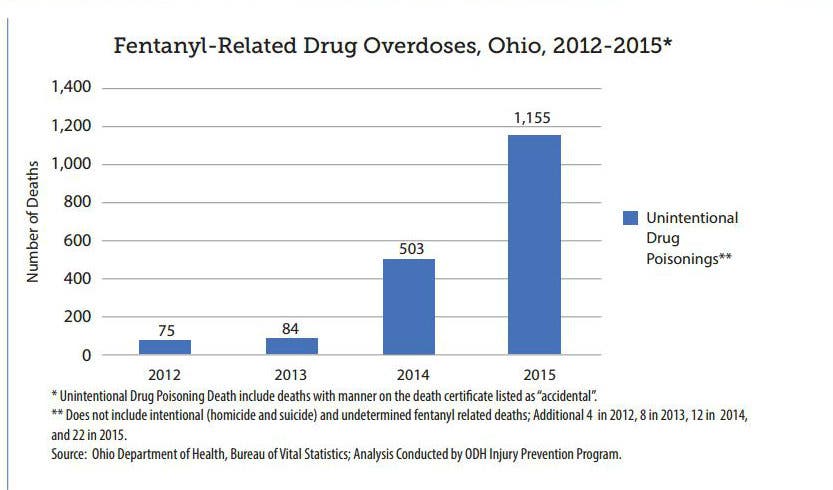
Specifically, fentanyl-related unintentional drug overdose deaths in Ohio more than doubled from 503 in 2014 to 1,155 in 2015, according to the Ohio Department of Health. Heroin-related deaths accounted for 1,424 unintentional drug overdose deaths in 2015, an increase from 1,196 in 2014. Heroin was involved in 46.7 percent of all overdose deaths in the state.
While the state has developed several programs to aid with the crisis, many of the tactics are focused on addiction prevention, such as Start Talking!, which targets at-risk youth and offers communities the tools they need to prevent youth drug use, or the Governor’s Cabinet Opiate Action Team setting prescription guidelines for doctors.
Find out what's happening in Clevelandfor free with the latest updates from Patch.

According to an American Journal of Public Health study, the current rate of opioid dependence in the state of Ohio is one out of every 100 people. However, the state only has enough treatment providers for one in 250.5
Today's report notes that the state has already pulled $36 million from other programs to fight this epidemic, and yet the gap in care remains. "If Congress were to fund the White House’s full request, the state of Ohio would be eligible to receive an additional $45 million to expand its treatment capacity," the report says.
In September, Democratic lawmakers called on Gov. John Kasich to declare the opioid epidemic a public health crisis and release emergency funds to offer more expansive care.
“Local addiction service providers are doing everything they can to prevent the opioid addiction crisis from overtaking our communities, but they have been pushed to capacity and their resources have been drained,” said Minority Whip Nickie J. Antonio, a Democrat from Lakewood. “The state can’t just rely on local communities to take on the opioid crisis alone. We need to call this what it is — a statewide public health emergency. The lives of Ohioans are at stake and we cannot afford to wait.”
Since the beginning of the year, Cuyahoga County has lost 250 residents due to drug overdose deaths and is on track to lose 500 or more to overdoses by the end of 2016.
Since the crisis in Cuyahoga County has become so dire, at least two police departments are seeking alternative methods for dealing with people suffering from addiction. Berea Police Chief Joe Grecol and Olmsted Township Police Chief Matthew Vanyo recently announced that they have partnered with the Police Assisted Addiction and Recovery Initiative (PAARI) to begin the Safe Passages program, which allows addicts to come into the Berea or Olmsted police stations and ask for treatment through the PAARI program.
PAARI Co-Founder John Rosenthal said that he wanted to create programs that allowed for a compassionate response from police to opioid addiction. "Quite simply, you can't arrest your way out of this epidemic," he said. "The War on Drugs has largely been a failure."
Rosenthal said that addicts need long-term treatment, the same way patients with other diseases, like diabetes, cancer or heart disease, need. Programs like Safe Passages offer front-line law enforcement officers a chance to stop arresting the same people over and over again and instead get addicts into appropriate treatment programs.
Rosenthal says that there are eight more departments in Ohio that are interested in pursuing a PAARI-style program.
Another recent development in the opioid epidemic, drug dealers have begun mixing heroin with carfentanil, a tranquilizer designed for large animals. Ohio has been among the states hit hardest by the use of carfentanil. It is often sold in pill form, but police in Akron, Ohio, said carfentanil showed up in syringes used by more than 90 people who overdosed in July, WOOD-TV reported.
Lead graphic from the Democratic Staff of the Senate Finance Committee
Get more local news delivered straight to your inbox. Sign up for free Patch newsletters and alerts.