Community Corner
Ohio Abortion Rate Drops Over Four Years
A new study finds the number of abortions have dropped from 2008 to 2011, both in Ohio and across the United States.



OHIO - A new study suggests the number of abortions in Ohio are dropping. A study from the Guttmacher Institute found that abortions decreased steadily from 2008 to 2011. The statewide drop mimics a national trend, the study finds. The rate of abortions in the United States has fallen to its lowest level since Roe v. Wade, the controversial 1973 Supreme Court ruling that prevented states from outlawing the procedure.
The Guttmacher Institute is a research and policy organization that works on reproductive health issues and advocates for legal abortion. For the study, Rachel Jones and Jenna Jerman, researchers with the institute, surveyed all abortion providers for the years 2013 and 2014. They estimate that in 2014, there were 926,200 abortions performed in the United States, a 12 percent drop from 2011.
Ohio's numbers show a decrease over the studied span. In 2008, Guttmacher estimates that there was approximately 33,550. In 2010, there were 30,220 abortions. By 2011, there were 28,590 abortions. The rate of abortions among 1,000 women dropped from 14.8 in 2008 to 12.9 in 2011.
Find out what's happening in Clevelandfor free with the latest updates from Patch.
In the state, there were 26 providers over that time. Ohio lost one abortion clinic from 2008 to 2011. Which leads to a larger question: If the number of providers and clinics have barely changed, why are there less abortions being performed?
The study didn't directly address this question, but the authors have their speculations.
Find out what's happening in Clevelandfor free with the latest updates from Patch.
“Abortion restrictions and clinic closures mean that patients may need to travel greater distances to access services,” said Jones in a statement. “The majority of abortion patients—75%—are poor or low-income, and nearly two-thirds are already parents. It can be very difficult for them to arrange for time off from work, transportation and child care. While many find ways to access care despite these obstacles, some of the abortion rate decline is likely attributable to women who were prevented from accessing needed services.”
According to their research, the number of abortion clinics conducting abortions dropped 6 percent nationwide between 2011 and 2014. This drop was sharper in the Midwest and in the South.
Kristi Hamrick, a spokeswoman for Americans United for Life, which advocates restricting abortion, told WBUR that she was skeptical of the institute's research but generally agreed with the results. She believes recent regulations on clinics have reduced the rate of abortions.
"These have been game-changers, and we see the abortion rate dropping in response," Hamrick said.
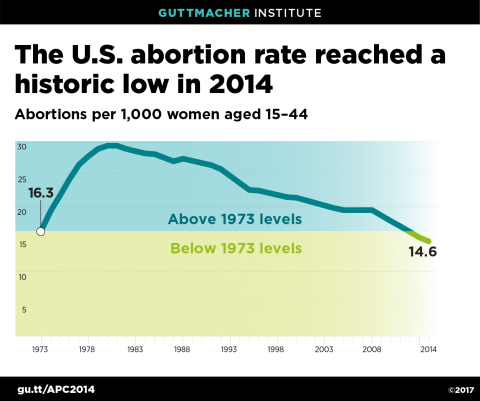
However, as the graph above shows, the abortion rate has been falling consistently since the 1980s. And the study didn't actually find a clear relationship between the state restrictions on clinics and local abortion rates.
While the number of clinics in the Midwest declined by 22 percent since 2011, the abortion rate only declined 9 percent. And as the authors point out, in the Northeast, the number of clinics actually increased by 14 percent, while the abortion rate declined 11 percent. These inconsistencies may mean these laws are less effective than they seem at reducing the abortion rate or that variations in the laws and states override the general effect. But these findings also suggest that access to contraception is also a reason for the reduction in abortions.
One reason to believe that contraception is playing a role is simple: There was no observable increase in birth since 2011 to offset the declining abortion rate. It seems instead that we have fewer pregnancies overall, particularly fewer unwanted pregnancies, which leads to fewer abortions.
Written by Cody Fenwick, Patch and Chris Mosby, Patch
Photo from Pixabay, Graphic from Guttmacher
Get more local news delivered straight to your inbox. Sign up for free Patch newsletters and alerts.