Health & Fitness
Parts of Lake Erie Are 'Impaired,' But That Won't Change Much
The Ohio EPA designated the Western Basin of Lake Erie as impaired. But that's not going to help clean up Ohio's biggest body of water.


CLEVELAND, OH — The Western Basin of Lake Erie, which stretches from the Michigan-Ohio state line to the Marblehead Lighthouse, has been designated as federally impaired by the Ohio EPA. In a report released this month, the agency said the designation is being issued "for recreation due to harmful algae and drinking water due to occurrences of microcystin." Arriving at that designation involved in-fighting, political lobbying and it's unclear what impact the designation will ultimately have.
"What that means is we’ve got work to do to make sure the water quality improves so there’s not impediments to our drinking water quality," Ohio EPA Director Craig Butler told Patch.
While most algae are harmless, a select few can be dangerous to humans and animals. According to the U.S. EPA, microcystins are "toxins produced by cyanobacteria. Cyanobacteria are also known as blue-green algae." The cyanobacterias can cause everything from a mild skin rash to death.
Find out what's happening in Clevelandfor free with the latest updates from Patch.
But federal help for dealing with the algae has been slow in arriving.
"To be honest, this federal designation doesn’t do anything. There’s a lot of folks that say this is like a silver bullet. That’s just not true," he said to Patch. "It doesn’t give us any additional authority or additional resources to fix the Lake."
Find out what's happening in Clevelandfor free with the latest updates from Patch.
So, Why Is The Lake Impaired Now?
This is the first time an assessment of this kind for Lake Erie has been completed by the Ohio EPA. The agency had to develop a new process for assessing impairment across the Western Basin. The agency said that, to date, there had been no standard process for state agencies to follow.
But the Michigan Department of Environmental Quality (MDEQ) declared Lake Erie as impaired in November 2016. That's because state agencies frequently have to create their own testing methods and standards. The results are then submitted to the US EPA for approval, but the testing is rarely uniform. Michigan conducted its own, unique-to-Michigan testing on the Lake.
Kevin Goodwin, senior aquatic biologist for MDEQ, told Patch his department used satellite imagery and first-hand examination of Lake Erie to determine the spread of algal blooms on the water. That guided the department's decision.
MDEQ then cited "extensive algal blooms caused by excessive levels of phosphorous." The MDEQ was also evaluating the Lake's Western Basin (which borders both Ohio and Michigan), saying that even though the Michigan portion of Lake Erie was "small" the department wanted to limit the explosion of algal blooms.
So Michigan declared Lake Erie impaired in 2016, Ohio failed to do the same. Somehow, the US EPA accepted both designations. That rankled Kaptur.
"This is not sensible. There is no imaginary line in the middle of Lake Erie where one side of the Lake faces challenges that don’t impact the other side. This is a shared challenge that the entire region faces," she said in May 2017. Her colleague, Michigan Representative Debbie Dingell, Democrat, also decried the EPA's decision. “Failure to recognize these waters as impaired puts public health, the Great Lakes and our $4.5 billion recreational and commercial fishing industry at risk. The administration must take a clear and proactive stance so we can confront this challenge and devise a plan to address this threat to public health and the environment.”
Goodwin was less bombastic than the politicians. He told Patch he wasn't surprised MDEQ and Ohio EPA came to different conclusions. "We’re sampling things at different times. Folks are sometimes focusing on different stuff. The reality was that Ohio had identified drinking water concerns in 2014 for near shore areas and that was based on blue-green algae. They’re just telling the story a little different way."
Butler said that MDEQ's evaluation was a "narrative review" meaning the department checked to see if algae was present in the water, it was, and then declared their portion of the Western Basin "impaired." That designation was also specific only to aquatic life and other wildlife. It didn't necessarily have an impact on human use of the lake.
He wanted Ohio to employ a more "robust process" than its northern neighbor.
The Ohio EPA's Investigation
As other state departments began stigmatizing the water quality of Lake Erie, as early as 2014, why wasn't the Ohio EPA considering doing the same? Why wasn't a process being created then?
It was, actually.
Butler told Patch his department went to US EPA in 2014, prior to the release of that year's Water Quality Report, and asked for guidance on how to assess the open waters of Lake Erie. The US EPA said it didn't know. There was no robust, scientific process in place for such an assessment, the agency allegedly told its Ohio branch, according to Butler.
Remember, 2014 was the same year that the waters around Lake Erie made regional headlines when they became thick and matted with bright green algae blooms. That year's outbreak left more than 500,000 Ohioans temporarily without drinking water.
While there were processes in place to search for the presence of other contaminants, like e. coli, there was no such process for researching the impact of these algae blooms. But it was clear something was happening in Lake Erie.
In 2015, Michigan Gov. Rick Snyder, Premier Kathleen Wynne of the Province of Ontario, and Ohio's Lieutenant Governor Mary Taylor established the "Western Basin of Lake Erie Collaborative Agreement."
That agreement "acknowledges the importance of nutrient reductions necessary to improve and protect Lake Erie’s water quality. It established the goal of a 40 percent reduction of total phosphorus loads to Lake Erie by 2025, with an interim goal of a 20 percent reduction by 2020," the MDEQ said in a press release from 2016.
So, though things moved slowly, Ohio knew there was a problem with Lake Erie and its state government wanted to take action. In 2016, again prior to the release of that year's Water Quality Report, Butler went back to the US EPA and asked for guidance on evaluating the open waters of Lake Erie. Once again, no help was forthcoming.
Then, in January 2018, the Ohio EPA tried to, again, avoid declaring Lake Erie as impaired because of its inability to study the to its satisfaction the open waters of the Western Basin. The US EPA initially accepted the state's non-impaired designation.
That didn't sit well with environmentalists and politicians. After backlash, on Jan. 17, 2018, the U.S. EPA withdrew its approval of the state's designation of non-impaired. The US EPA said the evaluation of Lake Erie was incomplete.
“This is simple, Lake Erie should be designated as impaired because it is. This past summer 1,000 square miles of the Lake were covered in green slime – even a child can see the Lake is impaired. The State of Ohio has proven time and again that it has more excuses than solutions," Kaptur said in a scathing press release at the time.
So the Ohio EPA partnered with Ohio State University, Bowling Green State University, University of Toledo, NOAA and some agencies in Michigan to develop its own assessment protocols for the water quality. The agency developed a new test for measuring Lake Erie's impairment and now wants that test to become standard practice for other EPA state agencies.
Being left to its own devices, also seems to have left a chip on the shoulder of the Ohio EPA. In the state's 2018 Water Quality Report, in Section D there's this quote: "Ohio’s position has been that since the open waters of Lake Erie are multi-jurisdictional and multi-national, that U.S. EPA should take the lead on setting targets and assessment methods for all parties to use."
The report continues: "Since there has been no progress is establishing federal targets for the lake, Ohio has proceeded, with the considerable aid of several universities and NOAA, to develop a method for assessing the western basin open waters in Ohio for algae blooms."
After being asked to address the comments made by Ohio EPA, a US EPA spokesperson emailed a two-sentence statement to Patch. That statement read, simply: "U.S. EPA appreciates the efforts by the state of Ohio to assess the quality of water in western Lake Erie. Ohio has been a longtime partner in protecting and restoring this critical resource. U.S. EPA will continue to work closely with the states of Ohio and Michigan and other stakeholders to ensure that local residents continue to have access to safe drinking water and to promote recreation on Lake Erie."
What The Designation Means
While the designation is nice to some, the more valuable work being done to preserve Lake Erie is taking place in Columbus and Washington, D.C., at least according to Butler. He said his agency is continuing to request additional resources for clean-up via lobbying of legislators in the Ohio Congress. "That has nothing to do with the impairment designation because it doesn’t bring us any additional tools," he told Patch.
Butler also said he and his agency have been working closely with water treatment plants to make sure they're able to weed out algae from drinking water. The Ohio EPA is also telling Lake Erie beachgoers that if they see algae, they shouldn't get in the water. If swimmers do find themselves immersed in algae, they should wash off when they're back on the beach.
But the designation shouldn't lead to over reaction. It isn't a "silver bullet" and "it doesn’t mean people shouldn’t recreate in the Lake," Butler told Patch. "It doesn’t change our general precautions that we give about avoiding areas with algal blooms."
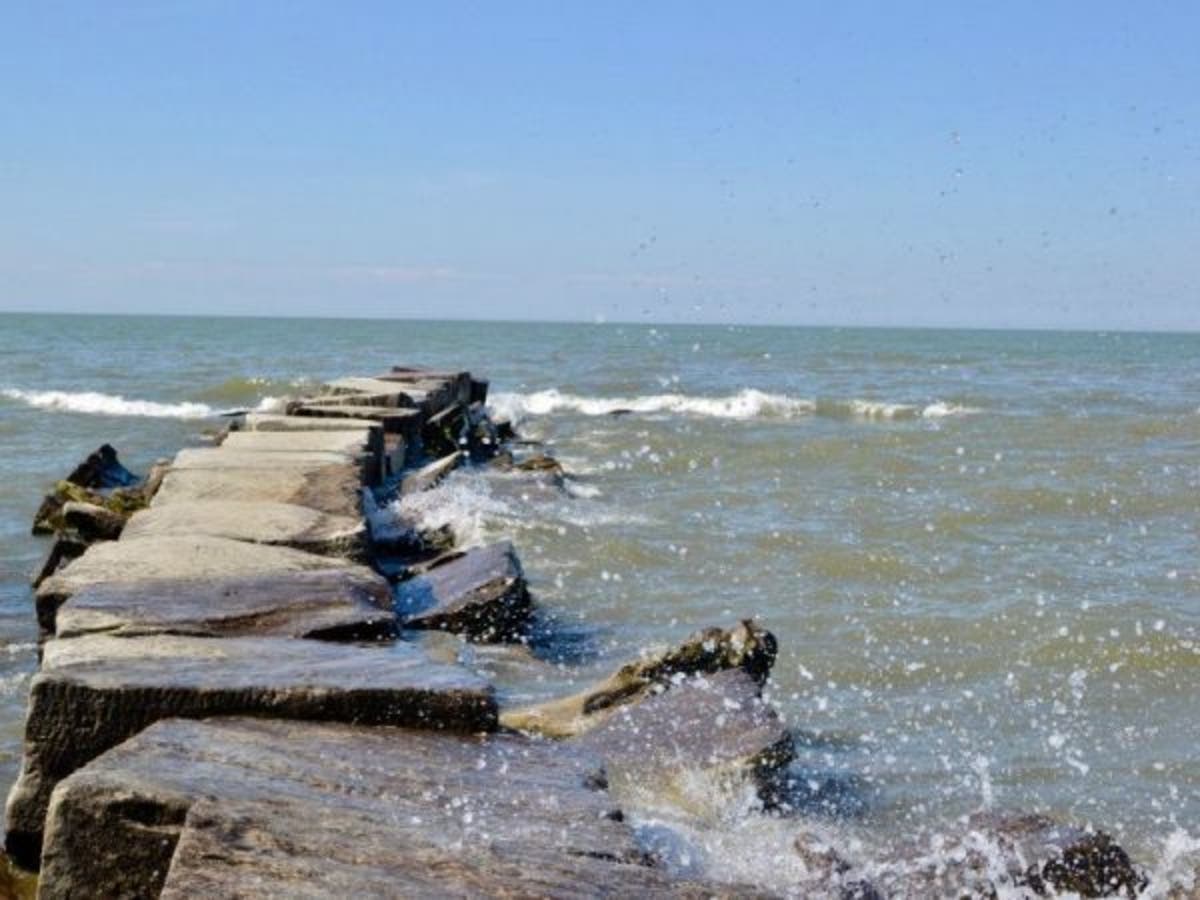
Photo from Rick Uldricks, Patch
Get more local news delivered straight to your inbox. Sign up for free Patch newsletters and alerts.