Community Corner
Researchers Now Understand How the World's Largest Dinosaur Walked the Earth
Paleontologists from the Cleveland Museum of Natural History discovered how the Sauropods' puzzling feet worked.


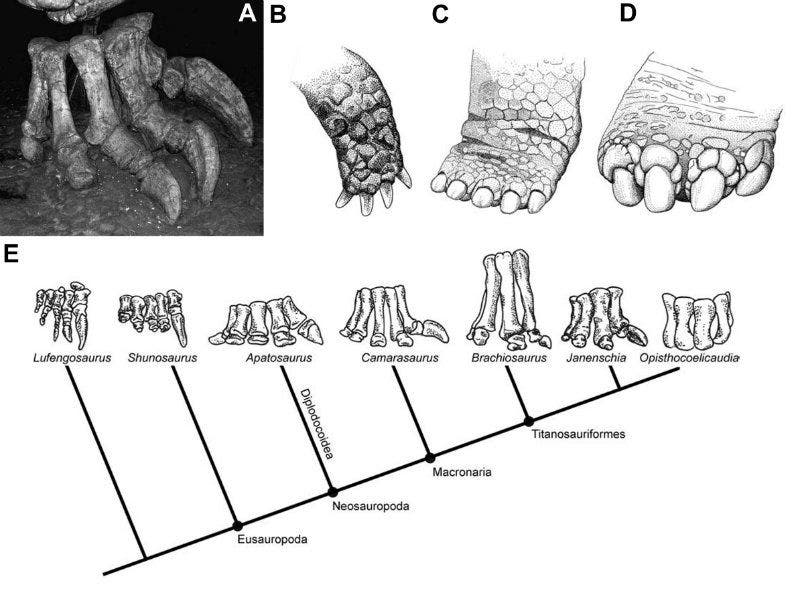
CLEVELAND, OH - The largest animals to ever walk the earth, Sauropods, walked on bizarre feet that folded across the foot. By comparison, when humans flex our foot muscles, our toes go straight down. Scientists have been puzzled by the Sauropods' feet for a long while and now paleontoligists at the Cleveland Museum of Natural History and Dickinson Museum Center (North Dakota) have put out new research describing the gigantic creatures.
“Sauropod hind-feet possess enlarged, flattened claws which folded across and under the foot when the animal squeezed or ‘flexed’ its foot muscles,” said Lee Hall, Vertebrate Paleontology Preparator at the Cleveland Museum of Natural History and lead author on the study. “When foot muscles are flexed in a human, the toes are pulled straight down. When a sauropod flexed its toes the claws folded across the front of the foot, rotating downwards, creating an overlapping stack of flat scrapers.”
This bizarre arrangement is unique among dinosaurs and has puzzled paleontologists: How could such a shape evolve? Does the unusual shape correspond with an unusual behavior?
Find out what's happening in Clevelandfor free with the latest updates from Patch.
Several hypotheses emerged to explain the behavior. One said that overlapping claws may have been useful in slippery, muddy environments like river banks or lakeshores, and could provide traction and prevent miring. Another possible explanation was that the claws could allow the animal to dig and scrape, employing its feet like a garden hoe.
Coauthor of the study Dr. Denver Fowler, who led the group's previous study on sauropod claws added: "dinosaur behavior is a tricky subject to address because most fossils are obviously evidence of dead animals, rather than living ones. However, we can go beyond speculation to actually test hypotheses of behavior if we understand what kinds of subtle evidence is recorded in fossils."
Find out what's happening in Clevelandfor free with the latest updates from Patch.
The eureka moment for the research group came when they considered alternative ways to test their hypothesis.
“Prior studies have tried to answer this question by examining the bones of sauropod feet, but no one looked at the tracks those feet left,” said Hall. Trackways are the fossilized impressions left by an animal’s feet after it walked through soft, wet sediment like mud or silt. “We studied over 30 tracks, all of which preserve the morphology of the foot and position of the claws while these animals were walking in muddy substrates. In some cases, impressions of the skin and scales from the bottoms of the feet are visible.”
Hall and his coauthors Ashley Hall (also of the Cleveland Museum of Natural History), and Fowler (Dickinson Museum Center, North Dakota), reached out to researchers across the world for images of well-preserved sauropod tracks, and received a wealth of data and photographs from Texas, to Morocco, to Portugal.

The fossil tracks showed that sauropods did not utilize their unique claw flexing arrangement while walking in deep, wet mud, meaning they did not use them to help ‘grip’ while walking in muddy areas. Instead, the toes were either carried in a neutral position or extended outwards, which was unexpected. The study concludes it is more likely that the claws of sauropods were an adaptation for excavating nests, a behavior corroborated by comparison with similarly shaped claws used by some species of tortoises for digging, and fossil evidence of trench-like nests in which sauropod eggs have been discovered.
“We’re fascinated with the bones of their long necks and size of their gargantuan bodies, but not many have looked at what’s going on with their feet,” said Ashley Hall. “This now begs the question of which sex was building nests? Did males or females have larger claws? Can we test this?”
Fowler added "surely the most exciting thing about dinosaurs is understanding how they lived; our new study takes us one step closer."
The study, titled “The flexion of sauropod pedal unguals and testing the substrate grip hypotheses using the trackway fossil record,” was published in the book “Dinosaur Tracks: The Next Steps” (Indiana University Press, 2016).
Photo from the Cleveland Museum of Natural History
Get more local news delivered straight to your inbox. Sign up for free Patch newsletters and alerts.