Health & Fitness
STD Rates in Ohio and Across the Nation Increasing
With STD prevention and treatment programs threatened, health officials worry the rates will continue to climb.


CLEVELAND, OH - Ohioans are more at risk than ever for contracting an STD. Total U.S. cases of chlamydia, gonorrhea and syphilis are higher than ever. And rates are climbing fast, according to new data released this week by the Centers for Disease and Control, with a 19 percent increase in syphilis cases between 2014 and 2015, alone. Ohio's STD rates, particularly of chlamydia and gonorrhea, have been climbing steadily for a half-decade as well, hitting a new high in 2015.
Ohio ranks 16th among all states in terms of chlamydia rates per 100,000 residents. The state reported 56,726 cases of the STD last year, that's 489.3 cases per 100,000 residents. The national average for chlamydia cases was 478.8 cases per 100,000 residents.
The statistics for gonorrhea are even more startling. Ohio has 12th highest instance of the disease among the 50 states. There were 16,564 cases last year, a rate of 142.9 per 100,000 residents. The national average was 123.9, nearly 20 cases lower.
Find out what's happening in Clevelandfor free with the latest updates from Patch.
Here's the kicker: The Ohio Department of Health's (ODH) statistics show the STD problem has actually gotten worse in 2016. The agency's quarterly report on gonorrhea shows that from January through June 2016 there are nearly 2,000 more cases of the disease than the same time frame in 2015 and 2014. Chlamydia is experiencing a similar surge. The disease jumped to 30,077 cases from January to June in 2016, versus 27,171 in 2015 and 26,646 in 2014.
"The increase could mean that there is more disease being transmitted or more people are being tested. The Ohio Department of Health will continue to work with our local county public health departments to help provide the best resources and care to all Ohioans across the state," said Melanie Amato, a public information officer for the ODH, in an emailed statement.
Find out what's happening in Clevelandfor free with the latest updates from Patch.
Amato says Ohio’s state and local STD prevention and surveillance staff do an excellent job of tracking new reports, including the local disease intervention specialists reaching out to provide partner services to those newly infected, including offering risk reduction strategies, and recommending testing for identified sexual partners.
What's Causing This
The sudden increase in STDs nationally started in 2014 when the CDC charted the first increase in the diseases since 2006. One of the demographics the agency said was seeing steady increases in the instances of disease were gay and bisexual men.
According to the CDC, "P&S syphilis among men who have sex with men (MSM) has been increasing since at least 2000. In 2014, rates of P&S syphilis increased among MSM, who account for 83 percent of reported cases among men when the sex of the partner is known. Also concerning is that more than half of MSM (51 percent) diagnosed with syphilis in 2014 were also HIV-positive. Infection with syphilis can cause sores on the genitals, which make it easier to transmit and acquire HIV."
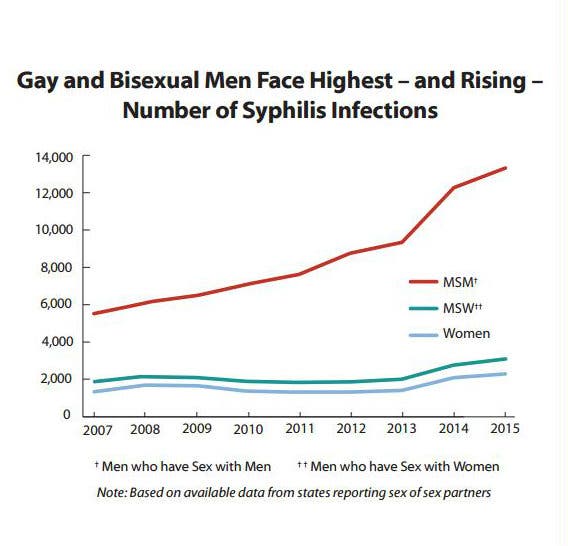
Men as a whole accounted for 90 percent of all syphilis cases.
The agency also says that young people simply aren't getting screened enough. Men and women between the ages of 15-24 are responsible for a majority of STD cases. The CDC's 2014 estimate said people in that age group were acquiring half of the 20 million new STD cases each year.
There are more than 1.5 million cases of chlamydia nationwide, as well as 400,000 cases of gonorrhea and almost 24,000 cases of the most infectious stages of syphilis, according to the new data. Teens and young adults ages 15 to 24 account for nearly two-thirds of diagnosed cases of chlamydia and half of gonorrhea cases.
STDs cost the U.S. healthcare system nearly $16 billion a year, according to the CDC. And chlamydia, gonorrhea and syphilis are curable with antibiotics, but most STD cases go undiagnosed and untreated. That puts those infected at greater risk for serious health threats, including infertility, chronic pain and HIV infection.
“We have reached a decisive moment for the nation,” said Dr. Jonathan Mermin, director of CDC’s National Center for HIV/AIDS, Viral Hepatitis, STD, and TB Prevention. “STD rates are rising, and many of the country’s systems for preventing STDs have eroded. We must mobilize, rebuild and expand services – or the human and economic burden will continue to grow.”
Federal health officials are sounding the alarm as state and local governments nationwide address budget challenges by cutting STD prevention and treatment resources. More than 20 STD clinics have closed within one year, according to the CDC.
“STD prevention resources across the nation are stretched thin, and we’re beginning to see people slip through the public health safety net,” Mermin said in a statement. “Turning the STD epidemics around requires bolstering prevention efforts and addressing new challenges – but the payoff is substantial in terms of improving health, reducing disparities and saving billions of dollars.”
More: See state rankings for chlamydia rates
Image via Shutterstock
Get more local news delivered straight to your inbox. Sign up for free Patch newsletters and alerts.