Business & Tech
Trump Targets Ohio GM Plant in Latest Twitter Storm
General Motors moved some limited production of its popular Cruze vehicles when the Lordstown plant couldn't keep pace with demand.


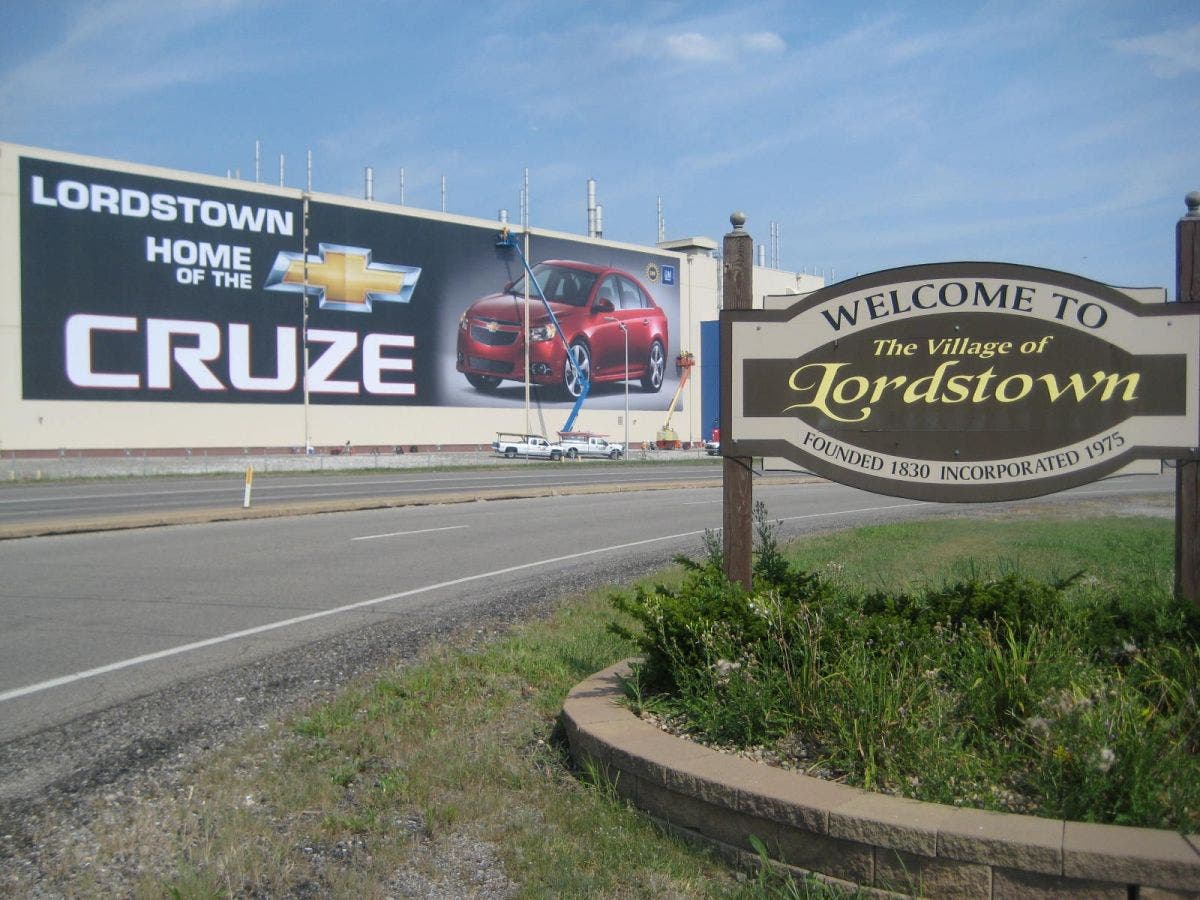
President-elect Donald J. Trump tweeted Tuesday that General Motors, which manufactures the majority of its U.S.-made Chevrolet Cruzes in the Cleveland suburb of Lordstown, Ohio, will face a “big border tax” if any of the compact sedans manufactured in Mexico are imported to the United States. During his campaign, the president-elect was critical of U.S. carmakers with foreign manufacturing operations.
GM, the world’s No. 3 automaker, responded in a statement that only a “small number” of the Cruze hatchbacks assembled in Mexico are sold in the United States. The majority of the cars produced in Mexico are sold in Mexico.
All of the sedan versions of the popular vehicle sold domestically — 185,500 — were assembled in Lordstown. Another 4,500 hatchback versions were assembled in Mexico and exported to the United States.
Find out what's happening in Clevelandfor free with the latest updates from Patch.
General Motors is sending Mexican made model of Chevy Cruze to U.S. car dealers-tax free across border. Make in U.S.A.or pay big border tax!
— Donald J. Trump (@realDonaldTrump) January 3, 2017
In June, GM said demand for the Cruze vehicles was so strong that the three shifts at the Lordstown Complex couldn’t keep pace. In a statement, the automaker said it was using an existing production plant in Mexico to augment U.S. production.
“In an effort to meet customer demand for the Chevrolet Cruze, GM will be utilizing existing production capacity in Ramos Arizpe, Mexico, to supplement production at its plant in Lordstown, Ohio.
Find out what's happening in Clevelandfor free with the latest updates from Patch.
“Cruze vehicles are continuing to arrive in dealers across the U.S. and Canada, and we expect that dealer inventories will increase this month. In May, Cruze retail share was up 2 percentage points and its average transaction price was up substantially from last fall.”
Tuesday was the first time Trump has specifically called out GM for its foreign manufacturing, though as a candidate, Trump famously feuded with GM rival Ford Motor Co. for its investment plans in Mexico. On Tuesday, Ford said it was cancelling its plans to build a $1.65 billion plant in Mexico and would instead invest $700 million in a suburban Detroit plant, creating 700 jobs to build “high-tech autonomous and electric vehicles along with the Mustang and Lincoln Continental.”
However, Ford CEO Mark Fields said the automaker didn’t acquiesce to Trump but made the decision because it’s good business, CNN reported. He called it a “vote of confidence” in the pro-business environment Trump is creating.
In addition to imposing a punitive 35 percent tariff on goods imported to the United States, Trump also criticized trade agreements like the North American Free Trade Agreement, which he said made it easier for U.S. manufacturers to move jobs to Mexico, where the cost of labor is cheaper.
Imposing tariffs could be risky for the president-elect. The New York Times reported that bypassing Congress is unconstitutional under the Origination clause.
There may be some limited cases where he might find the authority without Congress, according to experts consulted by CNN Money. As president, he could invoke the “Trading with the Enemy Act of 1917” to balance trade with Mexico and China. America isn't at war with either of those countries and would only have to be "at war" somewhere in the world to use that act to impose tariffs. The deployment of special forces in Syria and Libya could satisfy the threshold, according to CNN.
Authority to impose tariffs without congressional approval is also found in the International Emergency Economic Powers Act of 1977. Losing jobs to other countries might be interpreted as an emergency, and courts have never rejected a president’s reasoning when that act has been invoked.
Trump could also impose low across-the-board tariffs on all imported goods under the Trade Act of 1974, Section 22. To target specific industries, he could use the Trade Expansion Act of 1962.
But even if he can impose the tariffs, nearly 5 million U.S. jobs could be lost in a trade war, the McClatchy Washington Bureau reported, citing a study by the Peterson Institute for International Economics, a pro-trade group.
According to the study, Mexico and China would likely respond with equally large tariffs on U.S. goods, which would increase the cost of goods and decrease cross-border trade.
Photo via General Motors
Get more local news delivered straight to your inbox. Sign up for free Patch newsletters and alerts.