Politics & Government
The View from Ward 2: Issue #13
Coronavirus Response, Virtual Council Meeting, and a visit from the Easter Bunny!

Coronavirus Response Updates
Council Staff is attending Coronavirus Task Force Meetings held by the Administration every Monday, Wednesday, and Friday. At these meetings, the Administration provides updates about the City’s response to the pandemic.
Last Friday, Lakewood Health and Human Services distributed 260 Giant Eagle gift cards, valued at $20 each, to those picking up lunches at the local schools. The funds were provided by the Healthy Lakewood Foundation and Parkside Church. This week, Human Services will distribute essential groceries to seniors in subsidized housing, in response to reports from managers of these housing facilities who have observed seniors frequently venturing outside to purchase groceries. This program is also being funded by the Healthy Lakewood Foundation.
The stay-at home order and arrival of spring has led to a surge in spring cleaning and, accordingly, the Refuse & Recycling Department reports that they have experienced an increase in bulk pick-ups. Refuse wants to encourage residents to attempt to fit everything into your bins or bring the items to the Drop Off Center (12920 Berea Road) or the Temporary Drop Off Site at the Lakewood Park skatepark (14532 Lake Avenue). The hours are 8:00am to 2:00pm, Monday through Friday.
The Small Business Rental Relief Program received 275 applications, with 185 applicants qualifying for the program. The City expects to distribute the funds next week.
Please visit the City’s Coronavirus/Covid-19 website for up-to-date and detailed information: http://www.onelakewood.com/coronavirus/
Reported Infections in Lakewood
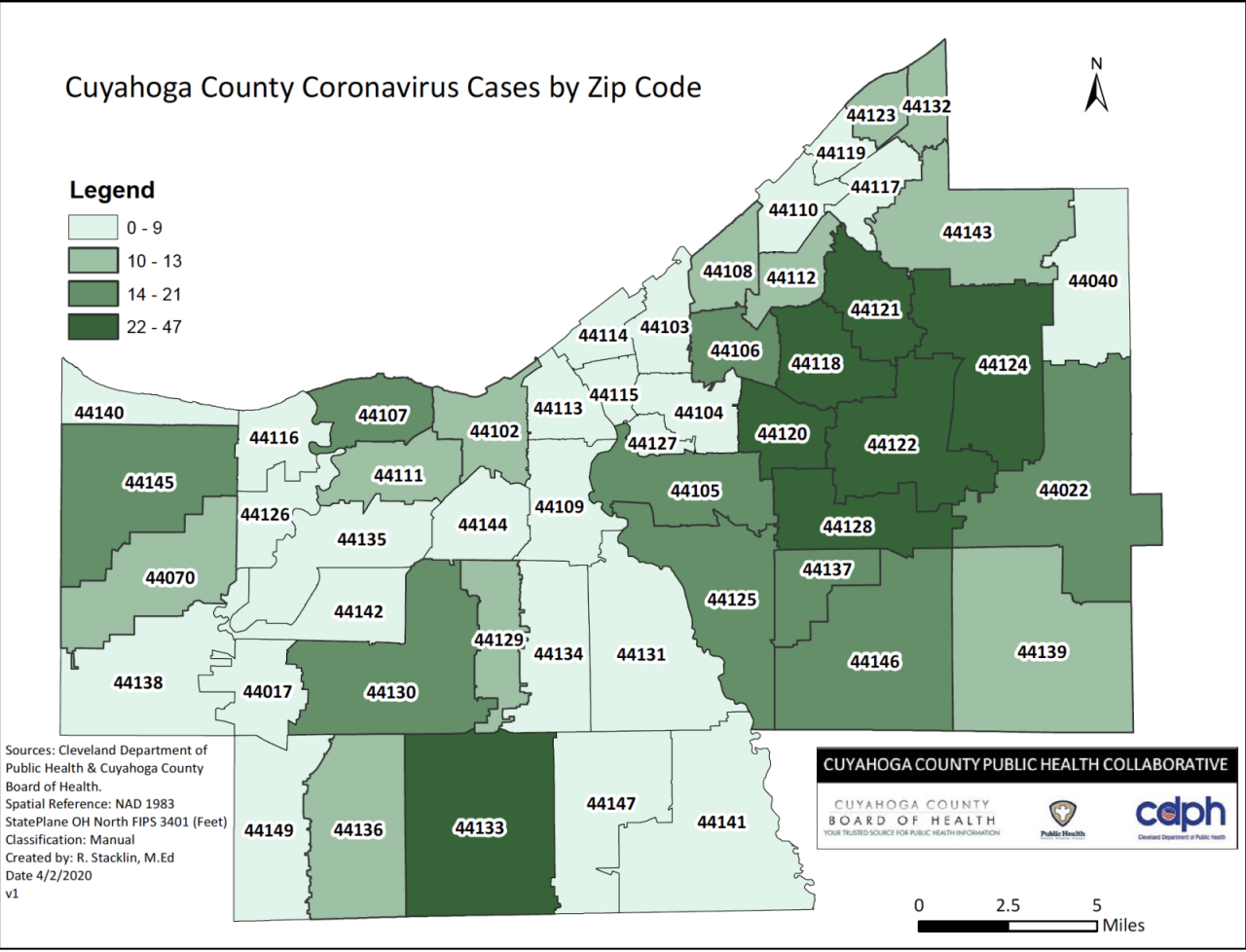
The most common question I get regarding the coronavirus is how many people are infected in Lakewood. Unfortunately, that information is not readily available. The County releases a map each Friday showing a range of positive cases for each zip code. Last Friday, the map indicated that we have between 14 and 21 residents that tested positive.
Find out what's happening in Lakewoodfor free with the latest updates from Patch.
Remember, testing is not widely available and is currently reserved for people who are both symptomatic and are in a high-risk group. We should continue to follow Dr. Amy Acton’s advice and proceed to act as if each of us is already infected. The more we adhere to social distancing the more we lessen the risk of spreading the disease.
Monday Night’s Council Meeting
The next Council Meeting will be held virtually on Monday, April 6th at 7:30pm. You can join the meeting from your computer, tablet, or smart phone by going to https://global.gotomeeting.com/join/934055205 or you can dial-in at 1-866-899-4679. If you are dialing-in, you will need to input the access code: 934-055-205.
Find out what's happening in Lakewoodfor free with the latest updates from Patch.
During this meeting, Mayor George will announce her intention to appoint Claudia Dillinger to the position of Director of Human Resources and Peter Rancatore to the position of Director of Finance.
City Club of Cleveland’s CARES Act Discussion
The City Club of Cleveland held a virtual meeting last Tuesday featuring Amy Hanauer, formerly with Policy Matters Ohio and currently with the Institute on Taxation and Economic Policy, and Robert Raben, President and Founder of The Raben Group. The speakers explained the details of the stimulus bill known as the CARES Act. I appreciated the discussion and learning more about the intricacies and potential impact of the CARES Act on our community.
The Deputy Clerk of Council, Nick Lascu, provided City Council with a summary of the discussion, which is included below.
Context surrounding the legislation
- The CARES Act provides $2 trillion in economic relief. This is double the size of a normal biennium appropriation and was accomplished in 10 days.
- It’s bipartisan passage should be noted, as it cleared both chambers of Congress with overwhelming majorities.
- More relief will be needed. Other countries are currently doing more than the US to support people in their communities.
Provisions affecting individuals
- One-time payments of $1200 will be made to any adult making less than $75k per year. Payments of lesser amounts will be made to adults making $75k to $100k. Individuals making more than $100k, along with 17 and 18 year-olds and dependents, will not be receiving this form of assistance.
- The CARES Act expands unemployment compensation system substantially. The unemployment compensation period was extended by 4 months and buttressed with federal funding. $600 will be added onto an individual’s existing benefits.
- Unemployment compensation has been extended to individuals not normally covered under the system, such as gig workers or self-employed workers.
- Unemployment provisions extend to some part time workers. Generally however, people working under 20 hours a week are going to struggle and the CARES legislation is not going to get them the assistance that they need.
- Senators Sherrod Brown, Cory Booker, and Michael Bennett initially proposed a plan to pay individuals $8k instead of $1200. Both participants credited this proposal for making the Senate majority more agreeable to items eventually included in the bill that benefit working people.
Provisions affecting corporations
- The intention of this portion of the legislation is to get money and/or loans out to national security related organizations/businesses, especially those relating to transportation and infrastructure. Curiously, utility companies were left out.
- $500 billion dollars are being appropriated for large businesses and corporations and $349 billion is being sent to the Small Business Administration to assist small businesses.
- BlackRock, the world’s largest investment management company, is the federal contractor designated to oversee the CARES Act’s flow of money to corporations.
- This contracting arrangement may be due to the fact that many senior positions at the top of government organizations such as the US Department of Treasury and the Small Business Administration, have gone unfilled due to a lack of Congressional and Presidential action.
- Limits have been put in place on stock buybacks and executive compensation. There is some more oversight this time around compared to the ’08 Wall Street bailout, but how much remains to be seen.
- It was noted that 6 of the 7 biggest airlines, who will be receiving billions in taxpayer dollars, paid $0 in federal income tax over the last several years.
Provisions affecting state & local governments
- $150 billion will be provided to state and local governments initially. A 4th piece of COVID-19 stimulus is expected to address state and local government shortfalls in the future, however Congress likely won’t be able to get back into session for another month.
- In Ohio, Governor DeWine has announced 20% cuts across the board in the state’s budget.
- The City of Cleveland will likely be eligible for more expansive federal funding due to its status as a high population urban center.
- Small-time landlords are not favored in this legislation. The CARES Act seeks to merely keep people on payrolls of businesses, which only a company with significant property assets would maintain.
- A 90-day forbearance on mortgage payments was put into place for anyone with a federally guaranteed loan.
- Evictions have also been ceased at any properties subject to a federally back mortgage (FHA, VA, etc.)
Actions taken by other countries
- Great Britain and Canada are guaranteeing continued payments to individuals at 75%-80% of their current income.
- Denmark and other countries have implemented a paycheck protection program, which covers the wages of people so they do not have to worry about losing their employment and employers do not have to worry about losing their workers.
Historical perspective and forecasting
- Ms. Hanauer alluded to the Great Depression and where our social systems were prior to that economic emergency. Prior to the Depression, the US did not have Social Security, unemployment benefits, a minimum wage, overtime provisions, child labor laws, or widespread unionization. These protections were born from the economic hardship of the 1930s and future protections are likely to result from this pandemic.
- Both participants indicated that this crisis will spur the rethinking of:
- The use of resources to address public problems (bailouts for companies paying little to no taxes)
- Work in relation to use of space
- Disaggregating of benefits from employment
Thank you Mr. Lascu for your thorough summary.
The Easter Bunny Visits Lakewood

Vote By-Mail & Census 2020
- Vote-by-Mail for the March 17, 2020 primary has been extended through April 28, 2020. Your ballot must be postmarked no later than April 27th. For more information, visit the Cuyahoga County Board of Elections site: https://boe.cuyahogacounty.us/
- 2020 U.S. Census: Don't forget to complete your census! You can do so online, by phone, or by mail. For more information, visit: https://2020census.gov/en.html.
Get The View from Ward 2 Newsletter in your Inbox!
Sign up here!