Schools
Advocacy Group Hopes To Help International Students And Staff
At its Feb. 15th meeting, the Miami University chapter of the AAUP talked about how to support those affected by Trump's travel ban.
By Dylan Srocki
Miami University journalism student
Protestors recently filled airports and city streets around the country. The target? A recent executive order issued by President Donald Trump.
Find out what's happening in Oxford-Miami Universityfor free with the latest updates from Patch.
The order restricted immigration from seven Muslim majority countries as well as curbed the number of refugees allowed into the United States.
While the order was framed as an issue of national security, many are worried about its impact on higher education.
Find out what's happening in Oxford-Miami Universityfor free with the latest updates from Patch.
"If learning is going to happen, everybody needs to be able to be a part of that," says Cathy Wagner, co-president of the Miami University chapter of the American Association of University Professors (AAUP).
The national organization, and its branch chapters, has been vocal in its opposition to what's become known as Trump's "travel ban."
The AAUP is working to find ways of helping university students and employees who affected by the ban.
"There are a lot of people, such as graduate students working in labs, faculty members, students of all kinds who are here who might be put at risk by the executive order," Wagner says. "So we are just wanting to support them in whatever way we can. Our particular interest is in faculty, but there’s no reason not to make big efforts to support the students as well."
The AAUP, which is composed of professors, is broadly concerned with issues of academic freedom and the rights of those involved in the academic world.
Collaboration With Students
One of the biggest takeaways from the Feb. 15 meeting of the Miami chapter was the uniting of the AAUP with a graduate student organization called "Graduate Students of All Nations." This group, headed by international graduate student Ancilleno Davis, has many of the same goals as the AAUP with regards to the travel ban and support for international students.
The travel ban was designed to prohibit travel between the United States and the countries of Iran, Iraq, Syria, Somalia, Yemen, Sudan and Libya -- countries the Trump administration points to as hotbeds of extremist activity.
Although the executive order has been halted by federal courts, Trump is set to propose a revised version of the order. This version would exempt Green Card holders from the travel ban, something the original order did not.
Davis says the partnership between his group and Miami's AAUP will generate better understanding of the difficulties students face.
"Part of this collaboration, attending the AAUP meeting, we wanted to see what was being discussed in relation to us," Davis says, "and also to contribute to the discourse so people would have a better understanding where we are coming from and what the impacts are."
Problems Students Have Faced
As spring break at Miami creeps ever closer, many students are thinking about the trips they might take. For international students, the travel ban has complicated any plans they may have for leaving the United States during spring or summer breaks.
"As you can imagine, right now, students who had planned to go home, with the travel bans, people may be losing the money they invested in a ticket that they already bought, they may lose that opportunity to go home and visit their family because they are afraid of what could happen if they go out of country," Davis says. "And if they do go out of country, they would under even higher scrutiny, so that would be an added stress."
At other universities, additional concerns have been raised, such as complications with international students studying abroad or their families attending graduation. Davis says there's also growing concern among international students that the travel ban may lead to their mistreatment in the United States.
"Sadly, a lot of our students could not be there at the AAUP meeting," Davis says. "Unfortunately, many of the students that I have spoken with don’t want to be on campus now, because incidents have become more prevalent against students of certain communities and identities, and it’s sad."
Next Steps
The AAUP has announced two more meetings dealing with the implications of the immigration executive order. These will be open to all students.
"I think the main thing we can do right now is to be really loud about being supportive of international students," Wagner says. "[Let] them know that everybody is welcome here, and try to make sure that that attitude is out there everywhere and everybody’s talking about it."
In Davis’ mind, the next action AAUP should take is clear -- convince the faculty and administration to take a stronger stand.
"I sincerely believe that if every departmental chair in every university across the US wrote a letter saying that they respect, appreciate, welcome international students, that they will do their best to protect us, the horrid things that we are seeing across the country in academia- all these problems on campus- on campus here and on campuses across the country, that could change very quickly," Davis says. "So, I’m looking forward to it, and I’m hopeful that some of the discourse we’ve been having encourages people to take that stand."
Wagner says she thinks that's a realistic expectation because she doesn't think the advocacy groups and the administration are that far apart on the issue.
"I actually don’t think that the AAUP and some of the other advocacy organizations and the administration are on opposing sides in this matter -- it seems like something we should collaborate on and share resources and information and so forth," Wagner says. "In some cases we might want to push them to be a little more clear, a little more explicit, a little more supportive, and we might be prepared to say more than they are...I think one of the nice things about not being the administration is that we can push a little harder, and we can push them along. “
The AAUP events focused on the experiences of international students are scheduled for Feb. 26 from 5 to 7 p.m. at the Interfaith Center and April 7 from 4 to 6 p.m. in the Armstrong Student Center.
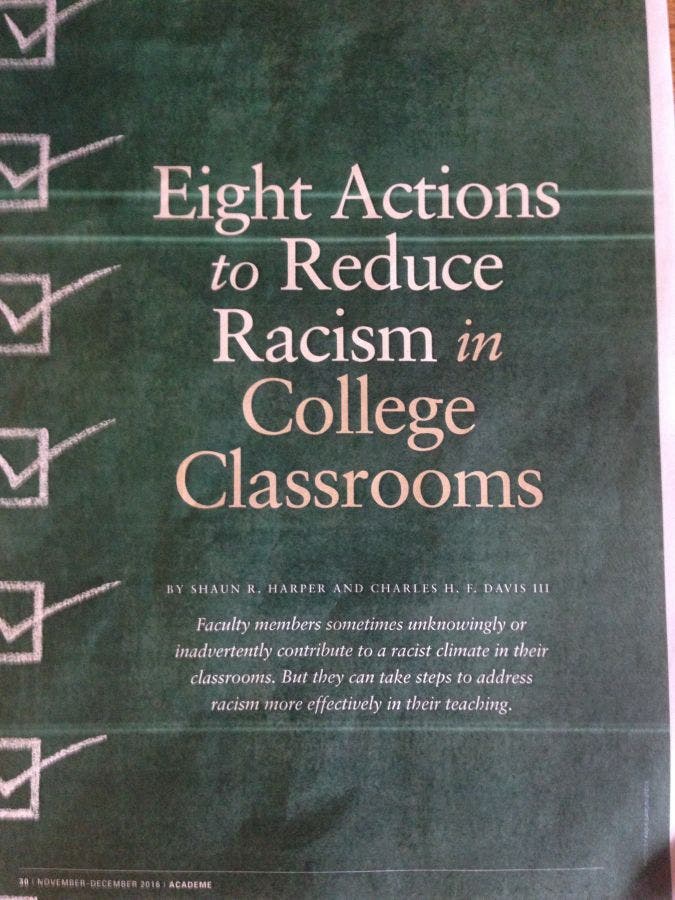
Photo: At their meeting, the AAUP distributed packets which gave suggestions to professors about how to create a more welcoming and open environment for all students. --Photo by Dylan Srocki