Neighbor News
ALICE Trains Faculty And Staff In Active Shooter Situations
ALICE training hosted by the Miami University Police Department teaches faculty and staff what to do in an active shooter situation.
By Laura Fitzgerald
Miami University journalism student
The Miami University Police Department is training faculty and staff in the ALICE method -- which teaches individuals how to deal with an active shooter.
Find out what's happening in Oxford-Miami Universityfor free with the latest updates from Patch.
It involves both private and open training sessions.
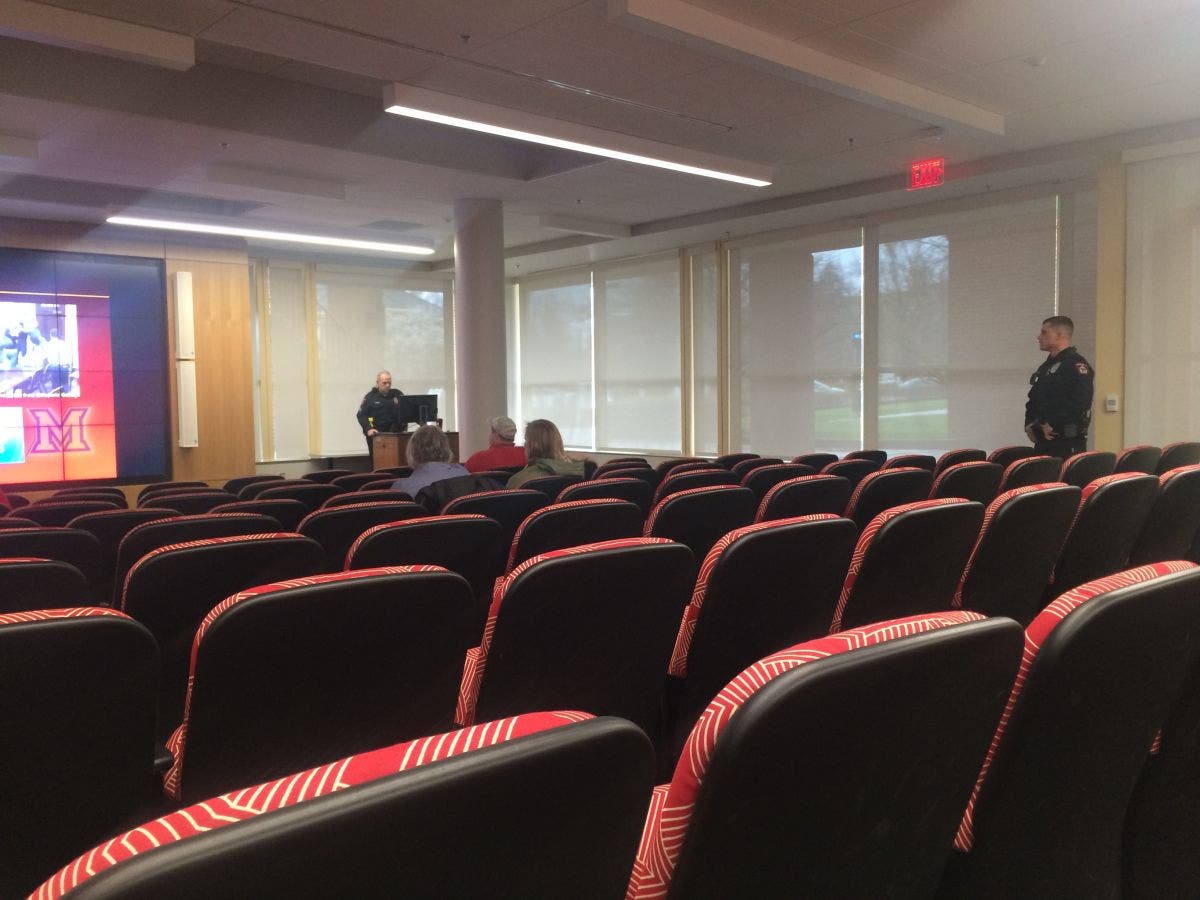
MUPD's Officer Michael Jarvi and Sergeant Scott Smith addressed faculty and staff in a session last Thursday that was open to the public.
Find out what's happening in Oxford-Miami Universityfor free with the latest updates from Patch.
ALICE Training
ALICE stands for Alert, Lockdown, Inform, Counter and Evacuate. The training program hinges on three basic principles: run, hide, and fight.
An individual may run from the shooter if there is a safe evacuation route and alert others to stay away from the dangerous area.
“If you think you hear gunshots, run away,” Jarvi says.
An individual may also hide behind a large object or barricade themselves in a room if the shooter is outside the building or they don't have a safe evacuation route. People in the room can turn off the lights, barricade the door, or even climb out a window if the drop is safe.
The last resort, which differs from the lockdown procedure that many schools and institutions once used, is to fight the attacker. This means if the attacker enters a room, people may work as a team to tackle and disarm the attacker and get the weapon away from them.
The ALICE method emphasizes that no situation is the same, and every person may respond differently based on the situation.
“You can do whatever is necessary to survive in a situation like this," Jarvi says. "If you have to burn the campus down burn the campus down. If you have to use violence, use violence. As long as you are actively threatened by a killer."
When police arrive, they are trained to eliminate the threat as soon as possible, Smith says. Everyone involved in the incident should leave with their hands in view and cooperate with police.
A Growing Number of Incidents
The ALICE method was created by law enforcement officer Greg Crane.
He was having a conversation with his wife, an elementary principal, after the Columbine shootings in 1999. In the traditional “lockdown” procedure, teachers locked the door, turned off the lights and told students to sit with their backs to the wall.
This made students easy targets.
So, Crane created ALICE to be a more proactive approach.
Miami experienced an active shooter in 1959, when Herbert Lucas shot his roommate and then the resident assistant that came to investigate in Reid Hall. Roger Sayles, the RA, died from the injuries, while Lucas took his own life in a telephone booth.
“It’s an unfortunate fact but Oxford is not immune to situations like that,” Jarvi says.
There has been no other active shooter situation since then, but universities across the country have dealt with instances of violence on campus. This past November, a student at Ohio State University injured 11 when he rammed his car into a crowd and attacked bystanders with a knife.
In June a student at the University of California Los Angeles shot and killed his professor in his office before killing himself. Students barricaded themselves in buildings with belts and cords, according to CNN.
And mass public shootings have increased.
TIME reports that a study by the Congressional Research Service in 2013 shows the rate of mass shootings has gone from about 1.1 per year in the 1970s to about 4.5 incidences per year from 2010 to 2013.
The FBI defines a mass shooting as an event in which four or more victims are killed in one or more public spaces.
Raising Awareness
The MUPD gives ALICE training at staff and faculty meetings and holds trainings that are open to the public.
MUPD also trains its own for active shooter situations as much as they can, Jarvi says. This includes using empty buildings in the summer for training.
“When there’s not as many students around that is when we take that opportunity to get inside these buildings and run through them, become more familiar with them,” Jarvi says.
Bobby Northcutt and Jessica Gray, both buildings ground assistants, attended the training on Thursday. Gray says they attended to learn how to better protect themselves and even prevent an active shooter on campus.
“It is possible to fight back. You know you don’t just hide under the desk,” Gray says. “You can use anything as a weapon.”
Northcutt says the training session was informative and helpful, making him more aware of what could happen.
“The more aware we can make ourselves of everybody around the more we can prevent the chances of this happening,” Northcutt says.
Photo: Police Officer Michael Jarvi and Sergeant Scott Smith offered an ALICE training course for faculty and staff and the general public. Jarvi says he has noticed more departments requesting these trainings in the past year. --Photo by Laura Fitzgerald.