Schools
Crawford Inauguration Today; Continues Miami Tradition
Gregory Crawford's inauguration on Oct. 10 marks a new era at Miami, as well as the continuation of long-standing traditions.

BY JAKE STANLEY
Miami University Journalism Student
In a continuation of Miami University’s longest-standing tradition, Gregory Crawford will be inaugurated as its 22nd president in a special ceremony on Monday, Oct. 10.
Crawford entered office on July 1, following the retirement of former president David Hodge. He previously served as the vice president and associate provost at the University of Notre Dame for eight years.
Find out what's happening in Oxford-Miami Universityfor free with the latest updates from Patch.
Despite holding his position for over two months, it is not unusual for the official installation to take place at a later time.
“It is common at most universities that inaugurations take place after the new president has been on the job for a while,” said Ray Mock, the executive director of the Miami University Alumni Association. “It sometimes ranges from a few months to a year or more in some cases.”
Find out what's happening in Oxford-Miami Universityfor free with the latest updates from Patch.
The inauguration date is similar to that of Hodge, who was inaugurated on Oct. 20, 2006.
Full day of celebration
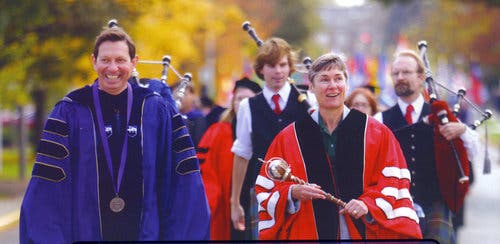
The inaugural ceremony will begin with a luncheon in the early afternoon, followed by a processional march featuring faculty and student representatives that will depart from the hub at 3 p.m.
For Crawford, the day involves a lot of movement for him and a multitude of guests.
“There is much preparation for an inauguration at a university,” said Crawford. “Guests come from all over the state and country, including other university presidents, government leaders, alumni, donors and many more.”
The march will travel up Talawanda Avenue before heading inside Millett Hall for the ceremony, which is open to the public. Following the inauguration, a picnic reception will be held on the lawn outside Millett.
“I am far more excited than nervous,” claimed Crawford about his upcoming speech, “although a major speech before a large audience can make anyone nervous, and I’m sure I will be.”
Long-standing traditions
While Crawford’s inauguration represents the beginning of a new era for Miami, it also marks the importance of tradition to the university.
“It is ceremonial, similar to a commencement,” said Crawford. “[It] traditionally marks a university’s move to a new era of leadership, so it is historical also.”
“In many respects, the essential elements have likely remained the same, though certainly there have been changes and additions over time,” added Mock.
The inauguration of Miami’s first president, Robert Hamilton Bishop, on March 30, 1825, featured a procession across campus, musical performances and speeches. Mock says that all three elements will be involved with next month’s ceremony.
According to university archivist Jacqueline Johnson, the ceremony has always been referred to as an inauguration, although it was not as elaborate as the modern version.
“There were speakers, who were often reverends, that would be invited to speak on behalf of the president,” said Johnson. “The president’s inaugural speech was considered more of a general assembly.”
Johnson’s archive on the third floor of King Library contains the original transcript of Bishop’s inaugural speech. In his address, Bishop, a Presbyterian minister, called for the university to be a “permanent blessing” by being connected with “the religion of the Bible.” He also stated that the university would “increase the resources and influence of the Western states.”
Bishop’s successor, George Junkin, intensified the rhetoric with his speech in August 1841, asking students if “the field of Armageddon [will] be won without one drop of your blood!”
Later presidential addresses would focus less on the end of the world and more on how students could positively impact an existing one.
Phillip R. Shriver, Miami’s president from 1965-81, described the university as the “common denominator” to bind students of differing backgrounds. A similar thought was echoed by James C. Garland, president from 1996-2006, as he imagined a shared “spirit” living inside all Miami students.
A new era
Crawford says he is still crafting his inaugural message, and cannot share it at this time. However, he was willing to give a preview of what he plans on saying.
“I want to convey not only how excited I am to be here, but my presidential platform,” said Crawford. “Primarily, what we stand for, what our principles are, in terms of our inspiration as a university. I hope the address will be inspirational.”
In previous interviews, Crawford has shared a general outline of his future platform. Following a prolific period of redevelopment under Hodge, Crawford has spoken about the need to build greater community bonds and globalism.
Regardless of his future plans, the president already feels like he has established a home in Oxford.
“I knew Miami was a very special place,” said Crawford, “but when you are here, immersed in it, and see the passion and dedication of the faculty and staff, the curiosity and enthusiasm of the students, and meet immensely successful alumni who are changing the world – well, it’s electric!”
For Miamians of different generations, the October ceremony will serve as a showcase of the qualities described by Crawford. It will mark the beginning of the future, while echoing rituals from nearly two centuries ago.
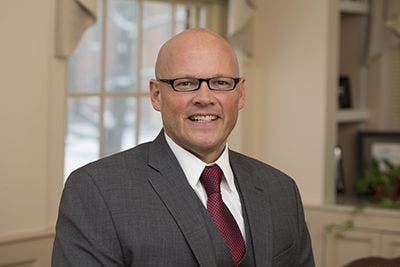
Photo: Gregory Crawford has served as the president of Miami University since July 1, following an eight-year tenure as provost at Notre Dame University. -- Photo by Jeff Sabo, Miami University