By Ellen Kahle
Miami University journalism student
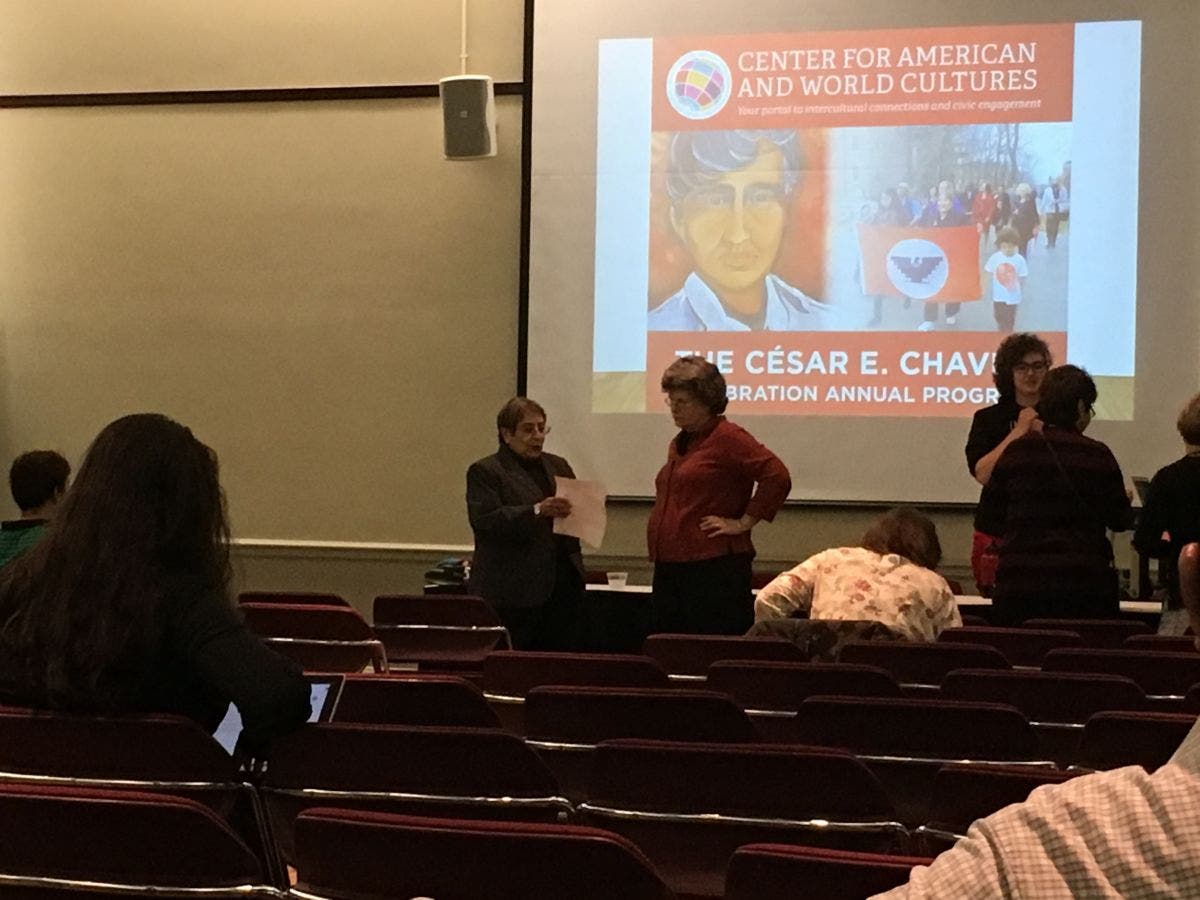
The Center for American and World Cultures sponsored the annual César Chávez Celebration panel last Tuesday at Miami University.
Find out what's happening in Oxford-Miami Universityfor free with the latest updates from Patch.
Chávez was a labor movement and civil rights activist known for his work to improve the lives of farm laborers in the United States.
Roxanne Cornelas, a Miami professor and Oxford resident, was one of the local panelists. She shared her experience growing up in California during the civil rights movement as well as how the activism in the environmental justice and LGBTQ communities influenced her life's work.
Find out what's happening in Oxford-Miami Universityfor free with the latest updates from Patch.
"I grew in California listening to the voices and witnessing the activism of César Estrada Chávez and his co-founder of the United Farm Workers/AFL-CIO, Dolores Huerta," Cornelas says. "Their commitment to social and environmental justice sparked a lifelong passion in me that has led to the type of research and teaching I do today."
Explaining how she became interested in the environmental movement, she shared a story about how she worked in a rice field and how terrible the conditions were.
Cornelas explained how all of the workers would have to be bent over, doing back-breaking work all day, with the sun beating down on them. She talked about how workers would have to go into nearby forests to relieve themselves and then would have to come back to the field to continue their work. These workers labored in miserable conditions for very little pay.
Far Reaching Influence
Magda Orlander, a Miami University undergraduate student who also spoke on the panel, talked about how she became interested in Caesar Chavez's work. She grew up in Germany and talked about how her childhood shaped her into an activist.
"I can remember in third grade that the children in my school were protesting the Iraq War," Orlander says. "When I was twelve, I remember going home and writing in my diary after I attended my first march. It was a protest because my country was trying to pass a law that would eliminate unemployment benefits and diminish them."
Orlander told the audience of her background coming from a poor family, explaining that they did not have much and relied on government benefits for food.
She went on to discuss how her family would have to jump from couch to couch and would sometimes end up homeless. The combination of these things led her to become an activist and to try to recruit more people for any cause that would be for the benefit of mankind.
The Need For People
Michael Zele, a student who attended the lecture, was impressed by what these women had been through.
"It's just amazing to me that both of these women grew up during different time periods but still had to endure such terrible conditions," Zele says. "It really makes you see the scope of the issue and that it needs people to fight for the cause."
The panel was held in the Dolibois Room in the Shriver Center and featured a group of local activists, including Oxford Mayor Kate Rousmaniere, Attorney Kathleen Kersh for Advocates for Basic Legal Equality Inc., Vice President of Ohio Farmer's Union and NAACP member William Miller Jr., and Miami biology professor and co-director of Miami's Institute for Food Alfredo Huerta.
Following the panel there was a community march that started in front of the Shriver Center and worked its way to the Interfaith Center. After that there was a breaking of bread ceremony and poetry reading by graduate and undergraduate students involved in the Poetry for Peace and Justice program.
For Cornelas, this kind of broad community engagement is the only way to effect real social change.
"Mainly, I believe that it is important for students and other community members to know that change and societal transformation can occur through personal interaction and coalition building and organizing for the betterment of all," says Cornelas.
"There is a saying that comes out of the rise of the environmental movement of the 1960s and and 1970s 'Act locally, think globally.' Our personal acts on a local level, no matter how small they may seem, can grow in significance like the rippling outward of water when a stone is tossed into a pond. Everything begins with a first step."
César Chávez Celebration events were supported by a number of university departments and programs as well as community partners.
Photo: Cesar Chavez Celebration panelists discuss the activist's impact on social justice movements as well as on their own work. --Photo by Ellen Kahle