Schools
Grad Rates Between Miami University Campuses Like ‘Comparing Apples To Oranges’
Wide range of factors create lower graduation rates in Middletown and Hamilton, compared to Oxford.
BY BONNIE MEIBERS
Miami University journalism student
When just looking at the numbers, the gap between graduation rates at Miami University’s Oxford and regional campuses is substantial.
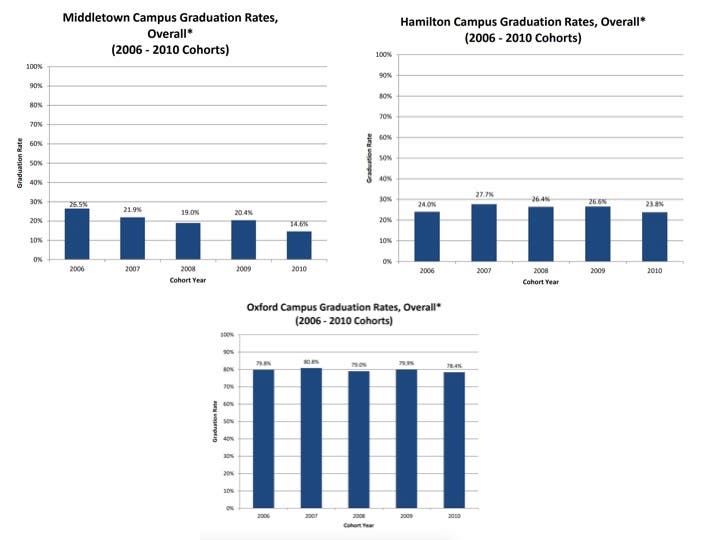
According to Miami’s Office of Institutional Research, the six-year graduation rate for the 2010 cohort at the Oxford campus was 78.4 percent. That means more than three-quarters of first-time, full-time students who enrolled on the main campus that year graduated within six years.
Find out what's happening in Oxford-Miami Universityfor free with the latest updates from Patch.
By comparison, the six-year graduation rate for the 2010 cohorts at the Middletown and Hamilton campuses was 14.6 percent and 23.8 percent, respectively. Translation: Fewer than two out of 10 students enrolled in Middletown finished in six years and fewer than four out of 10 enrolled in Hamilton finished in that time.
Nationally, the average six-year graduation rate for four-year public institutions is 59 percent. Miami students are beating that average in Oxford, but falling far short of it at the regional campuses.
Find out what's happening in Oxford-Miami Universityfor free with the latest updates from Patch.
Many factors
Cathy Bishop-Clark , interim dean of the regional campuses, said many factors contribute to the gap. Among the largest factors: the kind of students who choose to go to each campus.
Many of the students who go to Miami’s regional campuses enroll part-time, rather than full-time.
Of the 1,500 new students at the regionals in 2010, 88 percent were full-time. About 30 percent of those students go to Miami Middletown and 50 percent go to Miami Hamilton.
In comparison, of the 3,595 new students at the Oxford campus in 2010, 99.9 percent were going to school full-time. Just three of the students in that cohort had part-time status.
When calculating graduation rates, Miami counts only students who go to school full-time, so part-time students at the regionals are simply not included in these calculations.
Many never intend to graduate
Bishop-Clark also said that many students who start at the regional campuses never intend to end there.
“Many of our students don’t intend to graduate from Miami regionals. They transfer to main campus or another university,” Bishop-Clark said.
Until the last three to five years, the regionals only offered two or three bachelor's degrees. The regional campuses now have 17 bachelor's degrees to choose from, with more than 100 available in Oxford.
The regionals also offer 11 associate's degrees -- another factor that suppresses the published graduation rates. Students who choose associate's program, which typically run for two years, are also not included in the grad data.
“Everyone at Oxford is pursuing a bachelor's degree, which means that they are maintaining that core cohort that regionals is not,” Director of Institutional Research Denise Krallman said. “So you’re looking at a smaller group of students to begin with, and they’re not going through that selective process that Oxford students are going through.”

Open versus selective admission
Bishop-Clark also made this point, casting the open admissions policy at the regionals as a plus.
“The regional campuses have a lower retention rate because we have open admission, where the Oxford campus is very selective,” Bishop-Clark said. “But that is one of the things I love most about the regionals -- that we give anyone who wants it a high-quality Miami education. I think everybody should get a shot.”
Academic success in high school is the biggest predictor in how well a student will do in college, and whether or not they will stay after their first year, said Bishop-Clark.
Because the Oxford campus is highly selective in its admissions, most Oxford students are already more likely to graduate because of their academic records.
“The Oxford student tends to be a very traditional student, right out of high school, focused on a four-year degree,” Senior Vice President for Enrollment Management & Student Success Michael Kabbaz said.
Senior regional director of enrollment management Kristin Taylor, said that the recession that began in 2008 affected many open-enrollment institutions. She suggested that this may be a reason that regional graduation and retention rates around this time period lag behind Oxford's campus.
"The fall 2010 cohort would have been entering students at the height of the Great Recession," she said, "Open-enrollment campuses were particularly impacted by high entering enrollment at this time as unemployment spiked. When the economy turned around and jobs increased, many students stepped out to return to the workforce."
'Life ... gets in the way’
Many students who attend the regional campuses, meanwhile, are focused on other things in their life -- like jobs or families as they complete college courses part-time.
“Virtually all of our students work or have families,” Bishop-Clark said. “There is a lot of life that just gets in the way.”
Autumn Rogers is a good example. The 22-year-old is a second-year nursing student at Miami’s Middletown campus. She is married, with two children, and going to school full-time.
“I don’t necessarily participate in activities a lot of students participate in,” Rogers said. “I stay home and go to school. Those are my two jobs.”
Rogers had her first child eight months after she graduated from Franklin High School in Franklin, Ohio. “I spent my first two years after high school working and trying to figure out what I wanted to do,” she said.
Rogers said that it doesn’t seem like there’s ever enough time in the day to accomplish all of the tasks on her plate.
“Time management is what it all comes down to,” she said. “When you’re thinking for three people, it’s not just taking care of them, it’s doing laundry for four people, doctor’s appointments, feeding them, packing lunches. Getting everyone out the door before my 8:30 class is really difficult, especially if you’ve been up late studying.”
‘Always on the go’
Rogers is not alone in this.
“Regionals students are always on the go,” she said. “It certainly helps if school is all you are focusing on. I know some others who just about work themselves to death. Regional campuses are full of students that don’t have the same perspective and lifestyle as what is out in Oxford.”
Nicole Smith -- a pseudonym for a Hamilton student -- is very involved on campus. She has been a senator in student government and a member of the campus activities committee; she works part-time at the biology conservatory at the Hamilton campus; and she took a study abroad trip to Nicaragua with Miami.
“I think that differentiates me from other non-traditional students. I jumped right into the Miami experience,” said Smith, who asked to be identified by a different name as she shared private information about her mental health.
Now 36, Smith took 12 years off school to help raise her sister’s children. Both her sister and her husband work full-time, so they needed an extra hand.
Smith said she has “extreme” social anxiety. At one point, it was so bad, she said, that she couldn’t leave the house. But when her sister asked for help, she forced herself to go out.
“Taking care of the boys really helped me [with my social anxiety], along with them,” Smith said.

The boys are now 17 and 10 years old.
“When the youngest went off to kindergarten, I went off to college,” Smith said. “So we were starting school at the same time.”
After five years at the Hamilton campus, Smith is now set to graduate Miami in December with a liberal studies degree. She came in as a linguistics and anthropology double-major then changed direction.
“Along with my anxiety, I have other health issues, so school is physically and mentally a struggle for me,” Smith said. “I struggled so much last semester that I knew I couldn’t go to school anymore. I needed to get out and go to work.”
Last semester, Smith failed a class because her anxiety made it difficult for her to attend.
“I don’t think I could have done college when I was 18,” Smith said. “I don’t know if I would have had the maturity needed.”
Now she is in the process of applying for an internship as a plant grower at Berns Garden Center in Middletown. “Miami has opened a lot of doors for me,” she said. “I’ve been exposed to all sorts of cultures, backgrounds, races and sexualities. I think I’m a better person, better than I was.”
Living on campus helps grad rates
Among the other significant differences between Oxford and regionals students is where they live. All regionals students commute to campus.
“We’re not immersed in the college experience,” Rogers said. “Oxford is a campus where students live there and you have that sense of belonging. At Miami regionals, you don’t get that sense of belonging.”
Kabbaz said the fact that Oxford recruits students with great academic records, and then requires them to live on campus for their first two years, makes them more likely to stay and graduate.
“The fact that they’re coming here and living on campus makes them more engaged,” Kabbaz said.
Smith commutes from Oxford to Hamilton for classes, a process made stressful by her anxiety and other factors. “I know people who have missed class because of car troubles or weather issues,” she said.
‘Like comparing apples to oranges’
Denise Krallman considers comparing the Oxford campus to the regionals "like comparing apples to oranges.”
More accurate comparisons can be made between Miami's regionals and other university branch campuses, she said. Graduation and retention rates for these institutions are much closer to those of Miami’s regional campuses.
Taylor said that, for instance, University of Cincinnati’s Clermont campus has a 24 percent overall graduation rate, much closer to Miami’s Hamilton campus overall graduation rate of 23 percent.
(The overall graduation rate is the amount of students who graduate within 150 percent of normal time for first-time, full-time. For all of these institutions, the "normal time" is four years.)
The overall graduation rate for Ohio State’s Mansfield campus has the highest graduation rate, 46 percent, when compared to other Ohio regional schools. Akron University’s Wayne campus has the lowest overall rate, at 9 percent.
According to Krallman, it's not fair to compare grad rates in Oxford to those at Miami's regional campuses. "You need to make a comparison between other regional or community colleges," she said.
Solutions to lower graduation rates
In 2014, Former Miami University President David Hodge launched the Student Success Committee to increase graduation and retention rates and to increase student satisfaction. Kabbaz and Miami Provost Phyllis Callahan co-chair the committee.
At the regional campuses, Bishop-Clark said that she is putting together a committee starting in October that will focus on retention rates.
Rogers, who is involved with student government, said that current Miami President Greg Crawford wants to start a “One Miami” committee. This committee would bring together regional and Oxford campus students.
“The distance may separate us, but in the end all of our degrees are going to say Miami,” Rogers said.
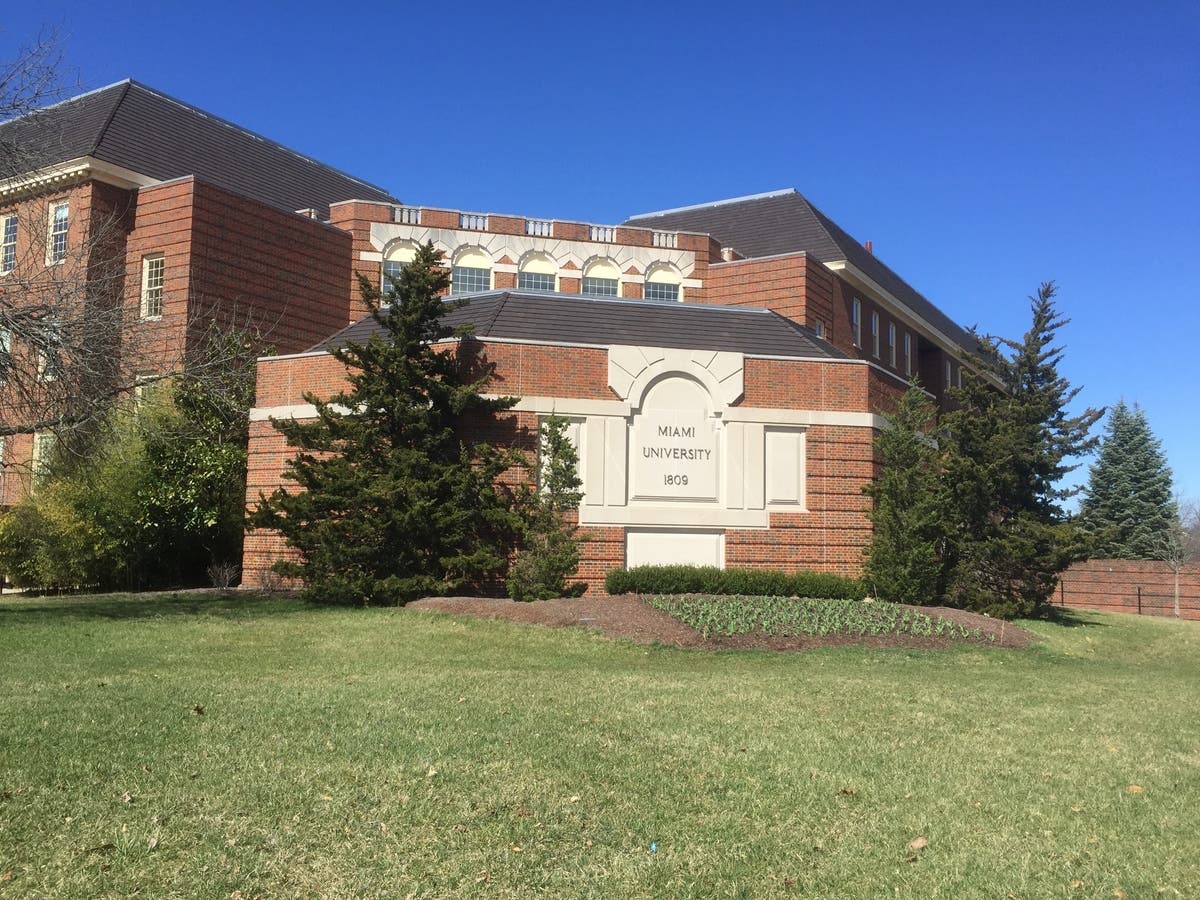
Top photo: Miami University's graduation rates in Oxford are starkly different than those at branch campuses. -- Photo by Bonnie Meibers