Neighbor News
Increase of International Students Heats Up Winter Term
Higher international enrollment and the introduction of the winter term has caused the break population at Miami to increase.

BY JAKE STANLEY
MIAMI UNIVERSITY JOURNALISM STUDENT
As the fall semester nears its conclusion, thousands of students on the campus of Miami University are preparing to return home for an extended six-week winter break, one of the longest in the nation. Although some return at the beginning of January, the small town of Oxford is mostly deserted, except for a small, but robust populace that stays throughout the empty days.
Find out what's happening in Oxford-Miami Universityfor free with the latest updates from Patch.
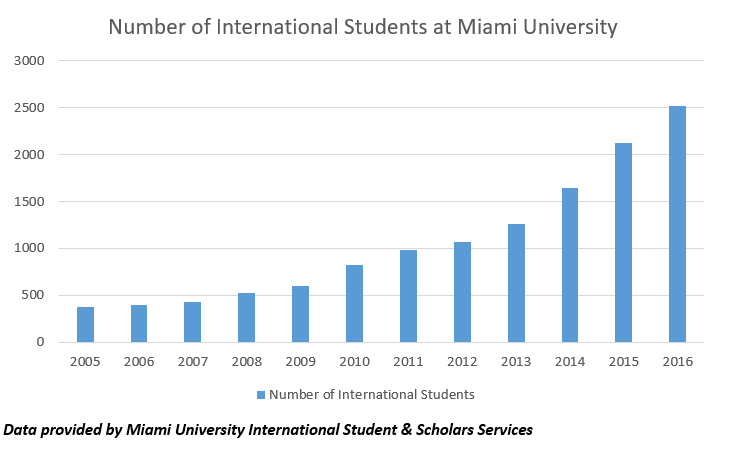
In recent years, the population of international students at Miami has increased dramatically, growing from 820 non-domestic students in 2010 to a record high of 2,517 this fall. With that change has come an additional rise in the amount of students staying on campus during the winter break.
As a result, there have been adjustments made by the university’s housing department, as well as high enrollment figures in winter term courses. It has also led to discussions about the opportunities provided for students in this quiet period.
Find out what's happening in Oxford-Miami Universityfor free with the latest updates from Patch.
Fully-Equipped Housing
In the 2015-16 winter break, 563 international students stayed at least one night on campus, accounting for over 26 percent of all international students at Miami. With off-campus residents removed from the figure, it becomes apparent that a high percentage of international students are remaining in Oxford.
In order to meet this demand, the Office of Residence Life (ORL) has taken steps to ensure that students are allowed to be comfortable and monitored.
During each day of break, one full-time ORL staff member is on-duty and is accessible to students by a widely-distributed phone number, even when the university is closed for the week of Dec. 25-Jan. 1. Full-time employees are eligible for vacation time, but many remain on campus during the majority of the period because they live within residence halls or at Heritage Commons. Following the Christmas week closure, full-time staff workers will return on Jan. 2, followed by graduate student workers on Jan. 10.
The winter break also provides an opportunity for undergraduate residence assistants (RA) to gain more experience. Last month, interested RAs were invited to apply for winter positions, with the added incentive of fee waivers. Each RA is assigned a cohort of students in a general campus area, with whom they are expected to contact in person at least once during break, even if they do not live in the same residence hall.
According to ORL director Jerry Olson, nearly 30 RAs will stay on campus, but the organization of these students poses some troubles for his department.
“It’s like a jigsaw puzzle putting these RAs in the right places,” said Olson. “We find where there are high concentrations of students and place RAs accordingly.”
The ability for students to remain in their own rooms is intended to limit disruption, but is also a relatively recent development. Until 2010, students staying on campus during break were forced to relocate to alternative residence halls.
Limited Dining Options
International students are required to announce their desire for winter housing on their Housing & Meal Plan Contract with the Housing Options, Meals and Events (HOME) office prior to the beginning of the fall semester. The document also provides choices for meal plans that can be used in the campus dining halls that are open over break.
During the week before Christmas, the only major dining location in operation is the Pulley Diner at the Armstrong Student Center, but it is only open from 8 a.m. to 5 p.m. Other Armstrong locations like Emporium, Miami Ice and Sundial Pizza have short-term afternoon hours.
Following a Christmas closure of all dining halls, Asian buffet Pacific Rim at Maple Street Station will be the lone dining location open for the week of Dec. 26-30. The amount of available choices increases during the winter term, with multiple locations throughout campus starting some semblance of regular service.
For Molly Heidemann, university director of international scholars, the dining void has proven to be one of the few complaints for her department, but the students have learned to manage.
“I spoke to the president of the CSSA (Chinese Students and Scholars Association) and they reached out to me about whether the hours at Armstrong were a problem,” said Heidemann. “They do close for some period of time and I asked if that was a problem. He said that if they were staying here, they know what they’re getting into. They know that they’re probably going to have to go Uptown and get food delivered. We certainly don’t get a lot of complaints, but some might be frustrated about being unsupported.”
A Primary Priority
Heidemann said her department is looking at providing more activities and programming for students.
“We’re talking about trying to put together a ski trip to Perfect North Slopes, but I’m not sure if that will come together,” said Heidemann. “We were also just contacted about a service project for students staying over the break. I think it’s an area we could continue to think about. With our limited staff and resources, it has not been one of our top primary priorities.”
The department’s efforts are good news for many international students who feel like their experience is limited by the lack of opportunities.
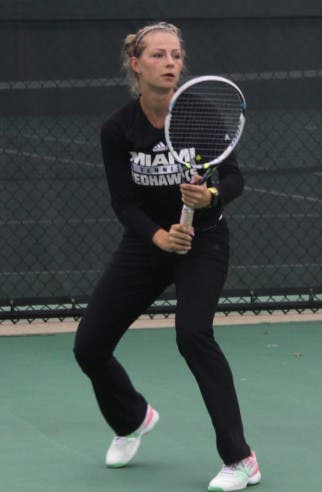
“To be honest, it was pretty boring since nobody was here and the campus was absolutely empty,” said Anastasiia Vasiukhina, a junior bioengineering student and member of the Miami women’s tennis team.
The Moscow native said that prior to the return of her teammates for practice in early January, she spent most of her time in the Rec Center because it was the main venue open on campus. As for entertainment, she did say that she attended multiple hockey and basketball games and visited a friend in Indiana.
Though she agreed with Vasiukhina’s sentiment, Heidemann said that staffing concerns and departmental business has restricted their abilities. During the week before Christmas, her staff has to complete files and documents related to the fall semester. More so, the international scholars department focuses the majority of its effort toward welcoming new students in spring semester orientation events that begin Jan. 17.
In spite of orientation, Heidemann said that her office is still there for student affairs, even with all of the commotion.
“Whenever there are students are around, there will be those who need our help with various things,” assured Heidemann. “We will continue to take appointments. So if they need us, we are open for business.”
Winter Term Interest
The most sizable change for the winter experience of international students in recent years has been the introduction of the winter term in the 2013-14 school year. Although the majority of winter term courses are only offered online, sections of popular courses such as Environmental Biology, Macroeconomics and World History are taught in Oxford classrooms.
Correspondingly, international students have taken advantage of this opportunity in numbers that have consistently risen in the four-year tenure, despite the tuition fee of $1,218.69 per credit hour.
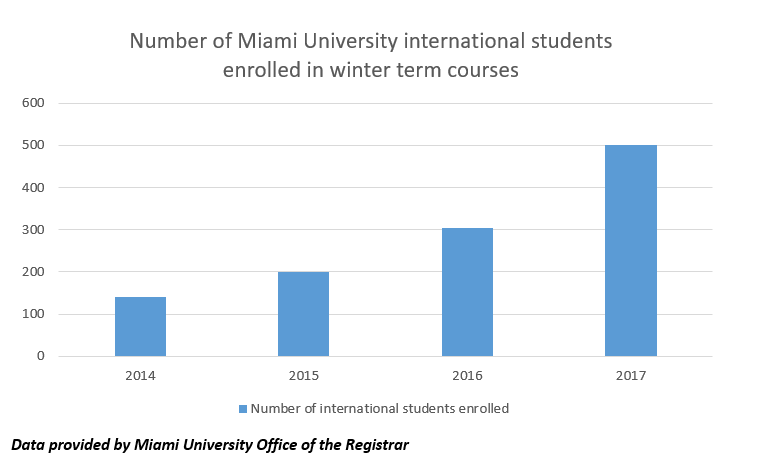
According to data calculated by senior assistant registrar Tim Kuykendoll, the 2014 winter term roster only included 140 international students, just 4.2 percent of the total registry. As of Dec. 12, 502 have registered for 2017 winter courses, comprising a solid 10 percent of enrolled students.
Olson said that the attraction of earning extra credit hours has helped keep more international students on campus and created an increasingly close-knit community.
“My observations are that many students who stay know others who stay and these groups get together for studying and social reasons,” said Olson.
The escalating winter enrollment has also been a financial success for Miami University. Over 5,000 students have enrolled for this year's term, up from 3,279 in the inaugural 2014 term. The high numbers resulted in Miami bringing in $12.7 million from the term last year, according to a presentation from a Feb. 2016 Board of Trustees meeting.
With less residents and decreased commotion, the winter break had previously been considered a dead period for Miami. But the elements of increased non-domestic enrollment and the winter term have led to more on-campus residents in this period than ever before in the university’s history. The housing and dining options are continuously expanding, leaving the need for activities as the main concern for future years, but Heidemann is optimistic about the prospects.
“A lot of them are taking winter term classes, so that keeps them pretty busy because it’s intensive,” she said. “But it’s cold and dark, so we’re always open to ideas. We are always wanting to improve in that area and with winter term, we have a little more time.”