Schools
Lost In Translation: Chinese And American Student Relations
Miami University accepts international students every year, a majority from China. But some students face cultural and language barriers.
By Claire Williams
Miami University journalism student
Starting college as a freshman can be one of the biggest transitions of a person’s life, whether you live near or far from home. You come to a new place, hardly knowing anyone with the expectation that you will build a life for yourself. Anyone would be nervous, but imagine being a new student in a foreign country.
Find out what's happening in Oxford-Miami Universityfor free with the latest updates from Patch.
Every year, Miami University accepts nearly two thousand international students. Some of these students are graduate students, who have been in college before, but a majority of them are undergraduates. It is normally their first year of college.
While Miami accepts a variety of students from many different countries including Brazil, Canada, Korea, and India, the largest number of students admitted are from China.
Find out what's happening in Oxford-Miami Universityfor free with the latest updates from Patch.
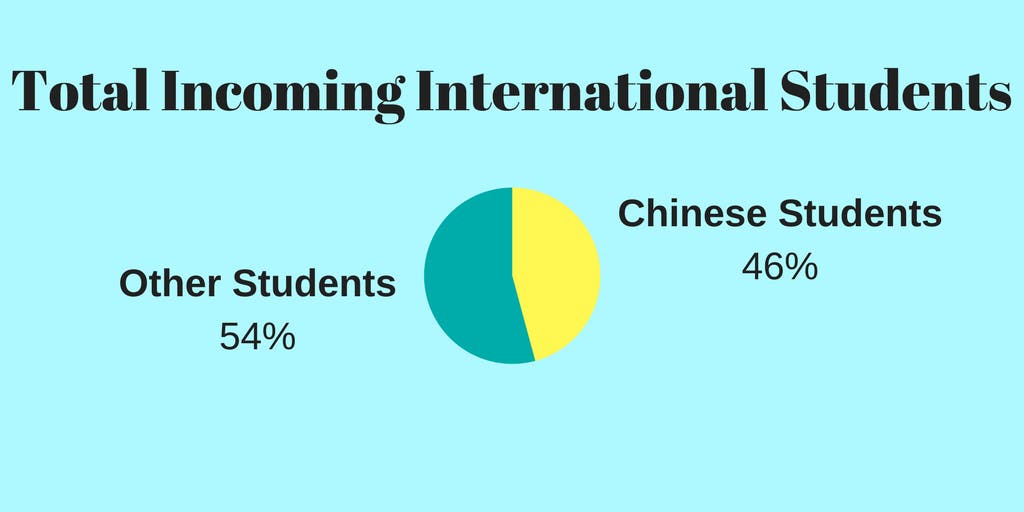
Miami domestic students often joke that everyone from Miami can be put into the "Five C’s." These C’s are Chicago, Cincinnati, Columbus, Cleveland ... and China. In 2014, Miami University saw a record number of Chinese students, with 1411 students joining the Oxford campus.
While more Chinese students are admitted to Miami every year, American and Chinese students notice that there is a "gap" -- a social, cultural and linguistic divide that sometimes makes it more difficult for these groups of students to interact and form relationships.
Sarah O’Connell is an international student advisor for International Student and Scholar Services, or ISSS. She works with international students, including Chinese students, and says that while there is a bit of a social divide, it is not because students don’t want to make connections.
"College is difficult for everyone, but I think our international students are facing different barriers than American students might face, just in terms if they are not a native English speaker," O'Connell says.
She insists that not only do Chinese students want to form friendships with American students, domestic students want that opportunity too.
One such friendship is that of Mason and Jacob.
Surprising Friendship
Mason Wang is an international student from China. He says that the biggest barrier between American and Chinese students is communication.
"The language (English) requirement to get into Miami is not that high, so they can get in and maybe understand the reading, but the listening and talking skills are not good enough to communicate," Wang says.
Wang, however, has not had any problems making American friends. His best friend is Jacob Bryant, a domestic student whom he met in a Japanese language class and who is majoring in Mandarin Chinese.
"We met in Japanese class, which is kind of funny," Wang says.
"I had mentioned that I was a Chinese major, and Mason had said ‘Hey man, speak some Chinese.’ We ended up agreeing on a lot of issues and life perspectives. It was an interesting fate," Bryant adds.
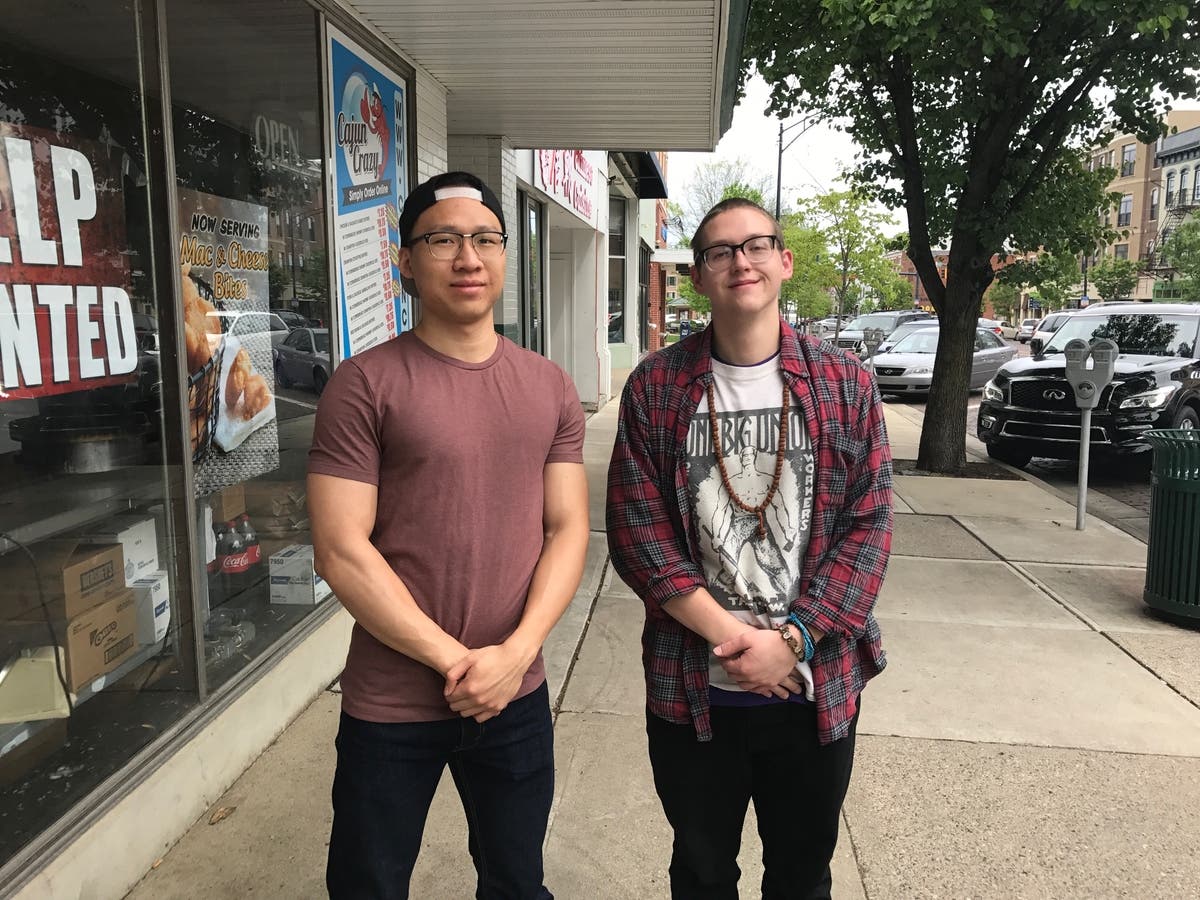
While they had no difficulties in communicating, they both agree that it can be a little hard for domestic and international students to really sit down and talk. Bryant was lucky that he had been studying Chinese when he met Wang.
"While the Chinese students speak English, not a lot of Americans speak Chinese, so there isn’t a connection to bridge that gap," Bryant says.
Language Barriers
Carol Olausen is the director of ACE, the American Culture and English program.
ACE is a one semester bridge program for international students who were not directly admitted to the university because they did not get the required TOEFL (test of English as a foreign language) score for direct admission. Students take two language based classes and one cultural course.
"We have a very robust social-cultural element because you can’t just go to a new country and be in a class, you have to learn to survive there," Olausen says. "We are proactive in helping our students engage in campus, we will take them out into the community to interact with people because in addition to the cultural barrier the language is another wall that can lead to people feeling intimidated."
Olausen says that while many Chinese students want to branch out, because of language and cultural barriers, it is harder for them to build the friendships and connections they hope for. She says that many Chinese students and American students tend to stick to what is more comfortable.
"Many students try first semester to strike out and go to clubs, but then sometimes end up feeling like it hasn't worked, and it is just so much easier to just hang out and talk with people who speak your language and who know your culture," she says.
Culture Shock
Both Olausen and O'Connell say that one thing that many Chinese students notice is that Americans are very friendly when they first meet someone, however it is described as a "superficial politeness."
"They'll (Chinese students) tell you that straight out," Olausen says. "But Americans tend to be reserved. They'll say 'Hey how are you, how is your day?' but that's it. And I know many Chinese students who want to have meaningful conversations."
Gerri Chen is a graduate student from China. She has noticed this American charm and it took her awhile to get used to it.
"I remember when I got here, and people would ask how I was, and I would be so confused. We don't do that in China, I think it be kind of surprising to other Chinese students," Chen says.
Opportunities For Connection
Although many students still feel there is a disconnect between domestic and Chinese students, it is not because students are not trying to bridge that gap.
Wang and Bryant are a part of a group called Tea Club, which aims to bring together people to celebrate the classic Chinese tea ceremony and to foster cultural sharing between American and Chinese students.
O'Connell advocated for Global Buddies, a program that pairs up domestic and international students so that they can get together throughout the year or semester to get coffee, dinner, do homework, or to just meet up and have someone to talk to.
As well as Miami sponsored programs, there are also initiatives sponsored by China. The Confucius Institute promotes learning Chinese language and social interaction, providing a variety of events including Chinese language tutoring, where domestic students learning Chinese can go to have advanced conversations and make connections.
Quanyu Huang is the former director of the Institute and believes the programs offered provide a chance for American and Chinese students to learn about each other's culture in a casual and fun way.
While there are barriers in both language and culture, students and faculty at Miami University continue to try to bridge the gaps between domestic and international students.
While Wang and Bryant have found a friend in each other, they hope that other students will take the initiative to look for friends in places they may not expect.
"It's as simple as going up to someone and asking them to go to lunch. You never know what might come from it," Bryant says. "If everyone could be a little more open it could really go a long way."
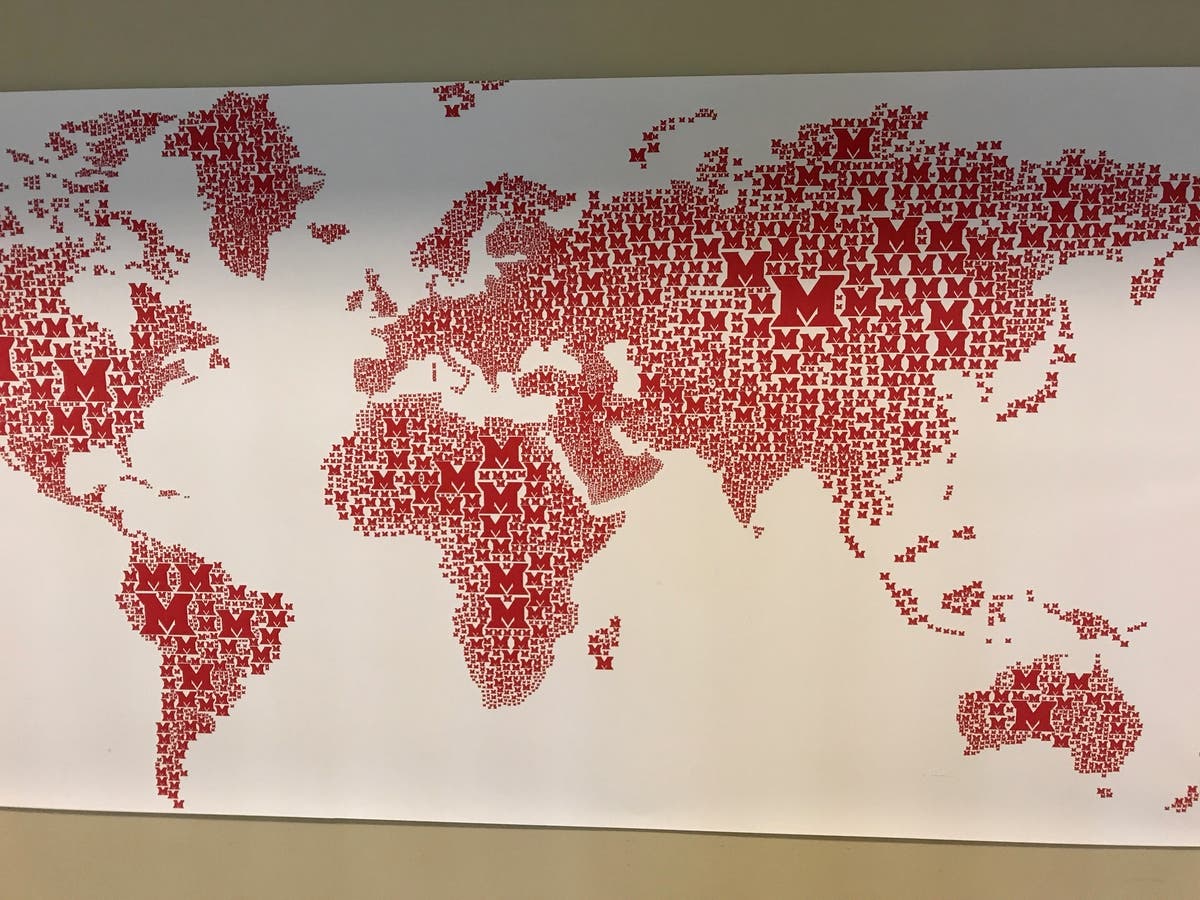
Photo: A map of all the countries of the world with the Miami 'M' making them up. It is in the main hallway of MacMillan Hall. --Photo by Claire Williams