Schools
Miami University AAUP Plans To Fight For Contingent Faculty
Faculty advocacy organization seeks to help year-to-year employees with fair pay and job security.
BY KERRY McFADDEN
Miami University journalism student
Miami University’s chapter of the American Association of University Professors (AAUP) will start its official business next week, working toward semester-long goals of improving conditions for what are considered "contingent faculty" members.
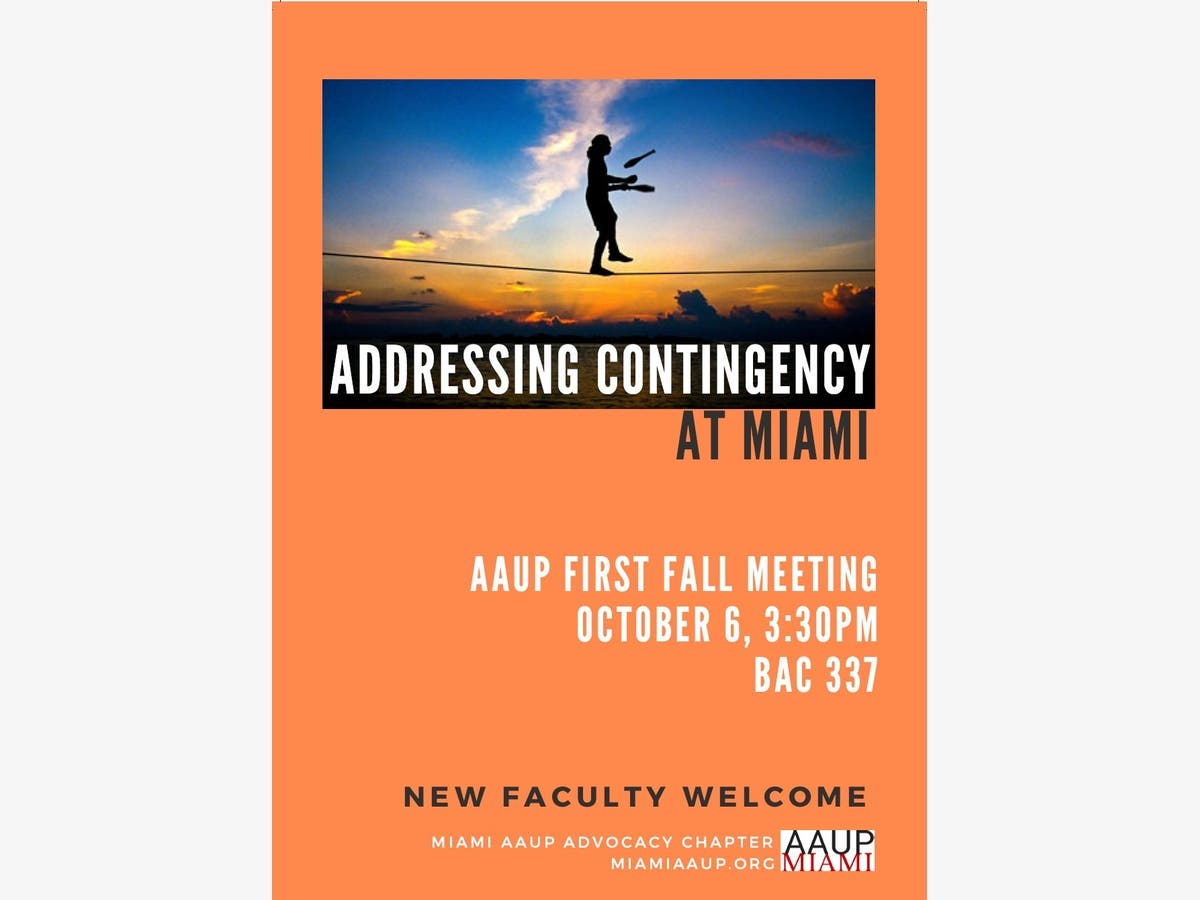
The first AAUP meeting, set for Oct. 6, will feature a panel of such faculty members. Their input will be used by the rest of the association to create goals and set an action plan, according to an e-mail sent to faculty by AAUP leadership.
Find out what's happening in Oxford-Miami Universityfor free with the latest updates from Patch.
The principle difficulties facing contingent faculty -- those hired outside of the university tenure system -- are low pay and job permanence. Faculty members with such titles as clinical faculty, lecturer, visiting assistant professor, adjunct professor or instructor are hired on a year-to-year basis, with some making only $1,000 per credit hour to teach. At that rate, with a full course load of three classes, a contingent faculty member would make less than $20,000 a year -- with no guarantee of continued employment.
Funding issues drive hiring
Find out what's happening in Oxford-Miami Universityfor free with the latest updates from Patch.
Universities across the United States have seen a decrease in the number of tenured and tenure-track professors. A lack of funding for such hires is among the reasons, said Deborah Lyons, secretary of Miami’s three-year-old AAUP chapter and associate professor in the Department of Classics.
“Over the years, as the states and the federal government have disinvested in education, universities have been more squeezed, and figured out that this is a great way to save money,” Lyons said.
The AAUP wants to combat this shift by raising awareness among both students and members of the administration.
“The best way to address issues is to make noise,” Lyons said. “One technique that I think we want to use is to emphasize to the university what the costs are of converting their faculty to contingent professors.”
The costs that Lyons noted are a lack of opportunity for invested faculty members to develop, as well as a cost to students who lose the opportunity to ask for recommendation letters or simply develop relationships with professors who may not be able to stay at Miami.
The AAUP expects to face obstacles in its fight for contingent faculty, primarily the unavailability of financial resources.
“The university will always cry poverty,” Lyons said.
However, she noted that progress has been made regarding transparency and shared governance since the beginning of Miami President Gregory Crawford’s term. Former President David Hodge, who retired in the summer of 2016, "wanted nothing to do with us," she said. "He preferred established channels.”
Changes to organization leadership
Members of the AAUP will also vote electronically to change the structure of their leadership.
The vote will decide whether the current executive committee -- comprised of the president, secretary, vice president, etc., of the Miami chapter -- should be called the “steering committee” instead. In an e-mail sent to faculty from members of the board, chapter leaders said “the new title better reflects our ethos and goals as a democratic organization.”
“We just didn’t feel comfortable with the top-down sound of ‘executive committee,' ” said Lyons.
Members were also invited to nominate themselves or others for co-president, vice president, secretary and membership director in advance of the first meeting.
The meeting will be in the Bachelor Hall Reading Room (337) at 3:30 p.m.
Photo: The AAUP's first meeting of the year will be Oct. 6. -- Photo contributed by Miami University