Community Corner
Miami University Attracts More Out-of-State Students Than Ever Before
The geographical diversity of the student body continues to increase as Miami expands recruitment efforts across the country.

BY MARIEL PADILLA
Miami University journalism student
The 2016-2017 freshman class set a new milestone for Miami University this year: it includes the highest-ever number of students from states outside of Ohio.
The out-of-state enrollment is 1,387 this year, which is approximately 36 percent of the entire class. This is about a 200-person increase from five years ago.
Find out what's happening in Oxford-Miami Universityfor free with the latest updates from Patch.
Tuition for out-of-state students is more than double in-state tuition. In Fall 2016, the tuition fee for incoming Ohio residents was $14,736 compared to $32,555 for out-of-state residents.
According to Director of Admission Susan Schaurer, "Miami is extraordinarily dependent on tuition revenue. First years contribute to faculty and staff housing."
Find out what's happening in Oxford-Miami Universityfor free with the latest updates from Patch.
Ten years ago applicants mainly came from Ohio, Indiana and Illinois. Today, applicants come from nearly every state, Schaurer says.
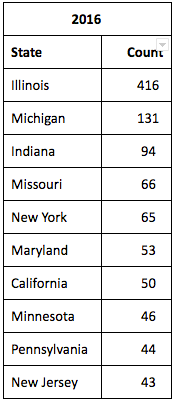
Illinois still sends a strong contingent to Miami, with Michigan at No. 2. This year's top 10 home states, excluding Ohio:
Fewer high schoolers
This steady increase in out-of-state enrollment can be seen across all Ohio state institutions. According to Schaurer, this trend can be linked to the steady decline in the number of high school graduates in Ohio over the past decade.
Miami’s admissions staff, like that at most U.S. colleges, uses the Western Interstate Commission for Higher Education (WICHE) website as a predictive tool to target and recruit students from high schools across the country.
Using information compiled from high schools in the United States, the WICHE site projects graduation rates years in advance. According to updated data, the majority of states, including all in the Midwest, are seeing fewer high school graduates each year -- with some, such as Texas, Colorado and Utah, seeing an increase in high school graduations.
Miami began heavier recruiting efforts out of state in reaction to those trends, says Schaurer.
A side benefit: Higher out-of-state enrollment brings in more tuition, since non-Ohioans pay more than twice as much. This fall, Ohio students paid $14,736 in compared to $32,555 for out-of-state residents.
Expanded recruiting efforts
To beef up its recruiting, Miami hired its first two regional recruiters in 2010 and now has a total of seven: one each in Colorado, Georgia, Washington D.C., Philadelphia, New York and two in Chicago. It employs another 10 to 12 in Oxford.
Regional recruiters reduce Miami's transportation costs since they live closer to where they are recruiting.
According to Schaurer, Miami was initially ahead of the pack in expanding its recruitment staff. Now, most state institutions use a regional system, including the University of Cincinnati and Ohio State University nearby.
Admission Counselor A.J. Searle travels to high schools and college fairs throughout the six- to- eight-week recruitment season. His region includes the greater Toledo area in northwest Ohio and the state of Michigan. He answers questions that students and families have about Miami.
“We look for students that are academically accomplished, involved in activities and ready to come to college to work hard and graduate,” Searle says.
Senior Delaina Weinroth attended high school in Colorado but decided to attend Miami after attending an information session. “I first heard of Miami University when my guidance counselor in high school suggested it. Miami recruits heavily in Colorado so I went to an info session, and what they had to offer really appealed to me,” Weinroth says.
The value of diversity
Miami's approach to recruiting boosts student diversity, according to Schaurer. "We value out-of-state recruitment simply because we value diversity broadly defined,” she said.
In addition to seeking regional representation, that means Miami recruiters seek applicants of varied racial, ethnic and socioeconomic identity, along with first-generation college students.
“One of the things we’ve heard consistently over time from students is they enjoy learning alongside people from all walks of life all over the U.S. and the globe,” Schaurer says. “Bringing people together really enhances a student’s education first and foremost.”
As a Miami student from the West Coast, Weinroth attests to the benefits of regional diversity.
“When looking at colleges, Miami offered everything I was looking for and was just far enough away from home. I liked that I wasn’t going to college with everyone from my high school, and that I could discover my identity somewhere new,” Weinroth, an English education major, says.
According to Schaurer, Miami has had very high percentages of out-of-state students historically. Even in the 1980s, the numbers were high in comparison to OSU and UC, along with Ohio University. It’s part of what makes Miami what it is.
“Other than standard demographic differences, the students that are coming to Miami are the same in the sense that they become a family the minute they step onto campus,” Searle says. “With the amount of variety they bring to the table and the opportunities that Miami provides for them to foster those gifts, it will always ensure that Miami’s identity holds true.”
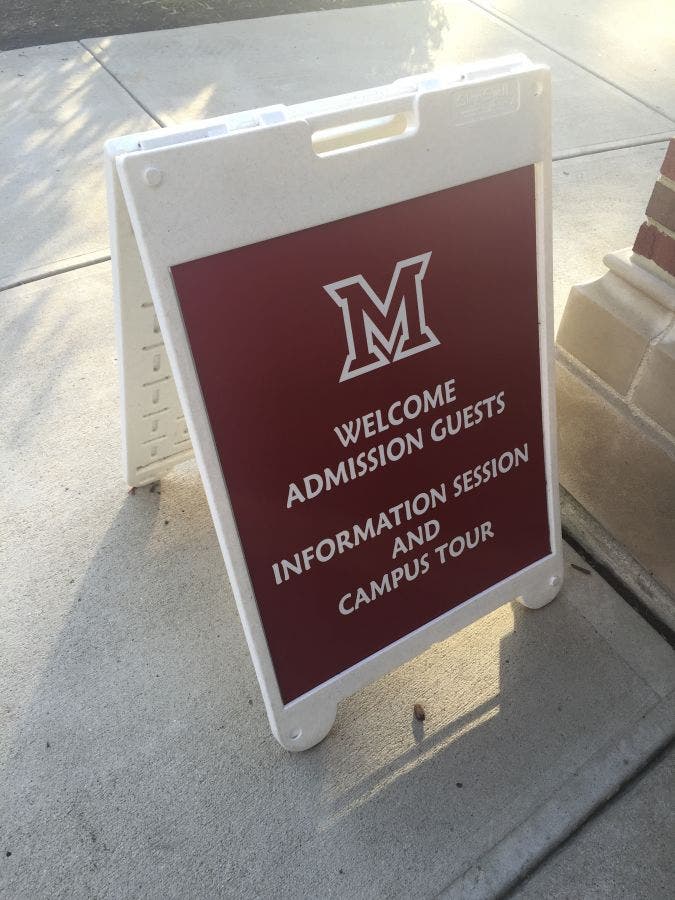
Photo: A sign outside of the Office of Admission, located in the Campus Avenue Building, welcomes prospective students to Miami. -- Photo by Mariel Padilla