Neighbor News
Miami University Holds Annual Genocide And Holocaust Education Program
Lecture and panel discussion featured Allen Wells and Robyn Steiner Lamont.

By Kelly Wagner
Miami University journalism student
Miami University is holding a series of events on campus for the annual Genocide and Holocaust Education Program. This year's theme is "Seeking Safety: Barriers, Borders, and Benevolence," with events taking place throughout the month of April.
Find out what's happening in Oxford-Miami Universityfor free with the latest updates from Patch.
The program kicked off last Wednesday with a lecture and panel discussion, "Life in the Balance: FDR, the Dominican Republic, and the Rescue of European Jews during World War II."
The event was headed by two Miami University graduates -- Allen Wells, a professor of history and Latin Studies at Bowdoin College and Robyn Steiner Lamont, of Refugee Connect.
Find out what's happening in Oxford-Miami Universityfor free with the latest updates from Patch.
Miami history professor Erik Jensen says the idea for the kick off event "was to look at refugees in both a historical and contemporary context." Wells discussed the historical side while Lamont talked about the contemporary circumstances.
Wells’s main focus was comparing and contrasting the early travel ban in the United States in the 1940s to the travel ban recently announced in January. The earlier travel ban kept Jewish refugees out of the country.
Three Different Factors
Wells says there were three factors that led to the decision to turn Jewish refugees away during WWII.
"The U.S. government, the Roosevelt Administration, and a philanthropy called the Joint Distribution Committee. It is one of the largest philanthropies in the world, then and now, which was interested in the resettlement of Jews beginning in World War I."
In the summer of 1930, refugees began pouring out of Austria and other countries in Central Europe because Germany had annexed Austria, an event called Anschluss.
Jews, in particular, felt the need to flee because they were considered enemies of the German state and were marginalized and persecuted by the Nazi government. As the Jewish refugees fled the Nazi threat, they began filling up camps which were put together very quickly in neighboring countries.
"It is interesting that they were called countries of transit because the places that they were didn’t want them," Wells says. "They wanted them to only stay for a period of time and then go transit somewhere else."
A Country Welcomes The Refugees
Though the U.S. turned away Jewish refugees, they were not completely abandoned by the Americans.
President Franklin Roosevelt called the Evian Conference in July 1938 to discuss having other countries take in the refugees.
"Many of these countries did not even want to send delegates to the conference in the first place," Wells says. "The only way Roosevelt could convince them to send delegates to the conference to talk about the problem of refugees piling up in Europe is to tell them 'You don’t have to change your immigration policy.'"
The Dominican Republic, Well says, eventually agreed to take in Jewish refugees.
However, Wells points out that the Dominican Republic dictator at the time, Rafael Trujillo, was brutally racist and wanted the Europeans there to secure the border along Haiti because he was anti-Haitian and wanted them to stop coming in.
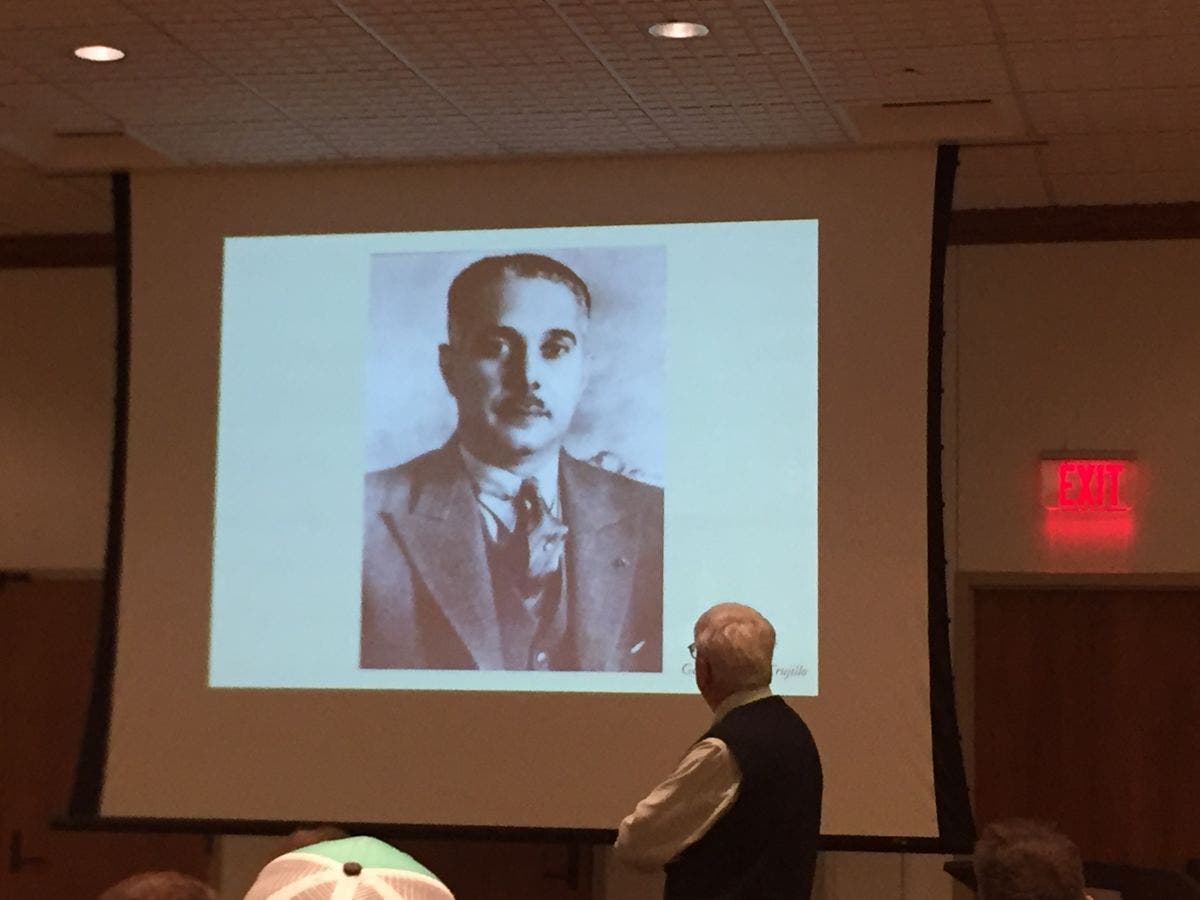
Wells wrapped up his talk by pointing out that the United States did everything in its power to not let in refugees, but to send them off to other countries.
Some worry that history is repeating itself now.
Current Crisis
Robyn Steiner Lamont, of Refugee Connect, focused her talk on her work with the program.
Lamont says that, in previous years, the United States allowed a large number of refugees to make their way to the United States.
Under President Donald Trump the number of refugees allowed into the country has fallen to 50,000.
"People are dispersed throughout the country and out of all of our states, 49 states have refugee programs," Lamont says. "Four percent came to Ohio in 2015."
Refugee Connect is a project of the Junior League of Cincinnati. Its mission is to improve the quality of life for refugees who live in Cincinnati and to provide them with a supportive community.
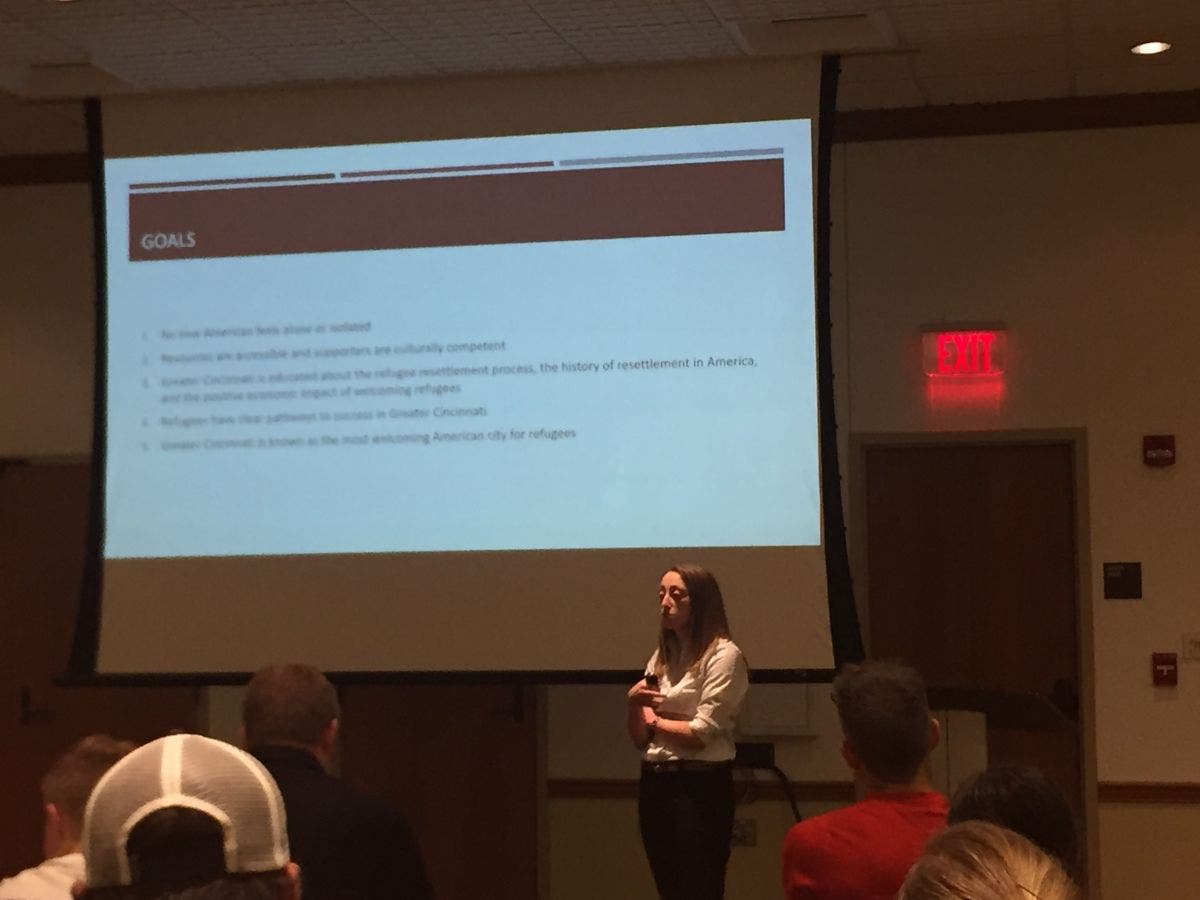
The ability to put down roots in a new community and make connections can determine how well a refugee adjusts to life in the place they've found refuge.
"Trust is super important in communities," Lamont says. "People haven't been able to trust their government, they haven't been able to trust the people around them. So, often, it is very much those relationships that are super important in someone’s ability to navigate helping something that is going to improve their situation."
Miami University senior Owen Walsh, who attended the lecture, says he's concerned that history is repeating itself when it comes to refugee policy in the United States.
"The main theme of the lecture was that modern day America isn't the first time America has been anti-refugee," he says.
To find out more about this program as well as upcoming events, visit the program's website.
Photo: From the program's website, "The annual Holocaust and Genocide Education Program schedules lectures, films, student panels, and other learning opportunities that examine historical and contemporary genocides." -- Photo by Kelly Wagner