Schools
Miami University Students Now Completing New Writing Curriculum
As part of overall Miami Plan changes, students will have to take an advanced writing course in their academic discipline instead of ENG 112


BY MARIEL PADILLA
Miami University journalism student
Starting next fall, Miami University will no longer offer ENG112 as part of university-wide curriculum changes. Once a required course for every student, the entry-level writing course will be replaced by an advanced course requirement.
Among the most-popular of the now-19 options for an advanced writing course is ENG225, Advanced Composition, geared toward non-English majors.
Find out what's happening in Oxford-Miami Universityfor free with the latest updates from Patch.
Although technically not a new class, ENG225 has seen a significant increase in enrollment since the university began requiring an advanced writing class three years ago.
“The idea of this course is to really focus on teaching students that writing differs depending on genre, context, audience and academic discipline," said Jason Palmeri, director of college composition. "Each course has a theme based on a discipline with unique insights.”
Find out what's happening in Oxford-Miami Universityfor free with the latest updates from Patch.
Instructors taught quickly
Miami currently offers about 20 sections of ENG225 each semester, and has been able to train faculty members and graduate students quickly to keep up with demand for the course, Palmeri said.
As it expands ENG225 offerings, Miami is also aiming to create new classes or adapt existing ones, across disciplines, as advanced writing options. Advanced writing can be taught by any department that proposes and wins approval of its course.
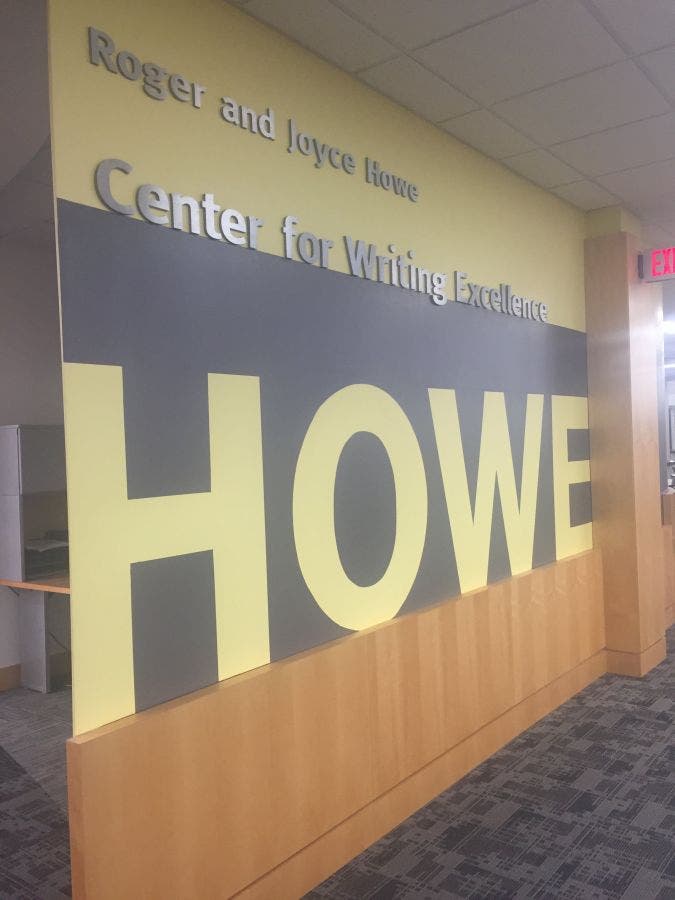
Miami’s Liberal Education Council is in charge of reviewing and approving advanced writing class proposals. Elizabeth Wardle, the new director of the Howe Center for Writing Excellence, chairs the committee.
“I’ve been really impressed because I’m new to Miami. With every department that I’ve talked to, I’ve only heard positive things about how important writing is,” said Wardle, who signed on as Howe director in July 2016 from the University of Central Florida where she taught writing and rhetoric. “They seem to really value it, and any issues that arise are purely logistical: how to staff and how to ensure there’s enough sections.”
Council picks classes
Wardle and the rest of the council, comprised of nine faculty members from across disciplines and colleges, have been assisting professors with curriculum design and reviewing the new course proposals.
Currently, the 19 approved advanced writing courses are offered by the math, psychology, teacher education, educational psychology, criminal justice studies, art and philosophy, among other departments and programs.
“I think there are a lot of benefits to this change because faculty in other disciplines can teach the kind of writing that their discipline requires,” Palmeri said. “It’s also a challenge. It’s a new thing for faculty who aren’t used to teaching writing-focused courses. They are already experienced with writing themselves, but it’s getting them to re-think how to make writing a central focus when teaching.”
Plan now 30 years old
Miami added the advanced writing requirement when it revised The Miami Plan three years ago. The plan -- one that promotes Miami's liberal education focus -- was created 30 years ago and had not been revised in decades.
“There was a sense that it was time for us to look again and make sure that [The Miami Plan] was meeting our needs,” Palmeri said.
The new writing requirement made sense because too many students were testing out of ENG111 and ENG112 due to high school AP credit, said Rich Taylor, director of liberal education.
“It needed to become an advanced writing course because we want it to be for students who have already done a good bit of college writing and now need to notch it up. We didn’t have a way to do that in the old plan,” Taylor said.
Former provost Conrado Gempesaw repeatedly said he wanted Miami to be known as a writing university, Taylor explained.
“Our real objective is that everyone graduating from Miami is as good a writer as they can be by virtue of having these courses. We’ve always been very good at taking the best students and letting them soar; we hope the baseline will be raised,” he said.
Numbers should increase
The number of advanced writing courses is expected to continue increasing as more faculty members create courses tailored to their respective disciplines.
The overview for the advanced writing requirements and instructions on how to propose a course can be found on the Howe Center for Writing Excellence website. Each proposed advanced writing course should have three main components, according to the website:
- The course should give students frequent opportunities to write and revise with ongoing instructor feedback across time.
- The course should provide multiple writing opportunities that lead to the equivalent of at least 7,500 words over the course of the semester.
- The course should include student writing as a central component.
“I think these changes are in line with Miami’s values, and I think students will like it because they’ll be taking a class that they can really see the value in,” Wardle said.
With ENG112 phased out, all students will still be required to take ENG111 along with the advanced writing course in their discipline.
All students who entered Miami in the fall of 2015 or later must take an advanced writing course. Students who entered earlier are completing the last version of the Miami Plan.
Photos: The Howe Center for Writing Excellence is on the first floor of King Library. Howe’s director Liz Wardle heads the committee in charge of approving new advanced writing course proposals. -- Courtesy of Howe Center for Writing Excellence