Schools
New President Pushes For More Diversity On Miami's Campus
As Miami recruits a more diverse student body, the issue of minority retention comes into question.



BY DARICE CHAPEL
Miami University journalism student
When Miami University inaugurated its 22nd president in October, Dr. Gregory Crawford highlighted diversity throughout the day along with his desire to see more of it on Miami’s campus.
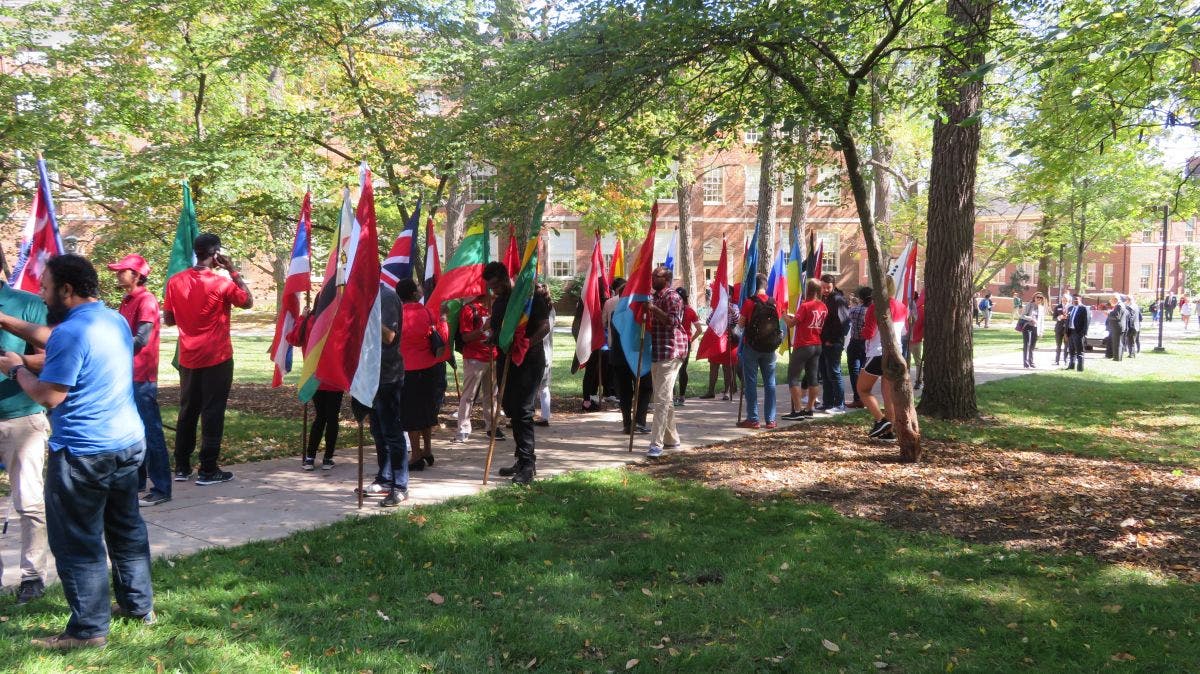
As Crawford made his way from The Hub to Millett Hall during his Inauguration March, a large group of international students followed behind him, carrying their country’s flags.
Find out what's happening in Oxford-Miami Universityfor free with the latest updates from Patch.
During the inaugural ceremony, students from different countries took the stage to recite Miami’s Code of Love & Honor in their native languages.
While speaking to the 1,000-plus people who gathered to hear his address, Crawford said called on Miami to increase its "connectivity."
Find out what's happening in Oxford-Miami Universityfor free with the latest updates from Patch.
“We must overcome division by achieving what I call 'meaningful connectivity,' finding synergy and synthesis among the vast diversity in our world to solve problems. In the coming months and years, you'll hear me talk a lot about the importance of entrepreneurial thinking, partnership, inclusivity, community, unity, and society—all of which require and advance meaningful connectivity.”
So far, advocates for campus diversity like what they are hearing from Crawford -- and are hoping he holds true to his early pledges to embrace, celebrate and increase diversity at Miami.
More than black and white
Ron Scott, Miami’s associate vice president of institutional diversity, shares Crawford’s passion for an inclusive environment. “Most people, when they hear 'diversity,' they think black and white. I care about ethnicity… It’s all ethnicities, it’s able-bodied and not, it is age, it is religion, it is place or country of origin, it is sexuality, it is orientation,” said Scott.
Scott reports directly to Crawford as a member of the President’s Cabinet and also serves as chair of the University Senate's Council on Diversity and Inclusion.
“My primary goal is to make sure that everyone who is on campus feels as if they are included," Scott said, "...included, welcome, safe, a part of the community.”
As one example, he supports Crawford's diversity goals by approving search committees for faculty hires. "We charge them with diversifying and looking for diverse candidates,” he said.
Other offices on campus, meanwhile, are likewise happy to hear Crawford focus on diversity.
What does diversity mean to you?
The term “diversity” means something different to everyone, but at the end of the day, everyone just wants to feel represented and included on campus. When asked the question, “What does diversity mean to you?,” several of Miami’s leaders in diversity and inclusion shared Scott and Crawford’s thoughts.
"I am looking forward to the dialogue that President Crawford is trying to create on Miami's campus. He's made it known that he's not afraid to have conversations that may be sensitive," said Tori Collins, president of Miami's Black Student Action Association. "He's having these discussion with groups who often feel pushed to the side."
Kelly Kimple, who became director of the Office of Diversity Affairs just this fall, likewise hopes to expand the dialogue about diversity issues.
"As we head into the 'Crawford Years,' I'm looking forward to the important message about diversity and inclusion being a topic of discussion not only by a few people on campus, but eventually engrained in the conversation of the culture of the campus," Kimple said.
Added Ronald Blassingame, a 2012 graduate who was active in diversity issues while a student: "I just hope to see a campus that really embraces all forms of diversity. I hope to see a campus where everyone feels that the university offers a space to be themselves."
One of the questions that many universities ask themselves year after year is, “How can we increase diversity on campus?” -- and Miami is no stranger to this question. Scott noted that it’s important to look at the numbers, and pay attention to the language. For example, multicultural student enrollment numbers are often separated from international student enrollment numbers, even though all of those students could be considered “minority” students.
Numbers increasing
According to the data from Miami Office of Institutional Research, 15.5 percent of the current freshman class is identified as “domestic multi-cultural," which includes black/African-American, Hispanic/Latino, Asian/Native Hawaiian/other Pacific Islander, and multi-racial. Another 8.4 percent of the freshman class are international students.
The entire Oxford undergraduate population, meanwhile, is 11 percent "domestic multi-cultural" with 13.4 percent international students.
Those populations have grown steadily over the years, according to the Institutional Research annual Fact Books. They show the non-white total of Oxford undergrads at:
- 10.3 percent in 2010.
- 8.3 percent in 2005.
- 7.6 percent in 2000.
- 6.3 percent in 1995.
| CULTURAL IDENTITY | CLASS OF 2020 | 2016-17 | 2010-11 |
| International | 8.4% | 13.4% | 3.9% |
| Black or African-American | 3.8% | 3% | 4.3% |
| Hispanic or Latino | 4.7% | 4% | 2.4% |
| Asian, Native Hawaiian or other Pacific Islander | 2.4% | 2% | 2.8% |
| Multi-Race | 4.2% | 3% | 0.8% |
| American Indian or Alaskan Native | NA | NA | 0.5% |
‘There’s definitely an increase in terms of the type of students coming to Miami," Collins acknowledged. "My freshman year, everything seemed pretty homogenous, but in my final year I am starting to notice some changes in the right direction."
Minority enrollment and retainment proves to be a challenge
Another issue that Miami faces as a predominately white public university is how to enroll and retain minority students. Scott pointed out that when state funding gets cut, tuition rates rise, and that can cause a problem getting and keeping minority students.
Collins agreed that retention is difficult. “The university is getting the students here, but once they’re here many feel as if they’re not receiving the support needed to succeed in this environment.” When asked how BSAA members are making sure their voices are heard on campus, Collins said BSAA is working with a variety of other student groups in the hopes that everyone from different backgrounds will be able to help each other.
Blassingame suggested that Miami could do more at the front end, with recruitment. “I really wish that Miami would recruit more in low-income areas in these bigger cities while also establishing relationships early on so that students in high school can grow with the university.”
Moving forward with a new president with goals for increasing diversity, Kimple is hoping for more positive change.
“I’m excited about the possibility of getting to a point where our diverse student populations will feel comfortable throughout the entire campus of Miami, and not just with the staff and spaces that have been designated to specifically assist them through their college journey," she said.
Photos: International students line up at the Seal as they prepare to carry the flags representing their respective countries during the march to Millett Hall for President Crawford's Inauguration. -- Photos by Darice Chapel