Schools
Returning To The Nest: Grads Move Back Home
Employed or not, many recent college grads find moving back home the right choice.

By Abbey Gingras
Miami University journalism student
The questions many college seniors face as they stare down graduation go something like this:
Find out what's happening in Oxford-Miami Universityfor free with the latest updates from Patch.
"What are you doing after graduation?"
"Do you have a job lined up yet?"
Find out what's happening in Oxford-Miami Universityfor free with the latest updates from Patch.
"So what are your plans for next year?"
Regardless of how it's phrased, the connotation remains the same. Do you have a job and a five year plan, or are you floundering in the final weeks of pre-adulthood? But the once-routine path of high school to college to a job, a house and marriage is not so simple these days and millennials more than ever are creating their own rules for life post-graduation.
"Everyone keeps telling me to stay at home as long as I can and not to move out or to wait until after the holidays and save up money," senior Sammie Osborne says. "But that's a long time to stay at home -- I'm feeling the pressure to move out, but I can't."
Osborne is one of the lucky ones with a job lined up after graduation. But due to the high cost of living in a city after an expensive four-year education, she's moving back home for now until she can save up some money and find an affordable apartment.
"Cincinnati isn't too expensive, but if you want to live in an area that's safe, good for young people, relatively decent -- you are looking at high rent," she says.
A Smart Financial Option
For seniors whose parents live in or near major cities like Cincinnati or Chicago, living at home is an ideal way to save money by avoiding paying for rent, utilities, and groceries.
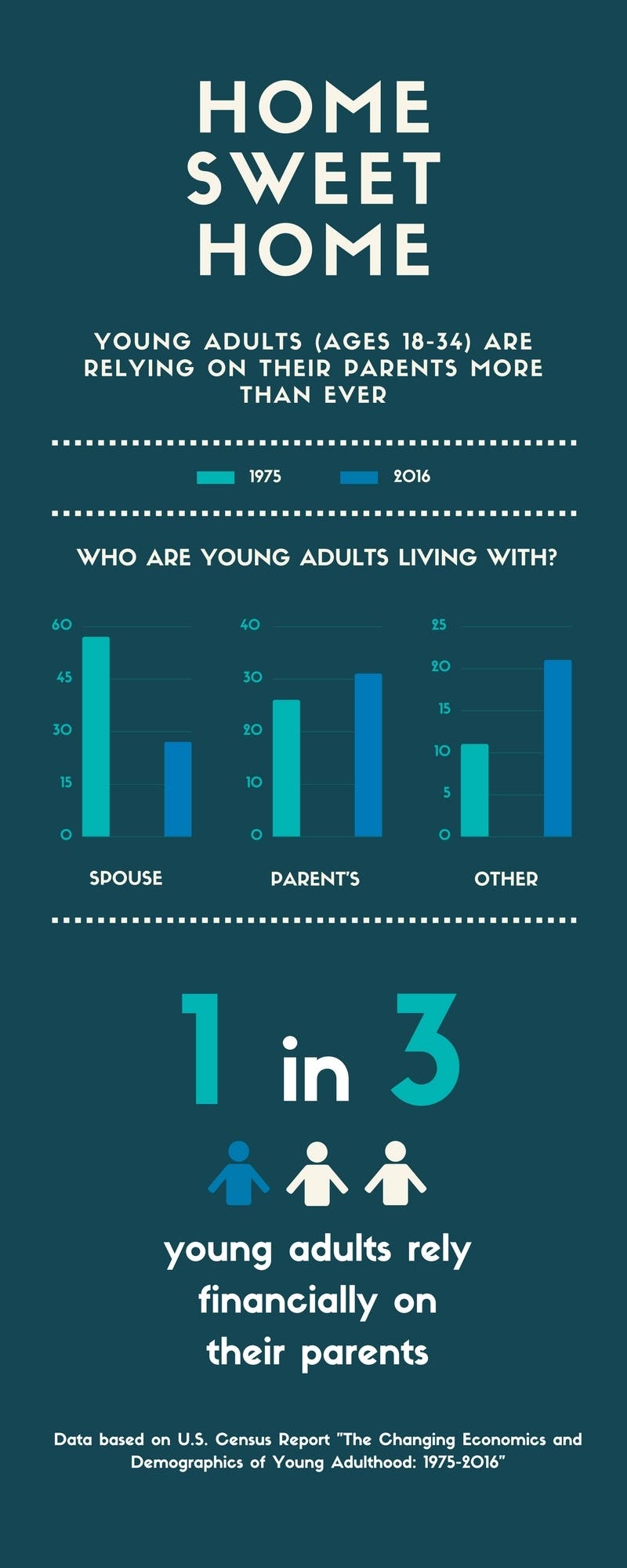
And Osborne isn't an oddity -- millennials are moving back home in droves. According to a U.S. Census report, roughly one third of 18-34-year olds live at home and rely financially on their parents.
"It's so popular to move home," Osborne says. "It's looked at as an incredible financial move that's only geared toward your success rather than something shameful. But I think you still feel somewhat ashamed."
Mary Beth Barnes, associate director for programming and advising with Miami's Center for Career Exploration and Success, says this is becoming a greater concern for students.
"Just based on my conversations with students and what their goals are, I don't think it's uncommon for students to consider moving back to their home state to get their feet planted and get support," says Barnes.
Senior Sami Chalupa is also moving back home after graduation as well, but she'll be working part-time until she can find a permanent job.
"I have not been that great about accepting graduation," Chalupa says. "I think it's expected to have a job after graduation, and being at Miami and FSB (Farmer School of Business) with so many kids having jobs is extra pressure. I definitely feel more judgment from adults than other students."
Location, Location, Location
For students from around major cities, jobs are easy to find and maintain while living at home. However, Barnes noted that not everyone is from a Chicago or New York, and not every parent can afford to support their child financially beyond college.
"It's a privilege in some ways to have a family that can support you and that you can move back in with, not all students have that," Barnes says. "Students come from all different family dynamics and personal lifestyles, so it does depend on the student. But it's a great option if you can get that support."
Chalupa, a Chicago native, has plenty of options.
"I live outside of a major metropolitan area, so I can go home and I can waitress so I can make good money, live at home, and figure it out while I'm there," she says.
Barnes recommends that new graduates reach out to Miami alumni groups to get emotional support in a new area, which she says can be just as important as financial support when entering adulthood.
New Standards For Adulthood
Millennials have changing priorities from other generations -- a majority of those surveyed by the Census defined becoming an adult as completing formal schooling or getting a full-time job, whereas generations past were more concerned with getting married and having a family.
"It's not that cookie cutter 50s society that we all grew up thinking would be our future," Osborne jokes. "Fifteen year old me would be so ashamed. She thought that at 22 I was going to move out and live in this high rise apartment with a great job and have all these friends to go out with every night, get a boyfriend and be married by 23 or 24. But now I don't even know how to live on my own, I can't remember to wash my dishes."
Although the trend to move back home is becoming more socially acceptable, many seniors' parents are eager to have their chicks leave the nest for good.
"My dad jokes that I have a limited amount of time, he likes to say 'you only have six months and then you're gone,'" Osborne laughs. "Which I don't think he means it totally, but I'm not sure. They both keep saying 'you're going to be moving out,' but I don't know when that will be."
Chalupa echoed that sentiment.
"They haven't put a time limit on me but they're looking to sell our house so once that happens I'm either going with them or moving out."
But Osborne doesn't see living at home as a problem -- and with the rising costs of education and city living a concern, she feels parents have an increased responsibility to their children.
"I think parents' responsibility has extended, especially because of this economy and the way the job market shifts so quickly," she says. "But we're all kind of navigating this together because this is not a situation you're often presented with. I'm kind of scared -- this all just hit me in the last 24 hours."
She says she feels unprepared for many of the aspects of adulthood that you don't learn about in the classroom.
"My high school had a financial literacy course that you took freshman year, but that means nothing," Osborne says. "You're not going to remember that eight years later. I want to have a class that teaches me about credit cards and investing, I need to know this kind of stuff."
Job or no job, seniors are finding the comforts of home an appealing option.
"I hope my parents will still be willing to offer me a couch to stay on once in awhile," Osborne says. "I think and I hope that I'm prepared for all of this, but the ultimate test is coming down the road."
Photo: As graduation day approaches, many seniors are feeling the pressure to get a job and be on their own. But some are finding living at home a more lucrative option. -- Photo by Abbey Gingras