Community Corner
The Wooden Spoon, Part 5
A minute and a half never seemed like a long time, until I had to give timeout to my toddler
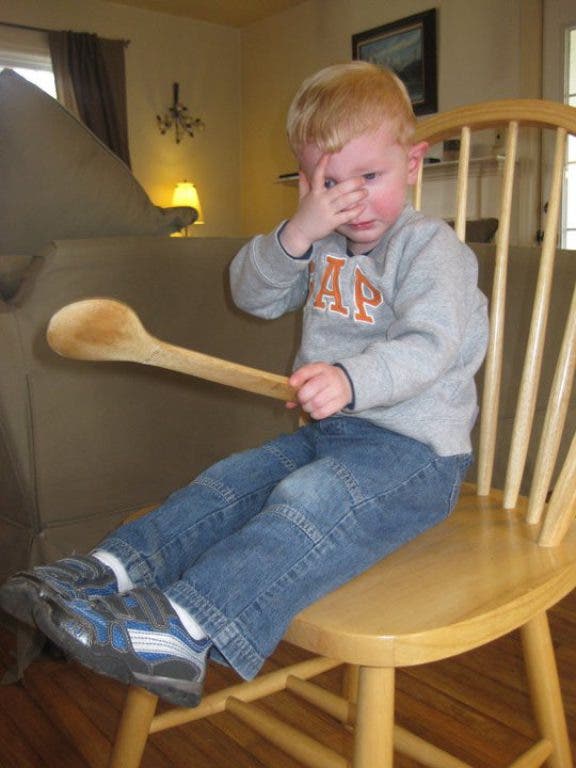
I deposited my 18-month-old in the chair and reprimanded: “This is timeout for Kody. You were not gentle with the cat when I told you to pet him nicely. You must sit until timeout is over.”
A minute and a half never seemed longer. For either of us.
Timeouts should be a minute for every year a child is old, right? That didn’t seem like much until I had to hold my hand against my son’s chest while he attempted to wriggle out of the chair.
Find out what's happening in North Cantonfor free with the latest updates from Patch.
Eventually, he learned to take it, especially when he discovered that not doing so led to further consequences.
“Timeout” is an excellent first-discipline measure (for children ages 18 months and up). It requires little thought about what a punishment will be, and “the chair” is close by and convenient, no matter where you are. It applies to any misbehavior.
Find out what's happening in North Cantonfor free with the latest updates from Patch.
It worked well for my son, a first-born, compliant “pleaser.” My daughter took her timeouts in her room, as I held the door closed and she threw a tantrum. A hand on the chest sometimes isn’t enough for the “strong-willed child.” Knowing your children and responding to them individually with what “speaks to” them is best.
Timeouts should follow misbehavior immediately, and parents should be clear about the reason for the timeout before or as the punishment is given. Even if you’re not sure your toddler understands all you’re saying, explain anyway. He probably has more receptive language than you realize, so talk away. In doing so, you’re helping to develop communicative understanding and language skills.
As children grow, timeouts give way to consequences that speak directly to the misbehavior. If, for example, your 2-year-old pulls the cat’s tail, a fitting consequence is that he is not to touch the cat for a half hour (the cat will thank you). Remind him every 10 minutes that the consequence is in effect for "X" more minutes.
Affirm your child and show him that you love him. After the half-hour period, model appropriate affection (for the cat and your son). Tell your son that you know him to be a caring boy. Remind him how his good behavior makes a difference to others (including the cat!).
Being consistent and firm in discipline measures is important because it allows children to know your expectations and limits. Affirmation as part of discipline shows a child that he is loved regardless of his behavior but that who he is and how he acts impact his world and has the potential to affect others positively. Giving children an opportunity to apologize (without forcing it) is also an important part of the process.
Of course, as parents, we’re not going to do the punishment thing right every time. What happens when parents speak before thinking and the punishment doesn’t seem to fit the misbehavior? Should you stick to illogical or overly harsh consequences? What if you get too emotionally charged and say all the wrong things?
Next week’s “Wooden-Spoon,” the second-to-last in this seven-part series, addresses these issues and more.