Community Corner
10 Questions with Laurie VanBalen of Columbus Crossing Borders
The Founder of Art Soup Studio and the Guiding Force behind the Columbus Crossing Borders Project spoke with Shaker Library's Margaret Simon

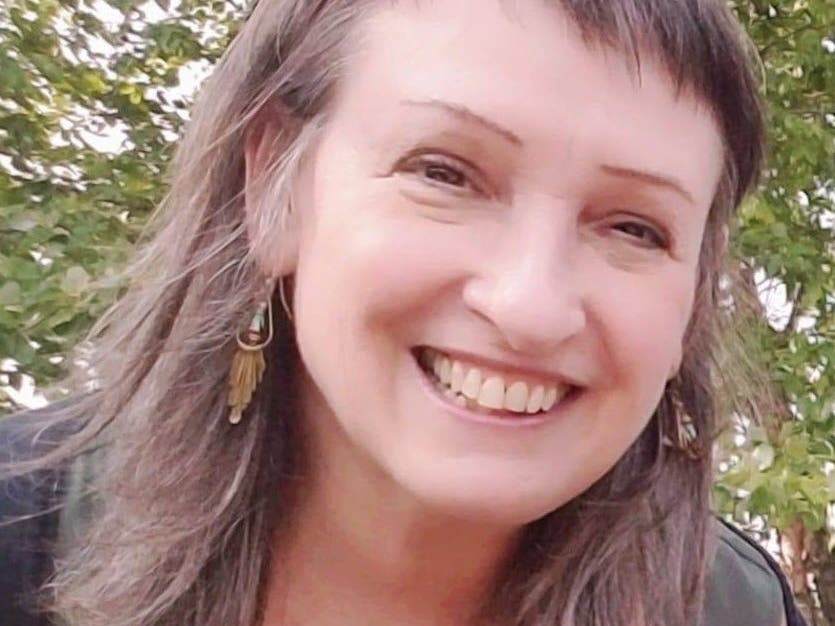
Laurie VanBalen is an energetic force for art. She lives in Pataskala, (OH) located in Licking County near Columbus. The town got its name from the Native American word for “Bright Waters” and is an appropriate springboard for the bright artist. Shaker Library's PR Manager Margaret Simon had the opportunity to talk with Laurie about the upcoming Columbus Crossing Borders exhibit.
1. What is your background?
“I studied journalism and education at Ohio University and The Ohio State University.” Originally from Columbus, I traveled extensively, then moved to the small town of Pataskala in 1988, with no intention of staying this long,” she says with a laugh.
2. How did you come to study art?
“I knew from the time I was a little girl that I wanted to be an artist. I spent many hours at my library, studying books on art. I was self-motivated and self-taught. When I was growing up, we didn’t have the opportunities that children have today through independent art study or extracurricular creative arts programs offered by schools and recreation centers.”
Find out what's happening in Shaker Heightsfor free with the latest updates from Patch.
3. What is Art Soup Studio and when did you found it?
“In 1985, I began teaching art through parks and recreation organizations, after-school workshops, and library programs. This evolved into becoming a community organizer for the arts. My goal was to create local programs that made art available and affordable for families. As I was raising my own family, I wanted to continue teaching so I opened a studio in my home—and 32 years later I’m still teaching classes to about 50 students per week. I named it Art Soup Studio because there is a sense of whimsy about it and because both art and soup are nourishing. I wanted to create a welcoming and affordable environment where artists of all ages would feel relaxed and not intimidated—a place where they could nourish their artistic spirits.”
4. In 2012, you partnered with the Pataskala Public Library and the city to create storyboards at the municipal park to promote literacy, health, and wellness. Tell us about this.
“My local library contacted me to write and illustrate a storyboard for a new park pathway. I named it, Who Played Here? It's a story about people who existed years ago where this park now stands and how their activities in the past compared to our activities in the same location today. I used sepia tones to depict past activities juxtaposed with our present-day activities, rendered in color. I made a conscious effort to produce a storyboard that would have appeal for all ages to be enjoyed as a fun family activity.”
Find out what's happening in Shaker Heightsfor free with the latest updates from Patch.
5. What inspired the Columbus Crossing Borders Project?
“About four years ago, I began noticing an uptick in anti-immigration sentiment and racism in our country. Groups of people were being marginalized with a lot of fear-mongering and 'othering' feeding into it. I felt compelled to do something, thinking that somehow each of us can help make a difference. There are millions of people fleeing war, terror, and persecution. I thought that perhaps I could use my art in a way that would invite the public to think critically and compassionately about forced migration and about how these courageous people should not be marginalized and mistreated.”
6. Where did you find the artists for the project?
“I invited 34 artists to participate, and except for three artists, all are from central Ohio. The collection of their work is deliberately diverse. Reflecting on stories shared by refugees, these artists were each asked to create paintings that would 'cross borders' into their neighboring paintings. In other words, the artists could not be territorial with their work, needing to find commonality and ways to work within each other's space.”
7. Are any of the artists immigrants?
“I am often asked this question, and yes, a few are, such as James Makuac, who is one of the Lost Boys of Sudan.”
8. How did the project grow?
“Originally, I thought we would display in local galleries for just a few months in central Ohio. Then we began receiving invitations to exhibit in venues in other cities. Before long, we were touring, and my husband decided to leave his full-time job to help me co-direct this project and manage the busy tour schedule. Columbus Crossing Borders visits galleries, schools, libraries, community centers, and places of worship. We are frequently invited to meet with students to share conversations and work on projects that address issues of inclusion, equality, and social justice. We talk about ways that we can all uphold human rights. The creative arts provide us with a powerful and practical voice for having these discussions and for sharing these actions.”
9. How did the documentary film come to be?
“I got a call from Joe Recchie, who is a board member for the Community Refugee and Immigration Services (CRIS), an independent, nonprofit organization serving the refugee and immigrant populations in Central Ohio. Joe asked how we might escalate our project to highlight an understanding of refugees. My quick answer was that we could create a film. And the amazing thing is we did create a beautiful documentary film, called 'Breathe Free.' Directed by filmmaker Doug Swift, this film spotlights the stories shared by refugees and the art exhibit inspired by those stories. Swift interviewed local refugees and intermixed their stories with footage of artists as they created paintings for our exhibit. The movie premiered at the Drexel Theater in Bexley (OH) to a sold-out audience and is now being shown in theatres, schools, and public venues throughout the US.”
10. What’s next?
“On Saturday, April 4 from 6 to 10 pm there will be a Columbus Crossing Borders Art Auction & Gala at The Columbus Cultural Arts Center to Benefit CRIS. During this time, all 34 original paintings from The Columbus Crossing Borders Project will be sold by auction with proceeds going to Community Refugee & Immigration Services.
To continue The Columbus Crossing Borders (CCB) advocacy after the original paintings have been sold, we made canvas print reproductions of all 34 paintings in the CCB art exhibit. These canvas print reproductions are not for sale but were created solely to continue the CCB exhibits in galleries, schools, museums, and public centers. In this way, we can continue our mission for refugee support, justice, and human rights.
________________________________________
The Columbus Crossing Borders Project will be on display on the second floor of Shaker Library, 16500 Van Aken Boulevard, on Wednesday, February 26 through Thursday, February 27. The Documentary, “Breathe Free” will be shown at 6:30 pm and 7:30 pm Wednesday, February 26 and 7:30 pm Thursday, February 27.
This inspiring exhibit has been made possible through the collaboration of the City of Shaker Heights, the Shaker Schools, and the Shaker Library.