Politics & Government
Solon Schools Fight For Funding In Columbus
As part of the Coalition of Fiscal Fairness, school district representatives argued that loss of TPP funding could cripple some districts.


COLUMBUS, OH - Public school districts in Ohio are worried they may be losing a crucial source of funding. Representatives of the Coalition of Fiscal Fairness (CFFO) submitted testimony on March 7 to the Ohio House Finance Subcommittee on Primary and Secondary Education, arguing that the repeal of the Tangible Personal Property (TPP) tax reimbursement funding would negatively impact Ohio school districts.
These arguments come despite claims from the state that primary and secondary education has never been better funded in the state and significant investment will continue. According to the Ohio Department of Education's website, "The governor’s budget recommendations for FY18 and FY19 continues this record investment. Resources allocated primary and secondary education total $10.51 billion in FY18 and $10.62 billion in FY19; increasing $199.8 million during the biennium."
And school districts originally supported the repeal of TPP. They believed that the presence of the tax would harm Ohio's business climate and thus voiced support for its repeal. The TPP taxed railroad property, general business, telephone and telecommunications. The Columbus Dispatch pointed out in 2015 that legislators dubbed it the "one of the worst taxes in Ohio."
Find out what's happening in Solonfor free with the latest updates from Patch.
However, the loss of the TPP has proven to be a significant blow to districts large and small, the CFFO says. That's partly because many districts rely heavily on TPP funding. When the tax was originally repealed in 2005, $1.2 billion was being sent to school districts throughout the state via TPP funding, the Dispatch reports. Governor John Kasich has gradually cut into that funding source, until now when many districts believe all TPP funding will be phased out, without any reimbursement from the state.
“It is because of this long-standing reliance on these significant TPP dollars that we remain highly involved with any tax policy or funding change as there are many Ohio public school districts that will be financially exposed if the TPP supplement and reimbursement funding is eliminated through the current TPP phase-out,” Tim Pickana, CFFO president and school treasurer in Solon, one of the state’s highly impacted TPP districts, told Ohio lawmakers during the hearing on March 7. “We want to continue the dialogue toward a more comprehensive and long-term solution to the TPP issue that preserves necessary and once local resources for schools and students.”
Find out what's happening in Solonfor free with the latest updates from Patch.
Pickana argued during his testimony that there appears to be an assumption of wealth among districts that will be impacted by the loss of TPP funding. Not so, he argues.
“As you are aware, this is an extremely complex issue and remains at times a daunting task when educating and informing our local taxpayers of potential revenue loss based on several state biennium budget tax and school funding formula changes over the last few years,” Pickana said. “We are here today to help you understand the financial dilemma our members face. We respectfully ask you to not assume all of the high TPP loss districts are ‘wealthy’ and will simply have to absorb the loss. A significant cross-section of Ohio districts will be impacted, so when considering the impact of TPP reductions, it is important to note that many districts will not be able to make enough reductions and/or pass additional millage great enough to maintain the integrity and quality of the education services they are providing to students.”
Ultimately what that means is that loss of TPP reimbursement funding could result in more layoffs and more levies in districts across the state. It could also disproportionately impact districts that came to rely heavily on TPP funding and reimbursement. The Dispatch also pointed out that 139 school districts counted 20 percent of their tax base from TPP funding.
Pickana has been railing against the total loss of TPP-related funds for years now. In 2012, he appeared before the Ohio House and asked, "What about those [districts] that stand to lose over 10%, 20% or even 30% of their total operating revenue, in addition to the 4% already lost over the past two years, as a result of the TPP loss alone?"
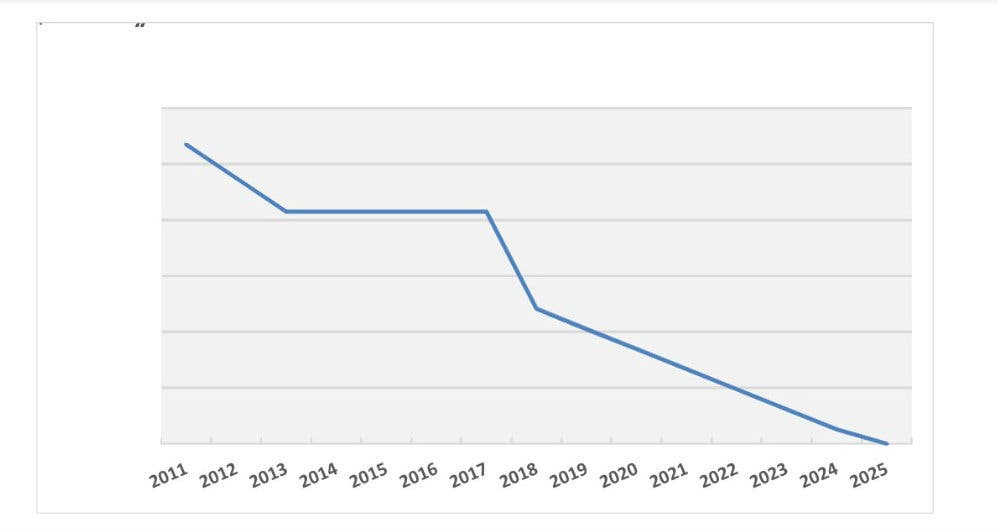
A spokesperson for the Solon Schools said the school system was collecting $10.7 million in TPP funding in 2011. The district is now collecting $8.3 million, and fears it will lose an additional $3.5 million on July 1 if current laws are not altered.
The spokesperson also sent along the following chart which demonstrates the Solon School district's losses up to this point and project losses out to 2025.
In 2015, Mason City School District Treasurer Ronda Johnson argued that taxpayers in her district were already supporting their school system at a capacity that may have exceeded their means. "Our current effective millage rate for residential/agricultural is 47.11 - 30% above the state average. Our taxpayers are contributing to our schools – arguably more than their capacity to do so." Mason is located in southwest Ohio and has a population of 30,712 according to the last US Census.
Johnson concluded her impassioned argument by noting that the district had absorbed a $7 million loss due to the phasing out of TPP funding and TPP reimbursement funding. She pleaded that her district could not lose another $7 million and taxpayers would not support another tax increase.
The budget process is still in a formative phase and changes will be made before Kasich's latest budget proposal comes into law. Pickana believes there's reason for hope.
“The legislative budget process is just getting started and we were encouraged by the committee members’ interest and engagement during the hearing,” Pickana said in an emailed statement. “They showed a keen understanding of this complicated issue and the dialogue was robust. There is no easy one-size-fits-all answer, but TPP districts statewide are engaged in the process to help develop a workable solution that doesn’t harm communities and students.”
Photo from Pixabay
Get more local news delivered straight to your inbox. Sign up for free Patch newsletters and alerts.