Arts & Entertainment
Residents of Stow's 'Little Ireland' Live on in Name Today
Display at Stow-Munroe Falls Public Library pays homage to early settlers of Irish heritage.
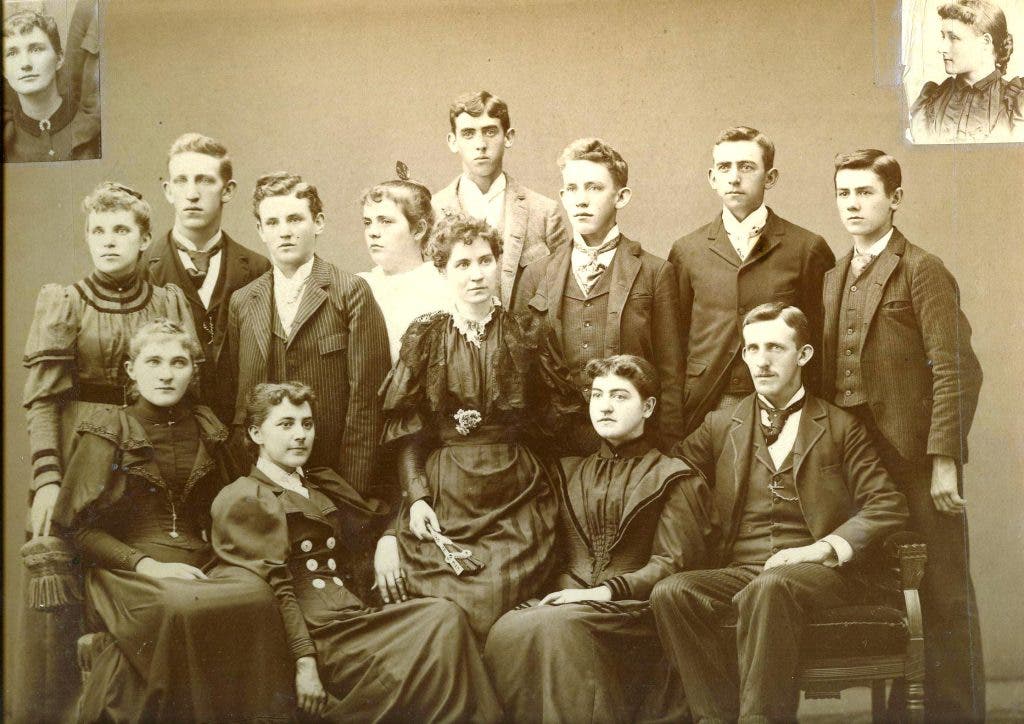


The names McCauley, Darrow, Galloway, Ritchie, Hibbard and Seasons are all known by modern-day Stow residents as city streets. But in early 1800s Stow Township, those were the last names of prominent families who were part of the “Little Ireland” neighborhood.
“Little Ireland” – situated around the intersection of what is now Hudson Drive and McCauley Roads – was settled by Irish Protestant farmers in the early 1800s.
In honor of St. Patrick’s Day, local history librarian Beth Daugherty has created a display paying homage to the city’s Irish settlers that runs through the end of March at .
Find out what's happening in Stowfor free with the latest updates from Patch.
Although the name was considered unofficial, the area in the northwest corner of Stow Township and southwest corner of Hudson Township was known as “Little Ireland” for nearly 100 years, according to Fred Long, author of “Stories From a Stow Native.”
That book is but one source Daugherty used to cull information for the library display. Another great source, she said, is the scrapbook entitled “Metz Womens’ Missionary Society, 1834-1977,” which was compiled by Sarah Hibbard Amlung and presented to the library in 1977.
Find out what's happening in Stowfor free with the latest updates from Patch.
Following is the information written by Daugherty for the library’s display:
Stow’s “Little Ireland”
The portion of land that included “Little Ireland” surrounded McCauley Road, west of Hudson Drive. Many Irish immigrants settled within this five-mile radius on the border of Stow and Hudson Townships in the early and mid-1800s.
Although many Irish came to Ohio to work on the canals, the families that settled in this area were Protestant farmers. They bought large tracts of land from the Connecticut Land Company and established their farms.
Familiar family names included O’Brien, McCauley, Ritchie, Hibbard, Sadler, Galloway, Calkins, Darrow and Steel.
“Little Ireland” had its own church, school and post office, with the Cleveland, Akron and Columbus railroad running through the heart of it in the 1880s. Because the railroad conductors felt that the name “Little Ireland” was too long to call out when going through the town, the name was shortened in 1886 to “Metz.”
O’Brien Cemetery
O’Brien Cemetery is located on the west side of Hudson Drive in Hudson Township, just north of the Stow border. Although the cemetery wasn’t officially platted until 1880, most of the burials took place much earlier. The first known burial was of Mary Deacon on August 15, 1806. Mary was born in 1766 and died at age 40.
The original platting for the cemetery took place on June 19, 1880. The plat was recorded in Summit County by Edward McCauley acting for the O’Brien Cemetery Association as a section of land in Great Lot 14 of Hudson Township.
The O’Brien Cemetery Association was formed to take care of the cemetery.
United Presbyterian Church
The United Presbyterian Church was first organized in “Little Ireland” in 1833 at the home of William Galloway on Allen Road in Stow Township’s northwest corner.
A church building was erected in 1834 at the corner of what is now McCauley Road and Hudson Drive. Another church building was put up in 1849, and still another in 1906.
Because of declining attendance, Metz United Presbyterian Church was disbanded and the building sold to North Hill United Presbyterian Church in the early 1920s. The Metz Missionary Society, however, continued to serve the community until 1977.
Metz Women’s Missionary Society
Metz Women’s Missionary Society was first organized in 1885 by Mrs. William Wallace, wife of the minister of the United Presbyterian Church. The purpose of the society was to support the community in various ways. The society continued until 1977.
The members by that time were not all Presbyterian, but of many denominations. They met the first Thursday of every month in members’ homes.
Several projects in the 1970s were financial support for an exchange student, eyeglasses, toys for Summit County Children’s Home, layettes for newborns and holiday food baskets for the needy.
Metz Post Office
The first postmaster of Metz was Edwin Seasons, who served from 1886 until 1893, when Harry Darrow became postmaster. The small, one-room post office was located in his home. It had only a desk and a cubbyhole for mail. Residents from nearby communities came by wagon and horseback to pick up their mail.
Darrow remained the Metz postmaster for 42 years, at one time having 50 post office box patrons. When Harry retired in 1935, Herbert Sadler became postmaster.
Sadler recalled hanging his mail bag on an outside post, waiting for the train to come by and hook it, while incoming mail was thrown out of the car. The train stop for the post office was alongside the northwest side of the tracks on McCauley Road.
Due to a decline in patrons, the Metz Post Office was discontinued in 1936 and the mail was then handled through the .