Community Corner
Eagle Creek Fire: Air Quality Improving; Fire 5 Percent Contained
The Columbia River and Union Pacific Railroad have been re-opened to some commercial traffic, though most closures and evacuations remain.


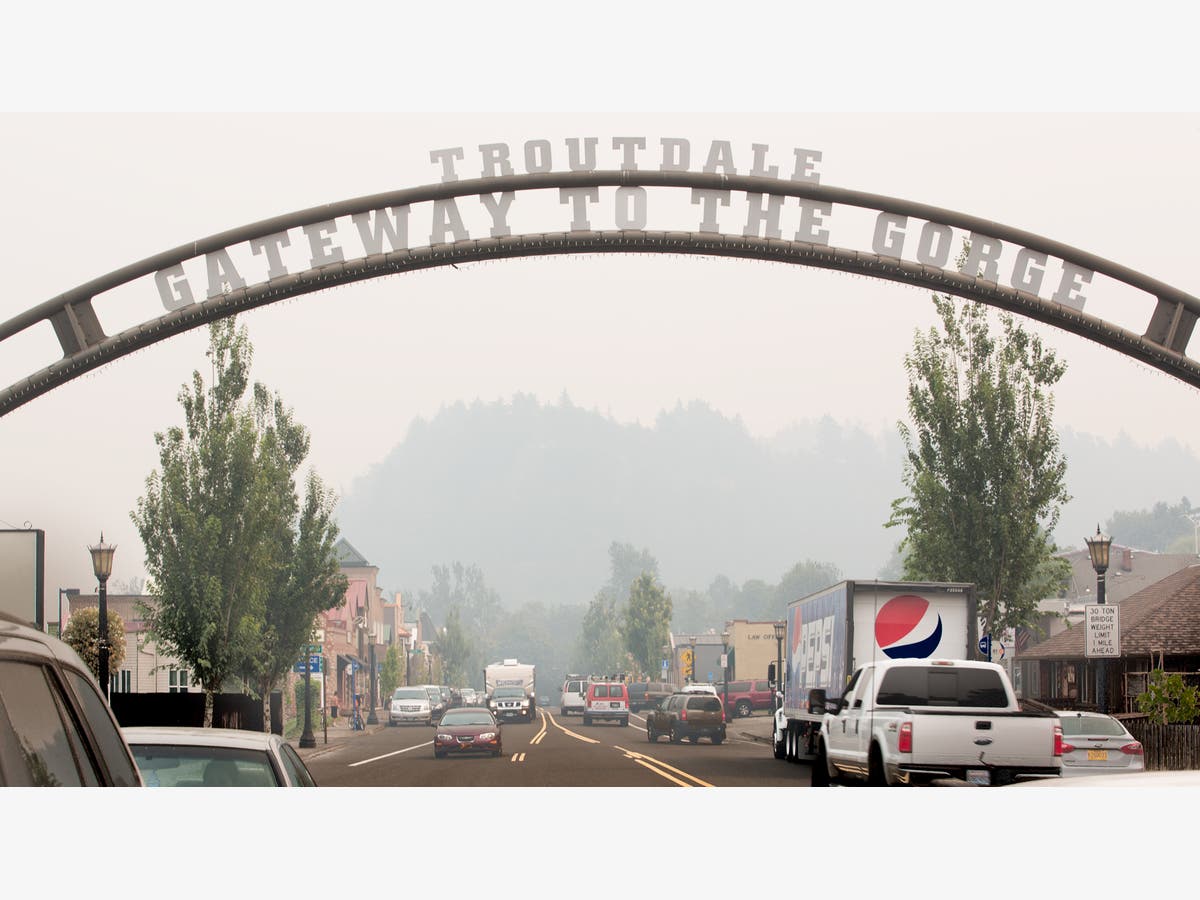


CASCADE LOCKS, OR — With the Eagle Creek Fire now 5 percent contained around its perimeter, the view through the smoke is improving across the Portland metro region Thursday.
Firefighters in the Columbia River Gorge working the combined Eagle Creek and Indian Creek fires now total more than 900 people, and their efforts are apparently paying off.
Find out what's happening in Portlandfor free with the latest updates from Patch.
Since it started Sept. 2, after a 15-year-old boy from Vancouver, Washington, allegedly threw fireworks into the Eagle Creek Canyon, the Eagle Creek Fire has burned more than 31,000 acres between Cascade Locks and Corbett — a span of about 25 miles. Overnight from Tuesday to Wednesday, fire officials say the Eagle Creek Fire merged with the 1,000-acre Indian Creek Fire, which had been burning just to the south since July 4.
The Oregon Fire Marshall's office on Thursday offered a few details about the headway firefighters are making in the gorge:
Find out what's happening in Portlandfor free with the latest updates from Patch.
Progress on the Eagle Creek Fire continued overnight (Wednesday to Thursday). There was some fire growth as firefighters worked to secure fire lines near Cascade Locks and Bridal Veil by conducting burnout operations.
Westerly winds picked up in the evening causing a few small spot fires around 8:00 p.m. These were within secondary fire lines, but kept firefighters busy making sure they were completely out. Most divisions of the fire had low-intensity fire activity, and firefighters continued to prepare and protect homes.
Around 4:00 a.m. (Sept. 7), with winds again gusting to 15 miles per hour, a small spot fire ignited near a cell tower. This spot was also within contingency lines and firefighters worked to keep the fire within those lines. With the fire now 5 percent contained, some key transportation functions of the Gorge are beginning to return.
Union Pacific Railroad trains safely traversed the fire area Wednesday, fire officials said, and the U.S. Coast Guard — which on Wednesday closed all Columbia River traffic — re-opened the river temporarily to night-time commercial boat traffic.
Most of the previously issued closures and evacuation notices remain in place, however, in the interest of public safety.
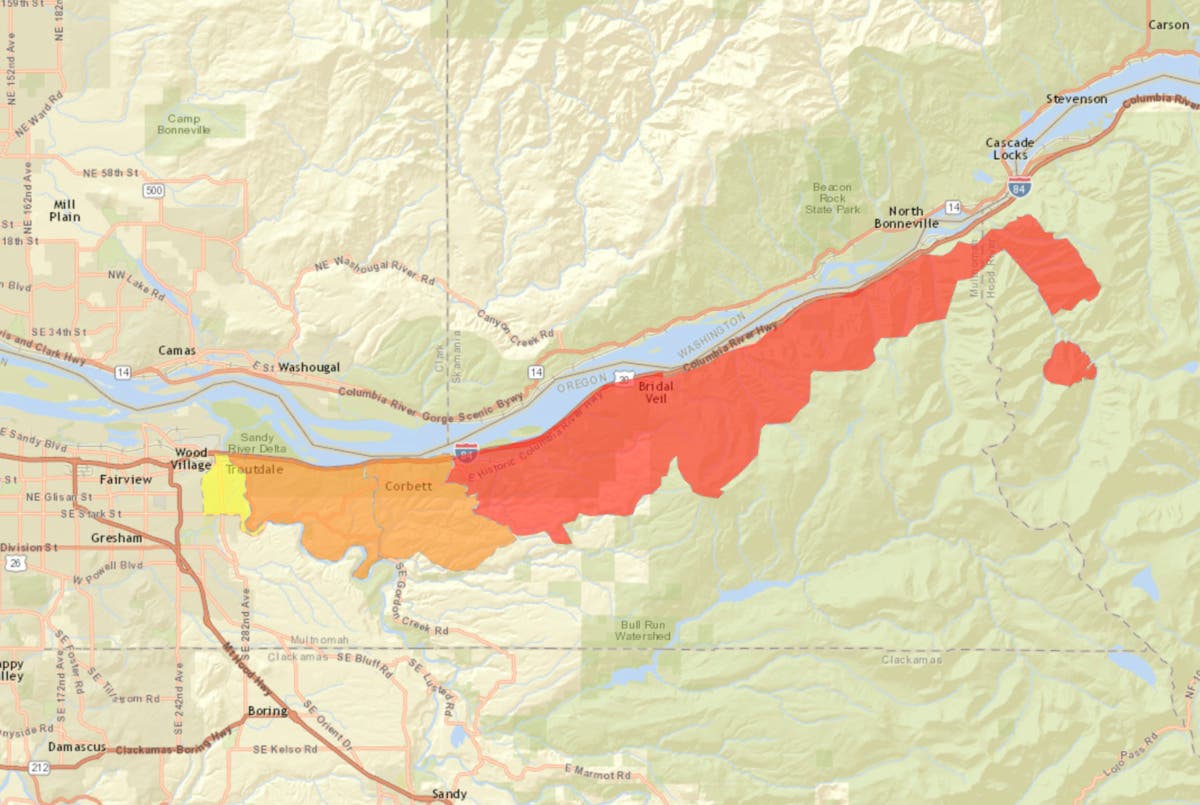
- Interstate-84 is closed from exit 17 in Troutdale to roughly 2 miles west of Hood River, around milepost 62.
- Multnomah County officials have issued Level 3 (meaning leave right now) evacuations for Larch Mountain and the communities of Bridal Veil, Corbett (east of the 38700 block of Columbia River Highway), Dodson, Latourell and Warrendale.
- Corbett/Springdale, west of 38700 block of the Columbia River Highway to the Sandy River, has been set at Level 2 (meaning be ready to evacuate at a moment's notice).
- Troutdale east of Southeast 257th Avenue and north of Southeast Stark Street has been given Level 1 evacuation orders (meaning get your stuff ready to go).
- Mt. Hood Community College, 3691 N.E. 17th Drive, has been turned into an evacuation shelter for the time being with help from the Red Cross, officials said. Anyone evacuating due to fire is encouraged to go there. However, the campus is close to the newly established evacuation area in Troutdale. What that will mean going forward is unknown at this time.
- Hood River County officials raised all previously issued Level 1 notices in Cascade Locks to Level 2. This reportedly includes all areas north of Wa Na Pa to the Columbia River and on the east end of Hood River north of I-84 to the river, as well as Forest Lane and intersecting roads, running east to Government Cove.
- Level 3 evacuations are in place for all residents south of I 84 in the Cascade Locks. An evacuation shelter is located at the Skamania County Fairgrounds in Stevenson, Washington, across the Columbia River.
Fire authorities said the Oregon Department of Transportation estimates about 2,000 trees will need to be felled before I-84 can be safely re-opened. Officials also advise residents that more smoke could be seen coming from the gorge Thursday as firefighters perform burnout operations to secure fire lines near the Bridge of the Gods.
Private property, historical structures, state parks, and the Bull Run watershed remain focused priorities for protection, fire authorities said, though local officials are working with the U.S. Forest Service on how best to manage those efforts.
Since the fire began, Portland area residents have taken to social media to critique Gov. Kate Brown's decision not to use supertankers to fight the fire by dropping heavy retardant across the Eagle Creek Fire area. On Thursday, the Portland Water Bureau explained that holding off on using retardant is in the interest of protecting the Bull Run watershed from contamination.
Currently, the Eagle Creek Fire is burning just north of the watershed area.
On Monday, Sept. 4, U.S. Forest Service notified the Portland Water Bureau that, if necessary, it would use fire retardant to fight the Eagle Creek fire. Under the terms of the Fire Protection Plan, U.S. Forest Service is authorized to use retardant under certain circumstances. To date, fire retardant has not been used to combat this fire, including in the watershed.
"The U.S. Forest Service will not normally make retardant drops in avoidance area," said Oregon State Fire Marshal and Portland Fire & Rescue representative Lt. Damon Simmons. "Number one on the list of avoidance areas is watersheds. Retardant is not dropped on watersheds unless there is an imminent threat to life."
The Portland Water Bureau has taken steps to prepare for the possible use of retardant by the U.S. Forest Service. The bureau continues to monitor water quality to ensure that the water remains safe. The U.S. Forest Service Fire Protection Plan and national policy prohibit the use of retardant near waterways.
While it's unlikely any retardant will be used, bureau officials said, "The most likely impact would be an increase in the water's nutrient load and a potential increase in algae production."
According to the American Red Cross, roughly 225 people have been evacuated from their homes in the affected areas. About 75 people are currently housed at the Mt. Hood Community College evacuation shelter, 26000 S.E. Stark St. in Gresham, while around 150 people are at the Skamania County Fairgrounds Hedgewald Center shelter at 710 S.W. Rock Creek Dr. in Stevenson, Washington — across the Columbia River from Cascade Locks.
To check the status of the Eagle Creek fire, or any other fire in Oregon and Washington, click the map below:
Photos Courtesy: Multnomah County
Get more local news delivered straight to your inbox. Sign up for free Patch newsletters and alerts.