Politics & Government
About Portland: Mayor Hales has a Plan to Fight the Zombie Houses
At a City Council work session on Tuesday, the Mayor will unveil a multi-pronged plan. One of his aides gave us a preview.


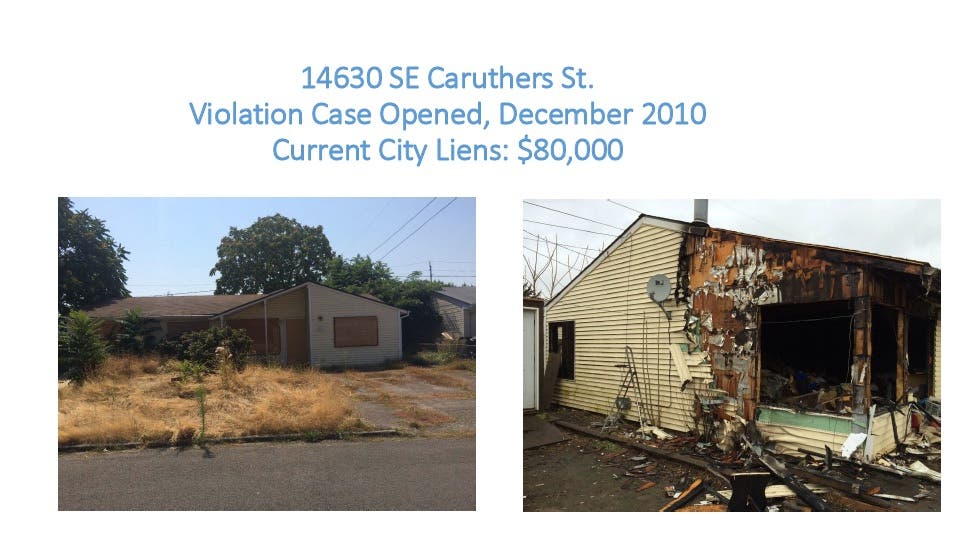

They are throughout Portland, sitting there eating away at neighborhoods.
They attract drug dealers and other criminal activity.
They are called zombie homes because their owners have abandoned them, the banks don’t know what to do with them and the city isn’t sure what can be done.
Find out what's happening in Portlandfor free with the latest updates from Patch.
To make matters worse, the city is not even sure how many there are.
“There could be dozens, there could be hundreds,” says Chad Stover, the Livability Project Manager for Mayor Charlie Hales.
Find out what's happening in Portlandfor free with the latest updates from Patch.
For months Stover has been working on this problem.
“Since I joined the Mayor’s office three years ago, this has been something I’ve been aware of,” he says. “People have called up saying, there’s this house that has been overrun by drug dealers, can you do something?
Stover says the city’s efforts picked up when the mayor went on a ride-along with police officers who took him to some of these "zombie homes" and showed him the ripple affect they have on the community.
The mayor saw first hand what happens when squatters move in, when drug dealers move in.
On Tuesday morning, Portland will take a major step toward fixing the problem when the City Council has a work session addressing the issue.
“This is a complex problem that we need to address,” says Stover. “We’re going to lay out what we know, what tools we have, what tools we need.
“The first step is to make sure that people understand the extent of the problem.”
From there, Stover says, the mayor will lead his colleagues on the council through the tools that the city already has its disposal - tools that in some cases, the city has not used for decades.
“The city has a foreclosure office that is part of the auditor’s office,” Stover says. “The thing is, they have not actually foreclosed on a home since the early 1970s.
“It has been forty-something years.”
Stover says it’s not that the foreclosure office hasn’t been doing anything.
“More often than not, when they are able to find an owner, they work to get them on a payment plan,” Stover says. “Sometimes that it is a good answer but we need to be open to the possibility that sometimes the owner can’t be found or sometimes the owner has moved away and foreclosure is the best answer.”
What the city has found that in some cases owners have received a notice of default and just packed up and moved away.
“These are people who don’t necessarily want anything to do with the property anymore,” Stover says, “They can be told that squatters have moved in, there is drug activity, would they please move to have these people trespassed so that the police could then move in and arrest them.
“And they say no.”
So, one of the steps that the mayor will propose to his colleagues is a revamping the foreclosure office, moving it away from payment plans to foreclosing on homes for the first time in forty years.
A second strategy the mayor will propose, says Stover, is a receivership program.
“This would involve finding a nonprofit that would be able to take homes, get them back into shape and put them out there for affordable housing,” Stover says.
“We’ve already had preliminary talks with some groups.”
Stover cautions that this has been an approach that has been considered and rejected before but the timing may not have been right.
“We are at a point where the housing market is hotter than ever and we are also having a real crisis when it comes to affordable housing,” he says. “Now is the time when we must take action.”
A third action that the mayor will propose, according to Stover, is a “distressed properties unit or team that will meet regularly with all the involved players at the table working together.”
Stover says that will include people from the police bureau, the city attorney’s office, andthe foreclosure office.
“The goal would be to have a team working together, making sure that the information was being shared and working to bring the banks to the table,” he says. “Too often, to the banks these homes are little more than numbers on an Excel spreadsheet. We need to work to show the banks that these are homes in communities and when they sit empty and when the squatters come in, there is a ripple effect.
“But before we can do that, we need to our own house in order.”
Stover says that the city needs to do a better job communicating with itself.
“The city knows where these houses are,” he says. “But the information is here, the information is there. One possibility is to create a registry, to say these are the houses, these are the banks, this is the last information we have on the owners.
“The fact is that we have the tools, we have the knowledge. We just have to make sure that we have the desire to make it happen.”
Get more local news delivered straight to your inbox. Sign up for free Patch newsletters and alerts.