Schools
About Portland: Students Want to Talk About the N-Word
One of Grant Magazine's editors-in-chief talks about the need to talk. HS publication just honored AGAIN as one of the best in the country.



Blu Midyett says that growing up as a racially-mixed person left him confused about his identity.
Looking at the work he has done as one of the six editors-in-chief of Grant Magazine in Portland should erase all doubt.
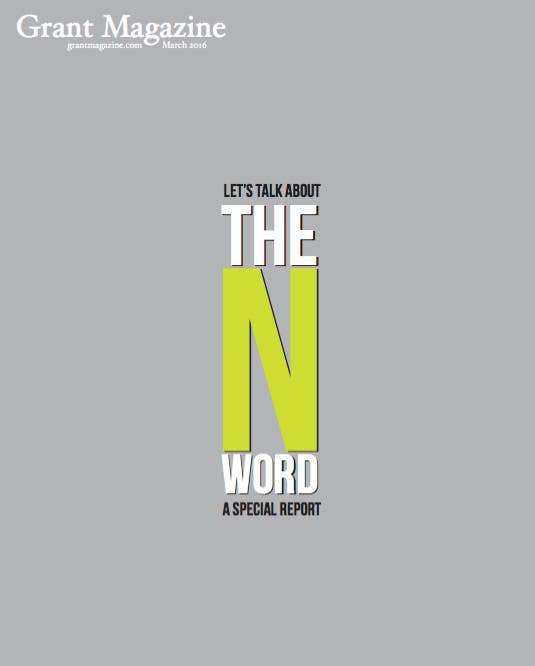
For anyone looking to believe that journalism has a future, that teenagers should be listened to, just head online to Grant Magazine’s special issue titled "Let’s Talk about the N-Word."
Find out what's happening in Portlandfor free with the latest updates from Patch.
Grant Magazine is the monthly magazine put together by students at Grant High School.
The students recently returned from a trip to Columbia University in New York where, for the third straight year, they received the Gold Crown Award as one of top high school journalism publications in the country.
Find out what's happening in Portlandfor free with the latest updates from Patch.
There’s a lot of talk that this issue, which came out the week before they left for New York, will send them back next year for a fourth Gold Crown.
"Talking about it is is the first step," Midyett tells Patch of the N-word. "It’s not just the word, but the attitude toward it and what is it about our culture that allows people to think it is okay."
Midyett tells Patch the issue was borne from two incidents in the past year at the school - both of which involved white students using the word.
"It’s an ugly word with ugly connotations," he says. "Yet, we have somehow reached a point where to certain groups of people, it has lost its power.
"They feel that they can use it as part of their daily conversation. That the hatred associated with it doesn’t apply to them."
Midyett says it is part of a larger problem in Portland.
"It’s a city where people pride themselves on how progressive they are," he says. "The problem is that because people can go through much of their lives without interacting with people who are different, they don’t realize what they are missing.
"They may not realize the offensiveness of things they are saying because they have not been in a situation where that is the case."
Midyett and his fellow students recognize that the Portland that they have grown up in is one that has struggled with racial issues, one where sometimes those issues are avoided.
In the issue, Midyett - who talks about the difficulty in confronting the issue - writes of his first experience with the word.
“As a child, I was goofy and loved to joke with my mom, often calling her silly names and laughing along with her.
"Nigger," I said to her, giggling along as I continued to laugh about whatever else I was saying. I watched as my mother’s always-optimistic face turned to a cold, stern gaze.
“Do you know what that word means?” she asked, incredulously. I had no idea. I had heard it in movies and on television, but had no idea of the weight that it held. My mom gathered herself, spoke softly and made her point. "You can’t say that," she said.
His mother explained the history of the word.
"It shocked me that one word could carry so much weight," he writes.
At Grant, and in Portland, the shock was how casually the word is used.
“White students use it, African-American students use it,” he says. “That anyone uses it is the problem.”
Midyett says at the beginning of the year, the magazine staff knew this was an issue they wanted to address.
“We knew that it couldn't just be us writing about what had happened at the school, us telling people it was wrong to use the word,” he says. “We charted out ways to address it, the history of the word, the context.
“We wanted to give people a complete picture. Help them understand.”
It was a big step for Midyett, a junior.
"I only joined the magazine last year as a sophomore reporter," he says. "I wasn't really sure what I was getting into. It was a new experience."
A couple of stories in, though, and he was hitting his stride. By the end of the year, he had impressed enough that he was asked to be editor-in-chief this year.
"I knew I would be stepping into big shoes."
Previous classes have tackled topics ranging from drug abuse to homophobia to bullying.
The issue includes interviews with historians, teachers, and civil rights activists.
Midyett and his colleagues realized that the power of the issue had to come from people’s stories, that journalism at its best is finding stories of people that illustrate larger issues.
"It’s so important for people to look at the world they live in" he says.
Midyett, who can see himself becoming a reporter, does not think he will necessarily study journalism.
"It’s important to do it, to experience the world," he says. "Studying things, that kind of experience will help me be better."
In the meantime, Midyett - who also runs track and cross country and plays bass and keyboards in a band - hopes people spend a little time looking at the magazine.
"I know it’s not going to change the world," he says. "But if it gets people talking, that is a very important first step."
Get more local news delivered straight to your inbox. Sign up for free Patch newsletters and alerts.