Community Corner
Portland Train Attack Raises Concerns For 'City Of Ostriches'
It was an attack that showed the best and worst of Portland. The aftermath has been no less complicated.


It is 4:19 in the afternoon on Friday, May 26. At the Rose Quarter stop of the Green Line MAX train in Portland, Oregon, 35-year-old Jeremy Christian gets on the train headed toward Clackamas Town Center.
Christian is unemployed, drinks weekly. He is very angry. Shouting. It is the third time — at least — in 24 hours that he has been on the MAX, creating a disturbance.
Find out what's happening in Portlandfor free with the latest updates from Patch.
On Thursday, he had been on the train by the Rose Quarter station. Christian threw a bottle of Gatorade at a woman who is black. She then sprayed him with mace. Later that evening, he was back on the MAX.
And again, Christian was very angry, complaining about Muslims, Christians and Jews. He said they should burn at the stake and spoke about wanting to stab people. The driver was informed, but it appears that police were not informed until later.
Find out what's happening in Portlandfor free with the latest updates from Patch.
Christian is a homeless man with a record on two levels: a criminal record documented in the court system and a record of anger documented on his Facebook page and in interactions with people.
CRIMINAL RECORD AND FACEBOOK RANTS
Almost exactly 15 years earlier, on May 12, 2002, Christian had walked into Ed's Market at North Lombardi Street and Vancouver Avenue. It was just after 10 p.m. The store had just closed.
Christian was wearing a black ski mask with openings for the eyes, nose and mouth. He handcuffed the owner, stole cash and cigarettes, and fled. As he ran, an officer chasing him fired shots, striking Christian in the cheek.
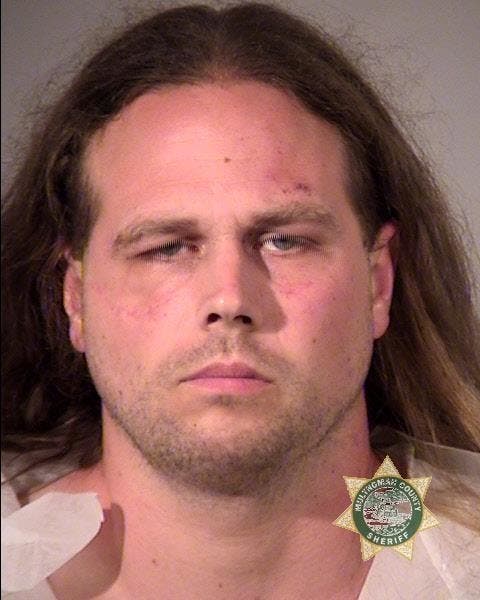
That landed Christian in state prison for seven and a half years. There would be another seven months in federal prison after a conviction for being a felon in possession of a gun.
People who know him say that while in prison he changed into someone complicated, with anger issues that are not easily characterized.
His Facebook posts make that clear.
He professes admiration for both Bernie Sanders and Donald Trump.
"If Donald Trump is the Next Hitler then I am joining his SS to put an end to Monotheist Question," he wrote. "All Zionist Jews, All Christians who do not follow Christ's teaching of Love, Charity, and Forgiveness And All Jihadi Muslims are going to Madagascar or the Ovens/FEMA Camps!!!"
And in April, he received a lot of attention for his appearance at a "March for Free Speech" on 82nd Avenue in Portland.
At that march, Mike Bivins, a reporter who often writes for Willamette Week, captured him on video and in photos spewing racial epithets and giving the Nazi salute.
Man engaging in hate speech and giving the Nazi salute at the end of the #Portland free speech march pic.twitter.com/8QRmmvTDAf
— Mike Bivins (@itsmikebivins) April 29, 2017
Christian would later share the video on his own page, writing, "Nobody likes me."
Already on the train are two black teenagers — 16-year-old Destinee Mangum and her 17-year-old friend who does not want her name releasd.. The friend, who is Muslim, is wearing a hijab, a traditional headdress.
The teens, students at David Douglas High School, are excited because they are headed to Clackamas Town Center. Neither gets to go all that often.
Destinee, who with her mother had been homeless for a period of time, has been on the MAX maybe three times.
Soon after getting on the train, Christian spots the girls, moves toward them and starts shouting at them.
"Get the f--- out!" he yells. "Pay taxes. Go home, we need Americans here! I don't care if you are ISIS. Fuck Saudi Arabia! Free speech or die!”
Christian, from time to time, interrupts his invective to take a sip of sangria from a bladder-style container.
A man named Shawn Forde, hearing Christian speak of "decapitating heads," approaches him, trying to get him to calm down. He is not successful.
Destinee and her friend are getting nervous and move to the back of the train.
HISTORY TO CONSIDER
"Portland is complicated," says Randy Blazak, a sociologist at the University of Oregon who lives in and studies the city. "It has the reputation of being a progressive utopia, which doesn't take into account that the state was founded as a whites-only state.
"It is a place that still embodies the pioneer spirit that settled the area. And that means that we have a lot of extremism on both sides of the political spectrum. People so far from the center that they are sometimes hard to differentiate."
The dichotomy goes back to 1844 when the territorial government passed two laws: one banning slavery and the other requiring all black people to leave the territory.
The ban was reaffirmed in 1849 and, again, in 1857 when Oregon adopted its constitution.
Things didn't necessarily get better as the state lagged behind the rest of the country in adopting protections for people of color.
While enough states passed the 14th Amendment – the equal protection clause and the 15th Amendment – giving black people the right to vote – to make them part of the Constitution, Oregon didn't pass them until 1973 and 1959, respectively.
Oregon's slowness to follow the rest of the country helped give rise to the Ku Klux Klan in Oregon.
"The area had the largest per-capita Klan presence in the country," Blazak says, referring to the 1920s.
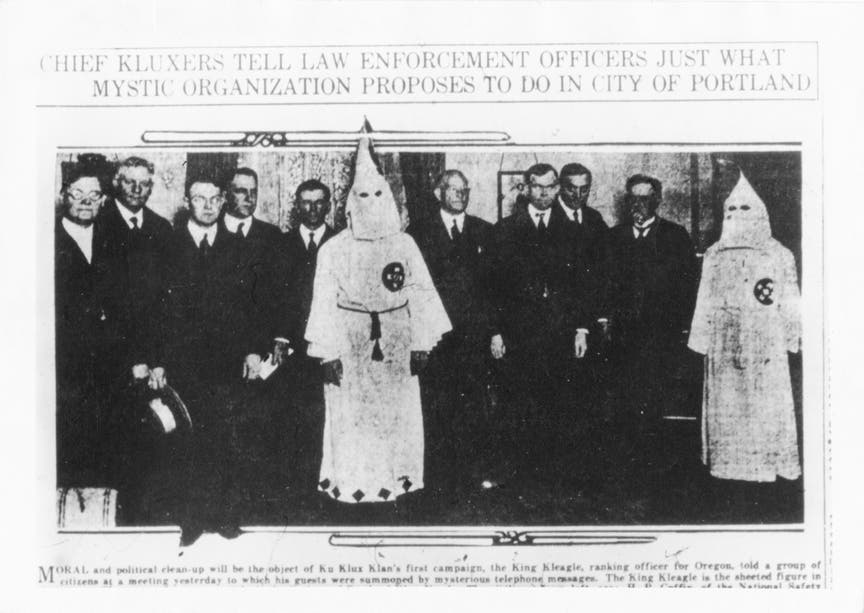
It was prominent enough that in 1921, the Portland Telegram ran a photo of Klan leaders meeting with city leaders including Mayor George Baker, Chief of Police L.V. Jenkins and the District Attorney, W.H. Evans.
VANPORT AND ALBINA
"Portland has a history that most people don't want to confront," says Cameron Whitten, a local activist. "And I'm not saying that things aren't better, but that is not the same as saying they are good.
"A white person can make a political statement and get praised for it, while a black person here can make the same point and be criticized for bringing politics into the conversation."
Even after the Klan started to dissipate in Portland, things didn't get much better for the black population.
In the 1940s, with the mayor of Portland saying that blacks were not welcome in the city, Vanport - a city between Vancouver and Portland (hence, Van-Port) sprung up, with affordable housing that attracted many black families.
There were discussions about tearing down Vanport, discussions only ended after the Columbia flooded the area, killing more than one dozen people and forcing thousands from their homes.
Many black families moved into the neighborhood of Albina, only to find themselves targeted once again. A decades-long gentrification move by the city which started in the 1950s— something the city would later apologize for in 2015 — drove as many as 10,00 from their homes.
A report by Portland State University in 2014 found the city had become significantly whiter. The report found that while in 2000 there were 10 census tracts in Albina that were majority black, 10 years later, there were none after nearly 10,000 people of color (mostly black) moved out.
The report rattles off disturbing statistics about some of the obstacles facing black residents of Portland:
- Family income is less than half of white families;
- nearly 50 percent of children live in poverty compared to 13 percent of white children;
- unemployment is nearly double;
- fewer than one-third of black families own their own homes compared to 60 percent of white households;
- more than half of black teens do not complete high school, compared to just over one-third of white students.
"The city needs to do a better job of standing up and calling things as they are," says Whitten, adding that too often Portland acts as a city of ostriches, people burying their heads rather than doing what's right.
It's an uphill battle made more difficult by the fact that the city is becoming whiter.
A study by Portland State University last year found that while 38 percent of the people who had moved to Portland from 2012 through 2014 were people of color, the city's black population actually fell by 800 residents to 65,778..
"At this point we can only speculate on the reasons African Americans seem to be leaving the Portland area, such as the gentrification of North and Northeast Portland," says Jason Jurjevich, assistant director of Portland State University’s Population Research Center. “But evidence suggesting that African Americans are opting for other large metros merits a closer look:
And if getting white people to experience black culture is a struggle, so is exposing them to Islam.
There are approximately 50,000 Muslims in the city.
On the train, Christian turns his attention to Taliesin Namkai-Meche, a 23-year-old recent graduate of Reed College with a degree in economics. Namkai-Meche, a white man who grew up in Ashland, is on his way home from his job as an environmental consultant.
His girlfriend, with whom he is thinking of starting a family, is waiting for him at the home they had recently bought.
Christian gets in Namkai-Meche's face.
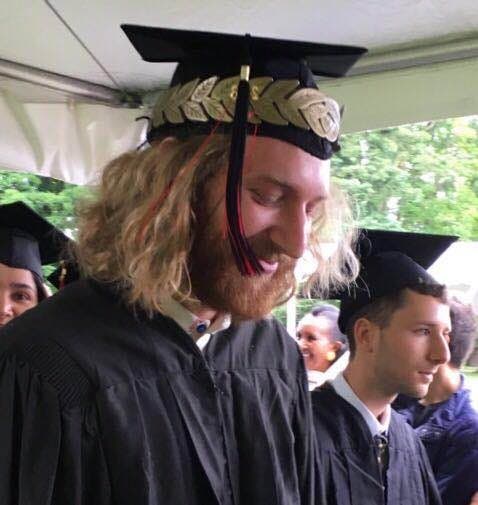
"Oh, do something, bitch!" Christian yells.
Micah Fletcher, who is white and a 21-year-old student at Portland State University, then stands up next to Namkai-Meche.
As a student at Madison High School four years earlier, Fletcher won the citywide Verselandia poetry slam competition. One of his poems was about the discrimination faced by Muslims.
"Do something!" Christian yells as he shoves Fletcher in the chest.
Christian can be seen on video taking a folded knife out of his pocket, concealing the knife in his right hand.
Fletcher pushes Christian away, causing him to stumble.
"Hit me again," Christian tells him as Fletcher keeps telling him to get off the MAX.
NOT THE FIRST TIME, NOT THE LAST TIME
"For all of the area's reputation for being progressive, there is also a history of violent white supremacism that has to be taken into account," says Portland Police Chief Michael Marshman.
It is a violence that erupts more than anyone would like to consider.
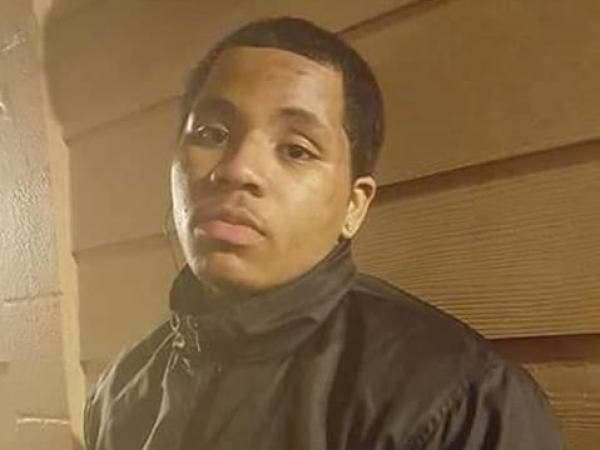
It was just last September that Larnell Bruce, a teenager from Vancouver, was run down and killed by a couple of suspected white supremacists from Gresham. The man in the car, who is charged with a hate crime, was found to have tattoos indicating he's a member of European Kindred, an Oregon prison-based white supremacist group.
Two weeks after Bruce was killed, Patricia Garner and her daughter, Foia Frazier, were loading three boys - ages 12, 11, and 7, into a van when a man on a bicycle rode by, yelling racial epithets. He sprayed the children with pepper spray.
One of the children was burned so badly that doctors had to sedate him as they washed the spray from him.
Perhaps the most notorious racial crime in Oregon's modern history took place on Nov. 13, 1988, when Mulugeta Seraw, an Ethiopian graduate student in Portland, was beaten to death by three neo-Nazi skinheads with a baseball bat.
It led to a wrongful death lawsuit filed by the Southern Poverty Law Center against the White Aryan Resistance movement. The suit bankrupted the movement but did not stop white supremacists from heading to Oregon.
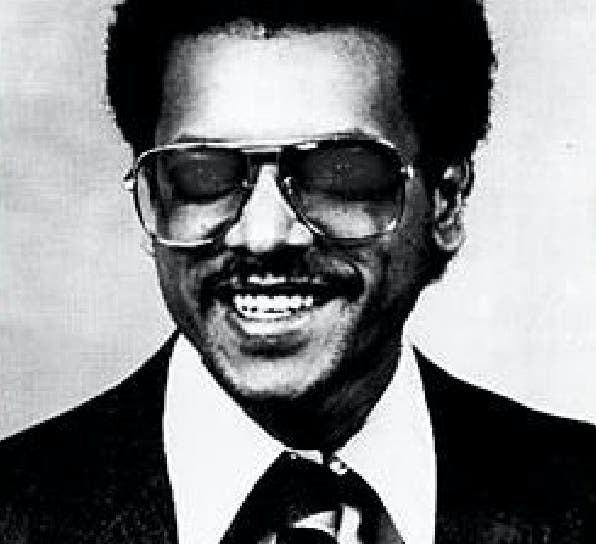
"Society moves slowly," Blazak says. "There certainly has been progress. There certainly needs to be more."
Earlier this year, the Southern Poverty Law Center released a report about hate incidents in the first ten days after the presidential election.
Oregon, they found, had 33 incidents. It was the highest total per capita in the country.
Christian swings his right hand, stabbing Fletcher in the neck. He turns and stabs Namkai-Meche in the neck as well. He then stabs Namkai-Meche in the neck a second time.
Ricky Best, a 23-year-veteran of the Army, is on his way home to his wife and four children from his job as a supervisor for the city of Portland's Bureau of Development Services.
Best, who ran for Clackamas County Commission in 2014, has a reputation of generally being happy, someone who looks out for others.
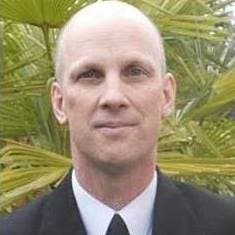
Eric Best – his 19-year-old son and the oldest of three sons and a daughter; the others aged 17, 15, and 12 — once asked his dad why he always smiles.
"Hey, I'm not getting shot at, why shouldn't I smile?" he replied.
On the train, Best moves toward Christian. Still on the attack, Christian shoves him into Namkai-Meche who was sitting in a seat, trying to stop the bleeding from his neck.
He stabs Best. He stabs Namkai-Meche again.
The train pulls into the Hollywood Transit Center. Three bodies are on the floor of the train, Christian is at the door, ready to flee. People are panicked, desperate to get out.
Destinee and her friend run into the 24-Hour Fitness across from the station.. They are so frightened, they leave their stuff. They find a payphone and, through tears, tell Destinee's mother what happened.
Fletcher, clutching his neck in an effort to stop the bleeding, makes it off the train where TriMet passengers run to his aid.
Christian flees, brandishing the knife at passengers who approach him. He also grabs a bag that had been dropped by Destinee's friend and throws it onto the freeway.
As Best lays dying, a 51-year-old homeless man named George Tschaggeny with a criminal record including 25 arrests, mostly for traffic violations, approaches him. He removes Best’s wedding ring and takes his backpack and runs.
Christian, meanwhile, flees toward Providence Hospital. He is cornered by cops and throws his knife at an officer's car. He is allowed to surrender.
His knife is recovered.
He is placed in the car, which has audio and video recording devices.
"I just stabbed a bunch of motherf------ in their neck," he says. "Just a punk ass bunch of motherf------. Get stabbed in your neck if you hate free speech."
Christian then spits.
"I'm tearing out motherf-----'s throats, you think I give a f--- who I spit on?" he says. "I can die in prison a happy man.
"I'm happy now. I can rest easy.”
Namkai-Meche is tended to by several people. One of them is Rachel Macy, a student at Portland Community College.
As he taken away on a stretcher, he gives Macy a message for everyone.
"Tell everyone on this train that I love them," he says.
He is pronounced dead at the hospital.
Best is pronounced dead at the scene.
Fletcher is the only one to survive. His doctors tell him that the injury missed being fatal by millimeters.
THE AFTERMATH
For Nick Zukin, the situation was simple.
Zukin, one of the city's better known restaurateurs, looked at what happened: two men had been killed. A third was in critical condition. The three were all stabbed defending two black teens targeted by a man on the MAX. They were heroes and someone should do something to help their families.
"They had done what I’d like to think I would have done in the same circumstances," Zukin says. "After some minutes or hours of shock, tears and a feeling of powerlessness, I looked to the internet for a way to help."
Zukin says he was looking for a campaign to which he could donate.
"I thought maybe someone would have set up a giving campaign in their names," he says. "I didn’t find one. I suggested on social media that perhaps someone should make one."
Zukin says that someone suggested that he, as a business owner — he helped start Kenny and Zuke's, he owns Mi Mero Mole, people know him — should start one.
He did.
Zukin set up a GoFundMe page to help the families of the two people had been murdered. When the third, surviving hero was identified, he added that person to the fundraiser.
It didn't take long for the fundraiser to become a flashpoint.
Whitten, the local activist, went on social media says to say he would never give to Zukin's campaign because not only did he neglect the two black teens when he set up the fundraiser, he also refused to make any changes to it when Whitten approached him.
Zukin says that's not true, adding that by the time he learned the identity of one, there was a fundraiser set up for her and her friend and he did not want to compete.
Whitten doesn't buy it and points to a bigger problem.
"No one wants to take away from what these three men did," he tells Patch. "But if it hadn't been for these two girls being targeted not because of who they were but because of what they look like, there never would have been an issue.
"And these girls are going to spend the rest of their lives thinking they were responsible for the deaths of two men."
Whitten looks at the number of people who have contributed to the funds for the three white men and how much has been raised compared to the numbers for the funds for the teens.
"We have to be willing to confront racism wherever it exists," he says. "It is not taking away from the heroism of the men to say that we also have to remember the teens as well."
Gregory McKelvey, another local activist, says that it's time for white Portland to stand up and do something, beyond just going to a vigil, donating to a fund.
"Join an organization, get involved, engage in individual reparations, shop at black-owned businesses," he says.
Sarah Adams, a 28-year-old from North Portland, looks at what's happened and hopes that things can get better.
"I'm white, and I can say without question that we — Portland — needs to work harder to make sure that people of color are treated better here," she says. "We need to do more to combat day-to-day discrimination because it leads to hatred."
Chief of Police Michael Marshman agrees.
"Do I know that the outpouring this week, the vigils, the demonstrations, the words written and said, are going to make a difference?" he says. "No. But, I know this. That we're talking is a starting point. That's a good thing."
Blazak says that he is hopeful that Portland is moving in the right direction.
"It's important to remember that the city that led to Christian, that led to some people hating is also the same city that led to three people standing up, giving their lives for people they did not know. It is the city that led to thousands donating to help the families of those heroes."
Fletcher says the important thing is not to focus on him and the others who stood up to Christian but on what led up to them having to step in — it's about the girls.
"Yes, two men died," Fletcher says on Facebook just hours before he meets Destinee, one of the teens that he had stood up for. "Yes, I was injured. Yes, yes of course we need to support all three of us. But we need to remember this is about those little girls."
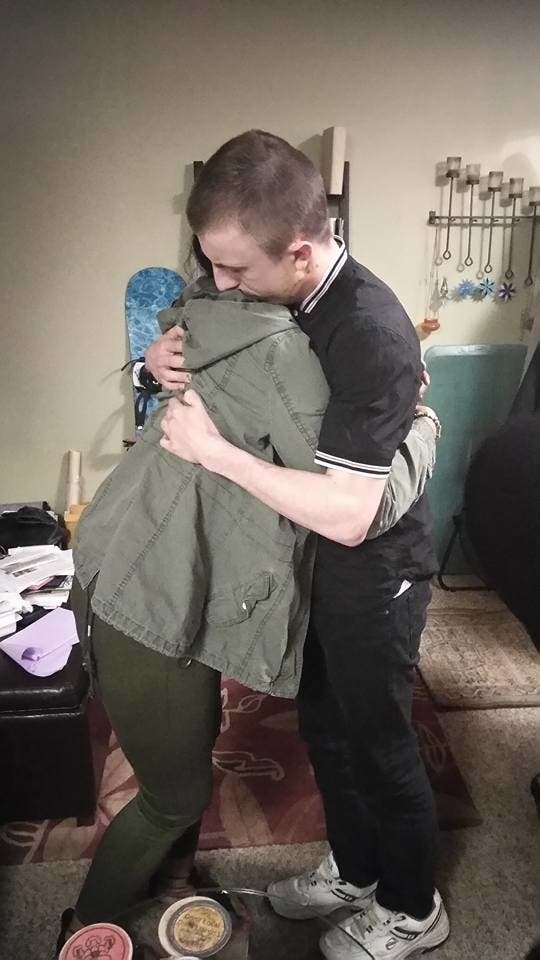
Photo of Larnell Bruce courtesy Gresham Police Department
Photo of Klan leaders with city of Portland leaders courtesy Oregon Historical Society
File photo of Mulugeta Seraw
Photo of Rick Best courtesy Clackamas County
Photo of Christian Multnomah County Sheriff's Office
Get more local news delivered straight to your inbox. Sign up for free Patch newsletters and alerts.