Arts & Entertainment
Tricks of the Bunny’s Trade
How to dye Easter eggs with a creative, affordable twist

Dying Easter eggs is a great tradition. Stores in Abington, from grocery stores to craft stores, carry dying kits designed to help at-home crafters make the perfect, colorful seasonal treat.
But it doesn’t take a kit to dye pretty eggs.
Instead of spending extra money on a kit, make dye at home with food coloring, vinegar and water. Start with the basic, primary colors that dye comes in. Use red, blue and yellow to begin. Then mix the colors to make secondary color dyes, including blue plus red to make purple, and yellow plus blue to make green.
Find out what's happening in Abingtonfor free with the latest updates from Patch.
Start with the basics and dye a few solid eggs to get a feel for how long to leave eggs in the dye. The longer eggs sit in the dye, the darker and richer they become. To make pastel eggs, remove eggs quickly, but to make vibrant, jewel-toned eggs, let them sit in the dye for up to 20 minutes.
With any type of dying eggs, be careful to not touch the surface too much. Oils from hands or lotions can smudge on the egg’s shell and block dye from absorbing. Some crafters choose to wear rubber gloves to prevent smudges, although they can be cumbersome. Rubber gloves can also muddy up an egg if colors stick to it.
Find out what's happening in Abingtonfor free with the latest updates from Patch.
Once a good time frame has been established, consider embellishments. There are lots of different household items lying around that can make eggs different. Create a pattern on an egg, either while it’s white before it goes in the dye, or after it’s been dye one color, before going into the next color.
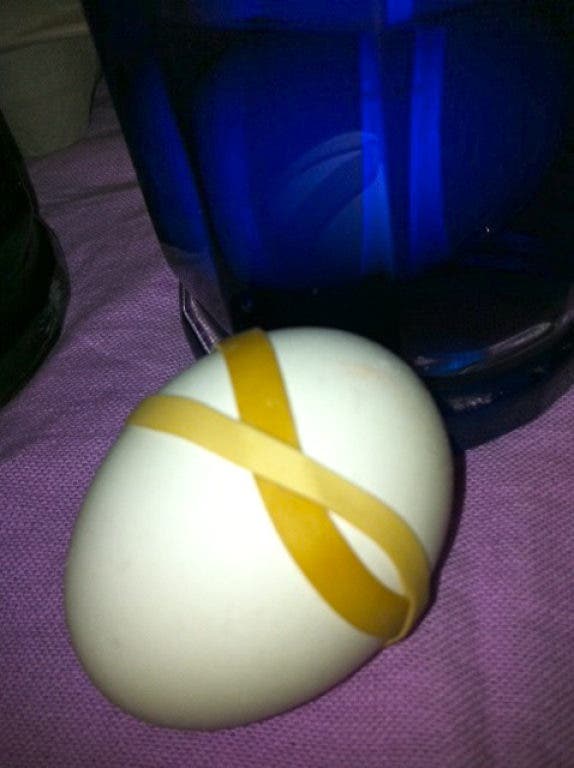
Wrapping large rubber bands around an egg will make rings. Use several different widths of rubber bands lying in the kitchen junk drawer to give the egg more patterns. Remove one rubber band after the egg comes out of its first color batch. Dip the egg into a different color and watch as different color rings appear on the egg.
If rubber bands aren’t readily available, use clear adhesive tape for the same effect. Put some tape vertically and some horizontally to create a plaid look.
Use crayons to draw patterns, write names or decorate an egg. The wax in a crayon prevents the dye from adhering to the egg. Again, color on the egg while it’s white then dye it for its first color. Remove it, let it dry, then add another patter or different name or phrase, such as “Happy Easter” and dip it into another color. Repeat until a rainbow effect comes out of the dye.
Be warned though — dipping an egg into every color available can result in a brown egg.
Stickers are an easy way to create a pattern onto eggs because they come in symmetrical, standard sizes. If drawing on an egg is intimidating or too advance for the age group, simply adhere stickers to an egg and dye. Once the stickers are removed, the shape is left in the original color. Use small, round stickers to create a polka dot egg, or find flowers, bunnies or lambs for a spring look. The smaller the sticker, the better it will work on the egg’s tiny surface.
Make a tie-dyed egg by wrapping it in a coffee filter, bunching the filter at the top and dropping the whole thing in dye. After removing it from the dye, the wrinkled pattern will appear. Wrap a clean, new filter on the same egg and dip it into another color to get a tie-dye effect.
These ideas are just a spring board into new and different ways to make Easter eggs more exciting than the traditional one-color egg. Look around the house to find other things lying around not in use and think of news to make designs on eggs.
Whether celebrating Easter in Abington or at a relative’s house, decorating a table with creative eggs, or using them for a hunt, is a seasonal treat.
Egg dye:
½ cup boiling water
1 teaspoon white vinegar
Half bottle 0.3-ounce liquid food colors
Add vinegar and liquid color to boiling water and stir to dissolve. Pour into a small glass. Let cool slightly until it is tepid and add eggs.
How to boil the perfect egg:
Fill a sauce pan ¾ full with cold water. Carefully add eggs to cold water. Over high heat, bring water to a boil eggs, uncovered. As soon as water goes to a high boil, cover and turn off heat. Let eggs sit in hot water, untouched for 10-12 minutes. Gently pour water from saucepan and let cool until safe to handle.