Schools
School Leaders Say Philly's Charter School Oversight Is Flawed. But Fixing It Is Hard.
One-third of the city's public school students attend charters.

June 16, 2026
Pennsylvania has a vision for charter schools: Improve student learning, provide families with choices, and explore innovative approaches to teaching — all while being held to high standards by the local district.
Find out what's happening in Across Pennsylvaniafor free with the latest updates from Patch.
But in Philly, where one-third of the city’s public school students attend charters, some education leaders say tensions between charter and district leaders have made that vision increasingly difficult to execute.
Many charter schools have operated successfully for decades, with students doing well academically and school communities thriving. But over the past five years, around two dozen have had academic, operational, or financial problems that could be grounds for closure, based on the district’s evaluation framework. Some have suspended students at high rates, struggled to boost low academic scores, or failed to meet state laws about school operations.
Find out what's happening in Across Pennsylvaniafor free with the latest updates from Patch.
Yet only one of those charters will close as of next school year due to the Board of Education’s actions. A few other charters have closed on their own accord.
Still, charter leaders say Philly’s approach to charter oversight has caused other problems. At least five have sued the district and board in expensive and lengthy lawsuits to prevent closures. Charter leaders have alleged the board’s charter evaluations are inconsistent, biased, and political. Many say they don’t get enough support from district leaders. And several point to what an independent investigation in 2023 called a “conflict of interest” within the system, where the district funds and regulates charters and traditional public schools, which all “compete” for the same students.
The resulting discord has created frustration, left families in limbo, and sucked up money and resources for schools. To some, it also shows that Philly has strayed far from the promise that charter schools and the district could collaborate to improve all students’ experiences.
Charter and district leaders seem to agree on one thing: The charter renewal process isn’t working the way it’s supposed to, with an accountability system everyone agrees on and efficient ways to resolve conflicts.
“It’s sad,” said Natalie Wiltshire, CEO of KIPP Philadelphia Public Schools, which is part of a lawsuit against the board. “Because now I feel like we have this adversarial relationship that just does not need to exist.”
Peng Chao, who leads the school board’s Charter Schools Office, said his team has worked to create a communicative and transparent accountability system. But, he said, “ultimately, what I think might be happening here is this basic perspective that accountability is inherently difficult.”
The board evaluates charters every few years on whether they meet academic, operational, and financial standards it sets.
If a school doesn’t meet standards, the board can decide not to renew its charter, kicking off a process that can lead to the school closing.
Over the past five years, all of the city’s roughly 80 charter schools have gone through the renewal process. The majority received scores of meeting or approaching the required standards, according to the Charter Schools Office’s evaluations.
But the evaluations also show more than 20 others received scores of not meeting requirements, which can be grounds for nonrenewal. They include schools where all teachers don’t get background checks, students’ grades are worsening, or absenteeism and suspension rates are much higher than the district average.
Still, the board has started the nonrenewal process for just six charters since 2022, including two in May. For two other schools, it’s moved to revoke charters outside renewals.
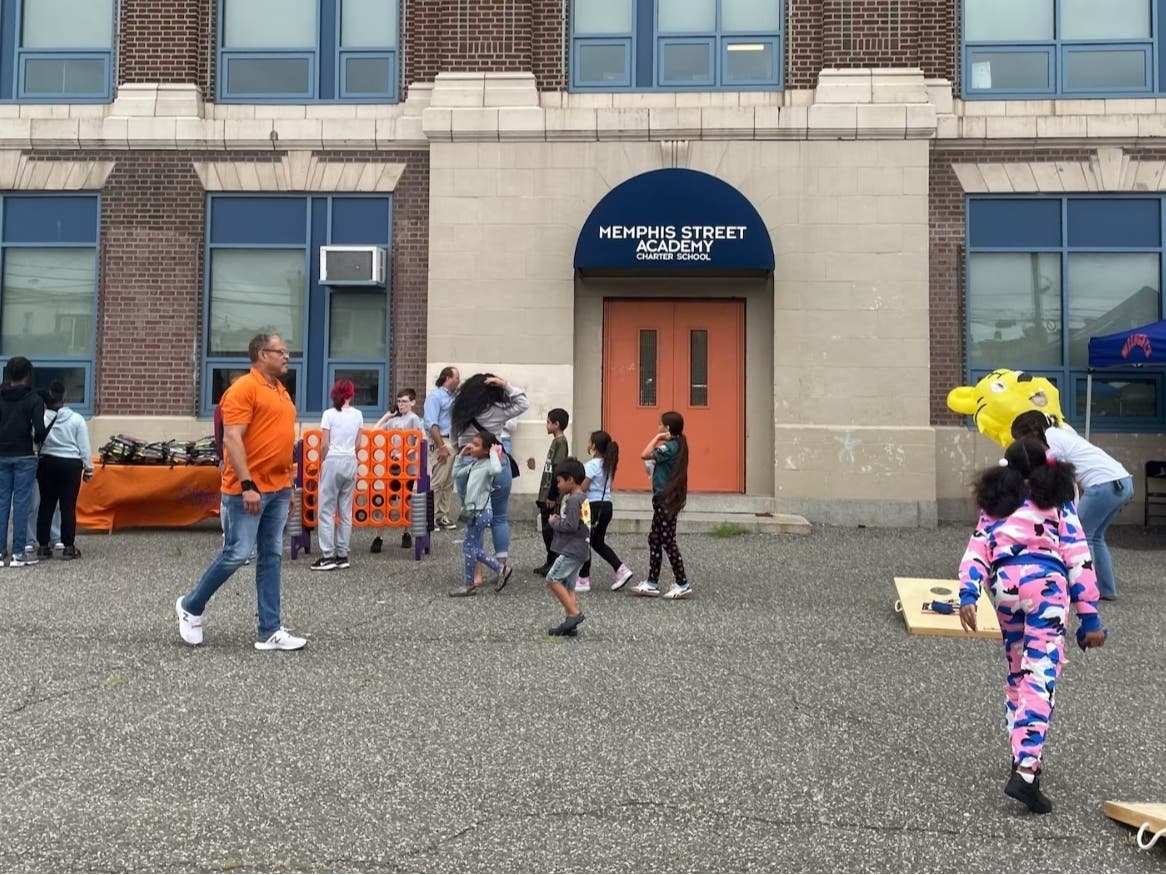
Of all those cases, only one has resulted in a charter operator losing its school. Memphis Street Academy, which sued the board in 2022 to prevent its closure, recently lost its appeal. Though the school operator will lose its charter, the school itself will transition to become district-operated for next school year.
For two of the schools not renewed, the board later reversed its decision. Others have remained open as they battle the decision in court, or wait for hearings and appeals to play out.
Philadelphia Montessori Charter School recently sued the board after it started the nonrenewal process for the school. Executive Director Amanda Wilson said the school felt turning to the courts was their only option because “there is no room for conversation or negotiation” in the board’s renewal procedures.
Chao said the state’s charter law requires districts to hold hearings over nonrenewals, and schools can appeal decisions to the state’s Charter Appeal Board. That board’s members are appointed by the governor, and they have largely sided with districts.
“There is a process for schools to put forth evidence and their side of the story,” said Chao. Lawsuits, he said, delay that.
Charter nonrenewal decisions are controversial across the country. But the number and frequency of lawsuits over the process in Philly sets it apart, said David Greenberg, vice president of authorizer learning and development at the National Association of Charter School Authorizers.
When authorizers and charter schools work together well, schools often do better, said Greenberg. When that’s not happening, students may pay the price.
“This kind of acrimony takes the focus away from teaching and learning,” said Greenberg.
Charter school leaders have a variety of problems with the renewal process, from how it compares schools to what some have called an “inconsistent” reaction to schools that don’t meet standards.
Some allege the board oversteps the law by requiring schools to agree to conditions, like raising students’ test scores by a certain amount. Others have alleged the entire process is discriminatory against schools that serve a disproportionate number of Black and brown students.
Chao said he could not comment on specific allegations. But he and the board are working to revise the renewal process.
Two years ago, the board launched a process called Project RiSE, meant to improve how it evaluates charter schools. It is expected to release the new framework in September, after delaying it from an initial release planned for this month.
“We know that accountability metrics must evolve over time,” said Board President Reginald Streater in a statement last year about the effort.
But Chao said he could not share details about how the new framework may differ from the current one.
Cassandra St. Vil, CEO of Philadelphia Charters for Excellence, a charter school advocacy organization, said she was initially hopeful the new framework could address concerns that evaluations are inconsistent and unfair. But as the district has pushed back its release date and failed to share any details about it, she no longer trusts that will happen.
Philadelphia Charters for Excellence recently sued the board to limit the requirements it can impose on schools in the renewal process.
“We are not trying to skirt accountability at all,” said St. Vil. “We’re actually trying to bring it to light and make sure that it’s mutual, across the authorizer as well as the (charter school) sector.”
The Pennsylvania Capital-Star, a nonpartisan, nonprofit news site, delivers honest and aggressive coverage of state government, politics and policy. Since launching in February 2019, the Capital-Star has emerged as a go-to source for in-depth original reporting, explainers on complex topics, features that ground policy debates, and progressive commentary on a range of issues. The Capital-Star is part of States Newsroom, a national 501(c)(3) nonprofit supported by grants and a coalition of donors and readers.