Neighbor News
FCS Math Team Named National Finalist in International Mathematical Modeling Competition
A Friends' Central team was awarded the distinction of National Finalist in the 18th Annual High School Mathematical Modeling Contest.

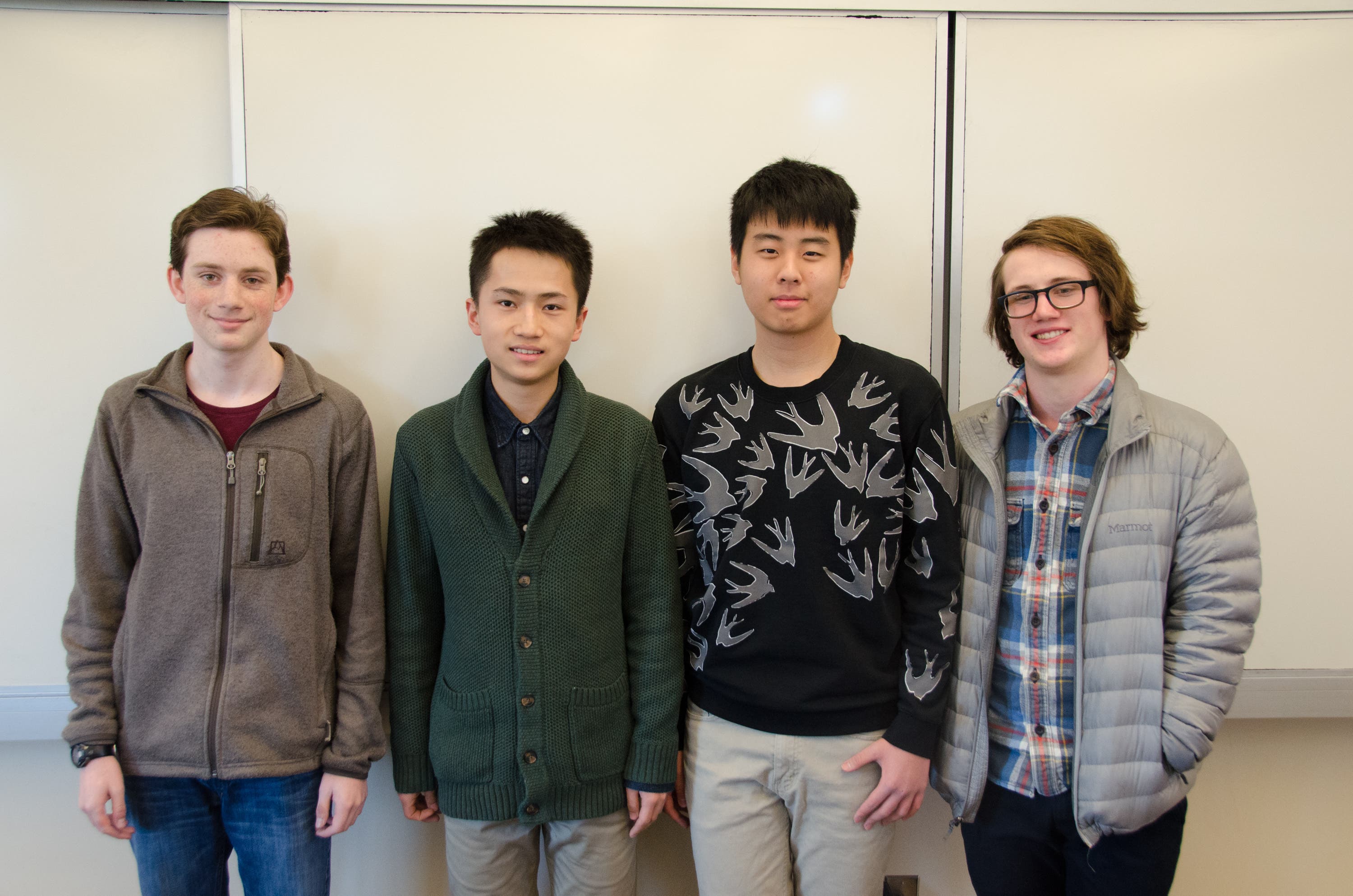
Friends’ Central’s outstanding and innovative math program earned national prominence when, earlier this month, the Consortium for Mathematics and its Applications (COMAP) awarded the team of Samuel Weiss ’17, Junyan Ge ’ 17, Dashiell Halpern ’16, and Jiwei Cheng ’17 the designation of National Finalist in the 18th Annual High School Mathematical Modeling Contest (HiMCM), placing them in the top 2% of 719 teams competing from around the world.
This is the first year that Friends’ Central entered the contest, which pitted 719 teams from top schools, both nationally and internationally, against each other. The contest, which allows for 36 hours of continuous work, took place last last November. Although students practiced all semester with different models, there was not much they could do in terms of preparation, as each year, the questions vary significantly, forcing the teams to think critically and quickly. The question they chose in this year’s competition asked them to analyze a large data set of crime data from a fictitious city called “My City” and create a safety rating for the city and an accompanying non-technical report on their findings. The team was notified earlier this month that their team’s 17-page document was one of only seven to earn the distinction of National Finalist.
The idea for the project came from Jiwei Cheng, who sought out classmates (and fellow Math Appreciation Club members) who he thought would be interested. “Everybody had a solid math background and that really helped,” Cheng said.
Find out what's happening in Ardmore-Merion-Wynnewoodfor free with the latest updates from Patch.
One of his teammates, Dashiell Halpern, who has taken college coursework over the summer and in the fall, was happy to join. He explained how experimenting and quickly ruling out a few approaches helped them succeed. “We spent hours on models that had no inputs on our end result because we would throw it out if it wasn’t working,” Halpern said.
“We found that participating in this competition led us through more applied math,” Cheng noted. Halpern added, “The kind of experience we don’t get very often is working on one problem for such a long amount of time. Until you do something like that, you don’t know whether you’d be able to, and now I know that if I put my attention on something for this long, I can really get into it.”
Find out what's happening in Ardmore-Merion-Wynnewoodfor free with the latest updates from Patch.
Samuel Weiss agreed adding, “It’s taking a real problem and going all the way through it, kind of on the level of what you’d do in a college classroom. It wasn’t simply that we did something with clear steps, it’s that we created something, which I think was interesting. I really liked that we were capable of doing that.” Although skeptical at first, Cheng found the process encouraging and fulfilling. “It was more like a research experience. In September, I never thought we could do this. When I think of this group, it makes me really proud of our accomplishment,” he said.
Upper School math teacher and the team’s faculty advisor Julie Plunkett stressed that the effort was entirely student run. “They met on Mondays and worked through differential equations and questions from last year. I was just there to support them.” When they approached the problem, they knew the summary was going to be weighed heavily, but Plunket was surprised by the attention to detail. “It was so incredibly well-written that it was as if a professor wrote it.”
While, in previous years, questions relied heavily on differential equations, this year it was primarily statistical analysis. “They had studied a lot of [differential equations], but that’s not what they ended up needing to do; yet they hit it out of the park.”
Plunkett added, “I think it speaks to the caliber of students that we have at FCS that we can accommodate some very bright and gifted math students. It says a lot about their willingness to challenge themselves. The biggest takeaway for me is that I’m helping teach students how to think - not necessarily what to think, but how.”