Arts & Entertainment
Wynnewood's Own Quaint English Village
"If Walls Could Talk" takes a look at a group of Northside Wynnewood homes built in 1925 that appear more Tudor than Roaring '20s.
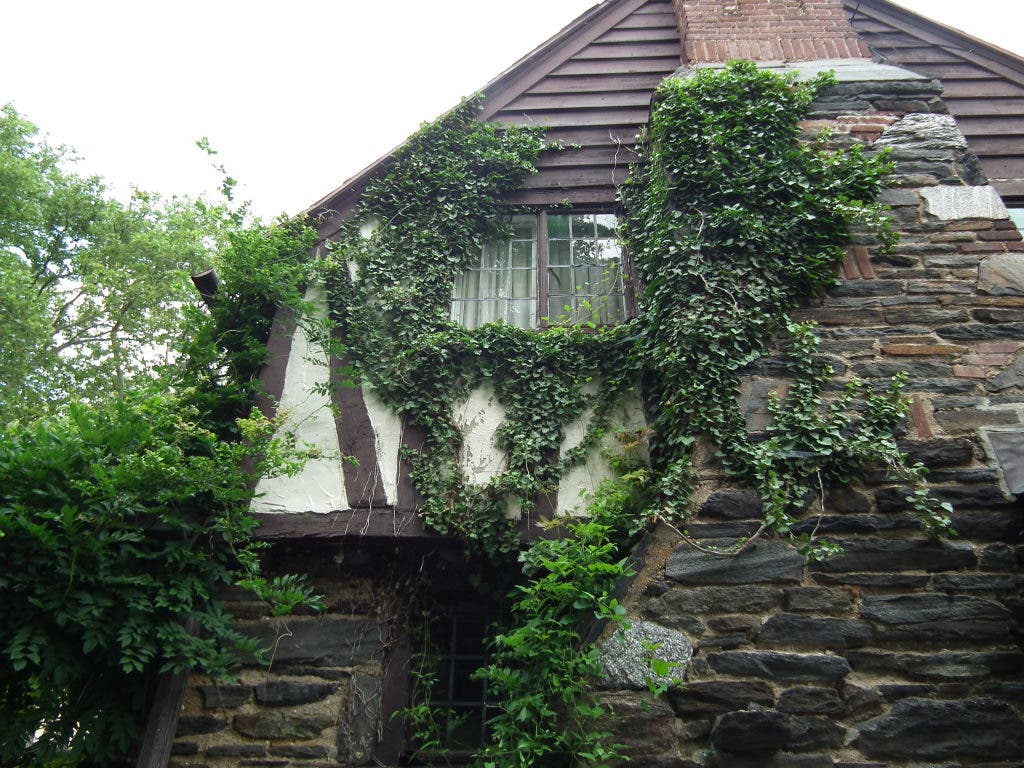


Almost hidden off Cherry Lane in "Northside" Wynnewood, on the down slope from Montogomery Avenue near Mill Creek, is a small village that appears to be from another time.
The name of the main, curving road is the first giveaway that something is different: Arthur's Round Table. No "St." or "Ave." on the end there, either.
Twenty-nine residences fashioned after Shakespeare’s hometown, Stratford-on-Avon, and influenced by the architecture of Shropshire, are a unique standout from the other opulent Tudor homes that dot the Main Line. Brothers Donald and S. Arthur Love felt the rolling hills of Lower Merion were similar to the English countryside, and in the early 1920s they began developing a cluster of homes to capture the ideal aesthetic of the Tudor revival. The homes are now known as the English Village Historic District.
Find out what's happening in Ardmore-Merion-Wynnewoodfor free with the latest updates from Patch.
"It's always captivated me, its an anomaly, its a very atypical type of development," explained Amy Sullivan, a Realtor for Keller Williams, who recently sold one of the homes.
A listing of Sullivan's still online Thursday on Arthur's Round Table was for $449,000, with four bedrooms, two and a half bathrooms, and 2,710 square feet of interior space. (And that's in "as-is" condition; the property needs work, she says.) They were veritable McMansions of their day—minus the poor craftsmanship.
Find out what's happening in Ardmore-Merion-Wynnewoodfor free with the latest updates from Patch.
The inspiration for Wynnewood's English Village comes from across the pond, but the materials used are very local. The homes feature Henry Mercer-designed tiles scattered throughout the floors and even in some of the exterior brickwork. All the fieldstones come from local quarries. Even the wood was pulled from local barns and railroad ties. All of these items make for an ideal artistic aesthetic, but it was also built without a standard system of measurements. The unique brick and stonework sometimes stemmed from the need to fill in gaps here and there, ensuring that no two homes were alike.
'To use indigenous materials to make something cool and creative is just brilliant.'
The village, often described as a medieval European hamlet floating amid a suburban sea, was recently been classified by Lower Merion Township as Class I, which means the exteriors must maintain their historic standards. Despite the hodge-podge of materials, the homes are solid and contain many of the original features, such as stained glass windows, hardwood rounded doors, and Juliet balconies.
"This is the kind of stuff you don't see; just to use indigenous materials to make something cool and creative is just brilliant," said Sullivan.
The homes still have an amazing appeal, Sullivan said. Her unit sold within a week. A Class I home puts certain restrictions on the homeowner, but to certain buyers, it's worth it.
"Its a unique buyer, explained realtor Corey Baumann. "Its more about buying into the neighborhood itself—not even the house, even though that is important. They want to specifically live in English village."
There is definitely a close communion among the homeowners. Their yards meander together with striking English gardens, and the S-shape of the development itself makes it hard to see where each individual property line ends. Even though these homes are less than a mile from Montgomery Avenue, there is a peace and quiet that gives residents the luxury of the country while still being able to easily access shopping centers and the SEPTA train.
Builder Donald Love inhabited 626 Loves Lane. When he purchased the property in 1930, it was the most expensive home in the village, valued at $26,000. Rumor has it that architect S. Arthur Love also kept a residence.
The unique structures, many of which featured studios, were the perfect haven for artists like Sue May and Paul Gill. Poet Agness Yarnell was also one of the villages' first residents. First Lady Eleanor Roosevelt also spent time visiting friends there.
The homes are about to turn 100 years old, but they can easily transport your imagination back a couple of centuries more.