Schools
Mock 'Mission to Mars' Held In Lower Merion
3, 2, 1 ... Blast off! Fifth grade students in Lower Merion recently held a mock "mission to Mars."


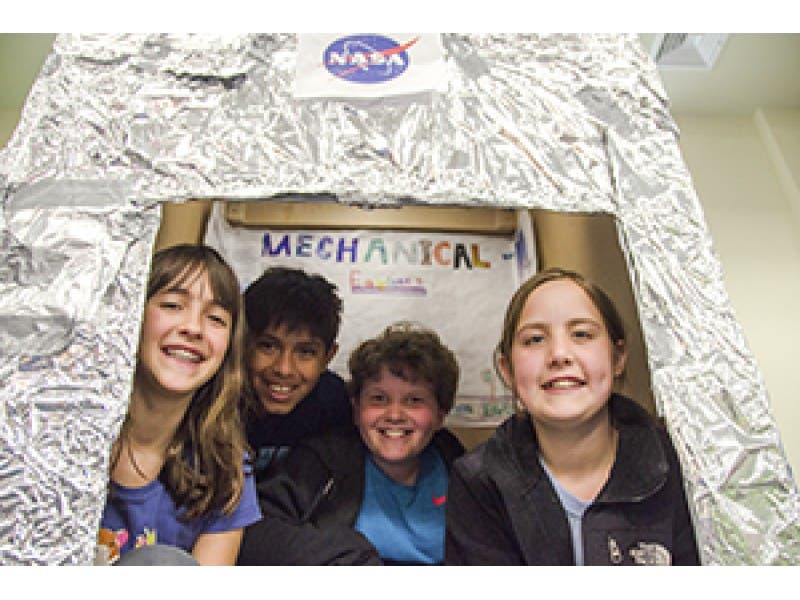
WYNNEWOOD, PA -- On Monday, May 2, Friends’ Central 5th grade students held a mock Mission to Mars for the Lower School community.
The 5th graders have been studying life on the International Space Station (ISS) and the importance of Scott Kelly's Year in Space Mission for future travel to other planets, specifically Mars, since January. The students spent a lot of time watching videos of Kelly’s mission and learning about the Twin Study, which led to their space exploration project – Mission to Mars.
Science teacher Tiffany Borsch explains what this Mission to Mars entailed: “As a group, we discussed aspects of the mission related to pre-flight, in-flight, and post-flight. What would the Mission to Mars look like? What would we have to study to make it happen? We decided three things in order to get from Earth to Mars: we had to get off Earth, we had to travel to Mars, and we had to land on Mars.”
Find out what's happening in Bryn Mawr-Gladwynefor free with the latest updates from Patch.
From there, Borsch and her students came up with a list of specific jobs for their space mission. The children listed their top three choices, and they were placed into one of the following groups: Mechanical Engineers, Navigational Engineers, Module Architects, Astronauts, Mission Control, Robotics Engineers, and Gear Engineers.
The next step was to come up with a list of job descriptions for each job, and the students did extensive research on their jobs. After their research, Borsch says, “The students made posters to show their process. We wanted it to be like a working gallery – to have others learn about our Mission as we learned.”
Find out what's happening in Bryn Mawr-Gladwynefor free with the latest updates from Patch.
Two other exciting events took place as the students were working on their Mission to Mars: Astronaut Scott Kelly returned from his year in space, and Dr. Mathias Basner visited Friends’ Central to talk to the 5th graders about his research related to the Year in Space. Dr. Basner was one of the leaders of the Penn Medicine research team who developed a cognitive test battery, called Cognition, for the National Space Biomedical Research Institute (NSBRI), which measures the impact of spaceflight stressors (microgravity, radiation, confinement, isolation, high CO2 level exposure, and sleep loss) on cognitive performance.
The students watched Kelly’s return to Earth with enthusiasm, and Dr. Basner’s visit added even more excitement, as they devised a culminating project to share all they’d learned in their Mission to Mars project. After much discussion, Borsch and her 5th graders decided to have a flight simulation, accompanied by a Fair to present all their extensive and impressive research.
On May 2, the Mission to Mars Flight and Fair took place in front of an engaged audience of Nursery through grade 4 students and teachers, grade 7 students, Middle School teachers, and special guests. The 5th graders “traveled to Mars” via a 10-minute launch sequence simulation, complete with students from Mission Control who performed checks leading up to the launch and a Google Chat video of the astronauts in space for audience members.
After the simulation, they hosted a Mission to Mars Fair, displaying the information they have learned and offering related activities for visitors. Students proudly displayed the satellite and rocket they had constructed, the suits they had made for the astronauts, the plants they grew and food they’d dehydrated and freeze dried in order to eat on Mars, and offered different activities for visitors, including “build your own module” and Mars puzzles.
Borsch was thrilled with the work done by each 5th grade student, as well as the way each team came together. She explains, “Part of my goal is to teach kids different options, different ways of building things. The 5th graders took that and ran with it – coming up with ideas for tools and items to make each project come to life. One example is how the gear techs made the suits and helmets for the astronauts. They really thought outside the box for ideas. They used white trash bags, duct tape, made helmets with papier Mache, painted them, and used thick twine covered with black electrical tape, which really looked like microphones!”
The students enjoyed the full experience of researching their Mission, bringing it to life, and showing what they’d learned to their community. Asha explains, “We felt like real scientists and that we were really going to Mars!”
“I liked how the Mission felt like a real Mission and how we studied hard and long and it all came out great. I was surprised how well the Google chat worked! I learned that getting to Mars would be super difficult. One little screw can change it," said Ryan.
“I learned how hydroponics worked. I thought it was going to be really complicated and wasn’t so sure that it would work, but in the end it worked really well," Elly said.
“I liked that we definitely had a lot more freedom than some of the other projects we did," Max said. "Other projects we had to stay within boundaries. This time we used our minds instead of our teachers, and we had to learn how to work as a team.”
Get more local news delivered straight to your inbox. Sign up for free Patch newsletters and alerts.