Neighbor News
TRIO Works!
Harcum College Student Support Services (SSS) and Upward Bound (UB) departments visited local representatives in Capitol Hill to advocate on

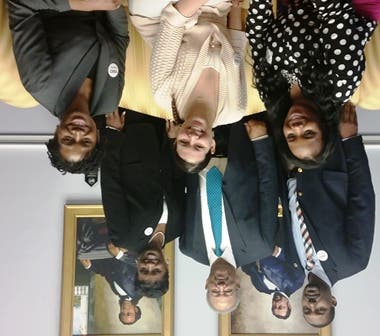
Front: Quadera Ball-HCUB Recruitment & Retention Specialist; Liz Walker, Director of HC-Upward Bound; and Crystal McCray, HC-Director of Student Support Services.
Back: Raymond Curry, Coordinator of HC-Upward Bound; Congressman Chaka Fattah; Susan Powell, Director of Upward Bound - Lincoln University.
On Tuesday, March 17, Harcum College Student Support Services (SSS) and Upward Bound (UB) departments visited local representatives in Capitol Hill to advocate on behalf of TRiO grant funded programs.
Find out what's happening in Bryn Mawr-Gladwynefor free with the latest updates from Patch.
For those unfamiliar, TRIO, funded through the Department of Education (DOE) serves as the umbrella for 8 programs (listed below). What is uniquely powerful about the comprehensive network of TRiO’s programs is the elementary to post graduate pipeline provided. Students from first generation and low income backgrounds have the opportunity to immerse themselves within a culture of educational success receiving a variety of educational supports including, college preparation, academic assistance, career exploration, financial literacy, and more.
Harcum’s SSS and UB programs met with representatives from Senator Pat Toomey’s office, Congressman Bob Brady’s office, Senator Bob Casey’s office, and Congressmen Chaka Fattah’s office to discuss their support of President Obama’s 2016 Budget Request to Congress.
Find out what's happening in Bryn Mawr-Gladwynefor free with the latest updates from Patch.
The request calls for a $20 million increase in TRiO funding, for a total appropriation of $859.75 million for TRiO FY 2016. Under the President’s proposal, these additional funds would be designated for supplemental funding for current TRiO grantees to launch research-backed interventions that may be included in future legislation.
The Administration hopes that funding for these types of demonstration projects may yield new information about what strategies work best to boost college access and success as well as inform decision-makers as they reauthorize the Higher Education Act of 1965. As we move from the wake of the Bush Administration’s, No Child Left Behind Act, as well as the post 9/11 economy, it becomes evident now more than ever, that in order to create an economy built to last, we must provide every student with a “complete and competitive education,” capable of enabling them to succeed in a global economy based on knowledge and creativity.
For this country to maintain a vibrant workforce, we need to produce a graduate population equipped with not only advanced skills, but innovative thinking and critical awareness. For today’s youth, earning a post-secondary degree or credential is a prerequisite for obtaining 21st century jobs and entering into the modern workforce.
Unfortunately, the college attainment gap is widening. While high school graduates from the wealthiest families are almost certain to continue on to higher education; just over half of our high school graduates in the poorest quarter of families attend college. In Southwest and West Philadelphia, where Harcum’s Upward Bound program serves, an average of 35% of high school graduates go on to college. Furthermore, while over half of middle class college students graduate within six years, the completion rate for low-income students is around 25 percent.
“Advocating for TRiO is really about advocating for this Nations underserved populations,” Crystal McCray told Casey’s representative. “Without programs such TRiO, the path of academic success becomes almost unfeasible to those who are from low income families and schools; those whose families do not offer them the legacy of navigating the system of higher education. Without TRiO, the country loses the support of a sector full of potential and power to effect vibrant changes to our economy and workforce. ”
Although TRiO reps were equipped with data that clearly reflected the effectiveness of programs such as Harcum’s Upward Bound (HCUB) and SSS, we wanted to let the Congressmen and Senators meet the very individuals whose lives and family lives are impacted by these funds. All too often, bills such as these are being reviewed and voted on by those who have no personal relationship with the programs or the lives they effect. Therefore, when seats were limited program staff stood in the back and let the alumni, students and parents sit at the table with the representatives.
On behalf of Harcum’s Upward Bound program, Quadera Ball came ready to discuss how TRiO has impacted her. Ms. Ball joined Harcum’s Upward Bound program in 2008 as a student participant. Miss Ball graduated HCUB in 2010, and in 2014 became the first member of her family to receive her Bachelor’s Degree, graduating from Lincoln University. Miss Ball quickly joined the HCUB team as the Recruitment Specialist and is now on the path to receiving her MSW from Temple University. “Without Upward Bound I would not be the woman I am today,” Miss Ball told Senator Casey, “The program not only helped me academically but has helped me build my character as well as helped me form great bonds with individuals on the same educational trajectory as me. It has instilled in me tools for success… Harcum UB will forever be my family”
Mr. Curry, the Academic Coordinator for the Harcum Upward Bound program, noted that one aspect of Harcum’s Upward Bound which makes it such a worthwhile investment for the government is that with a limited amount of money, we are not only effecting change in the life of one person, we are shifting the entire culture of their family. “See, our students are the ones that pave the way for their brothers and sisters to go to college, and then they will have the skills to not only set the standard that their children will go to College, but offer the skills to help them get there. They are literally the ones paving the way in their families.”
This is the same type of results-driven support that inspired Miss Susan Powell of Lincoln University to tell Senator Toomey’s rep that, these funds he, “has the opportunity to support with this Bill, and carries a significant ‘bang for its buck’. This is why it’s not simply a handout, but an investment in the future of this country’s productivity.”
“TRiO Works!” became the slogan for our day in Washington. As we walked through the marble corridors of Capitol Hill greeting fellow TRiO reps, all of us were impressed by the feeling of pride and solidarity. Regardless of which state we were there to represent, we were all passionate about the same thing, making sure that individuals, just like Miss Ball, are able to receive the opportunities, support, and services to continue on the road of success.
Although this was the first year that Harcum College participated, both SSS and UB departments are excited to become more active in the TRIO community at large. It is clear that we must work diligently with our defenders in Congress to secure not only these funds, but also to restore services that have been lost to students in these programs over the last decade. The state of our future literally depends on it.
To learn more about TRIO Programs, please refer to website www.ed.gov or contact the Director of SSS - Crystal R McCray at 610-526-6052 or cmccray@harcum.edu or Director of UB - Liz Walker at 610-526-6170 or lwalker@harcum.edu.