Health & Fitness
About That 1788 Coin in Centre Square
Curious about that 1788 coin they found last week in Centre Square? Would you be rich if you found one like it?



Last week, construction workers busy remaking Downtown Easton's Crayola Experience area discovered several small historical artifacts in Centre Square. Among them, a copper coin dating from 1788, now green and faded.
Patch has a story about it complete with pictures of the coin. I commented on it, saying,
The coin may be virtually unreadable, but I can make out a horse's head on one side and "E Pluribus Unum" and a shield on the other. That, and the year 1788, means it's from New Jersey. In that condition, it wouldn't be worth much.
Find out what's happening in Eastonfor free with the latest updates from Patch.
Still, a cool find.
So how do I know it's from New Jersey? If you or I found a similar coin, would we be rich?
Find out what's happening in Eastonfor free with the latest updates from Patch.
Let me explain a little more about the history of those types of coins. For some sweet, sweet context, let's go back to 1786, two years before that coin was minted.
Old New Jersey's Money Making Plan
In 1786, the American Revolution had ended a few years prior, and the thirteen newly independent colonies were struggling to come to some sort of agreement on how the structure their fragmented government, still under the Articles of Confederation. The Constitution was still years away from being ratified, and the United States Mint, the coin-producing body the country still has today, was just shy of six years from being created. This is important to us now because while the Constitution does not grant the states the right to coin their own money, the Articles did. And New Jersey took advantage of that.
The New Jersey General Assembly, on June 1, 1786, granted citizens Albion Cox, Walter Mould, and Thomas Goadsby the right to go ahead and coin three million copper coins over the next two years, worth 1/15 of a shilling. (On the condition that 10% of the royalties went to the new state, naturally.)
The coin found just found in Centre Square this week is one of those three million coppers.
Oh, and talk about letting money come between people. The men involved here - if they liked each other to begin with, did not care for each other by the end.
Goadsby and Cox had a financial disagreement with Mould, it seems, because they petitioned the state legislature to mint their own coins independent of Mould. This was granted, and as a result New Jersey post-colonial coins were minted in a few places: Rahway (Cox and Goadsby) and Morristown (Mould) as well as Elizabethtown by a Matthias Ogden, a bondholder for Cox and Goadsby.
Goadsby and Cox grew apart, too, you might say. If "growing apart" means suing each other and doing jail time. See what money does to people?
Naturally, all these coins weren't minted on the same equipment with the same exact designs, as they are today. There was no set standard for the art of a coin back then, so as a result one will find variances in design and even size. These coins in particular are known to have over 140 variances.
To know which mint produced the coin in Centre Square, you would have to measure it. Coins 30mm or more are generally considered to have come from the Morristown mint.
The Design
So, aside from that riveting history of money tearing the bonds of men asunder, what about that coin?
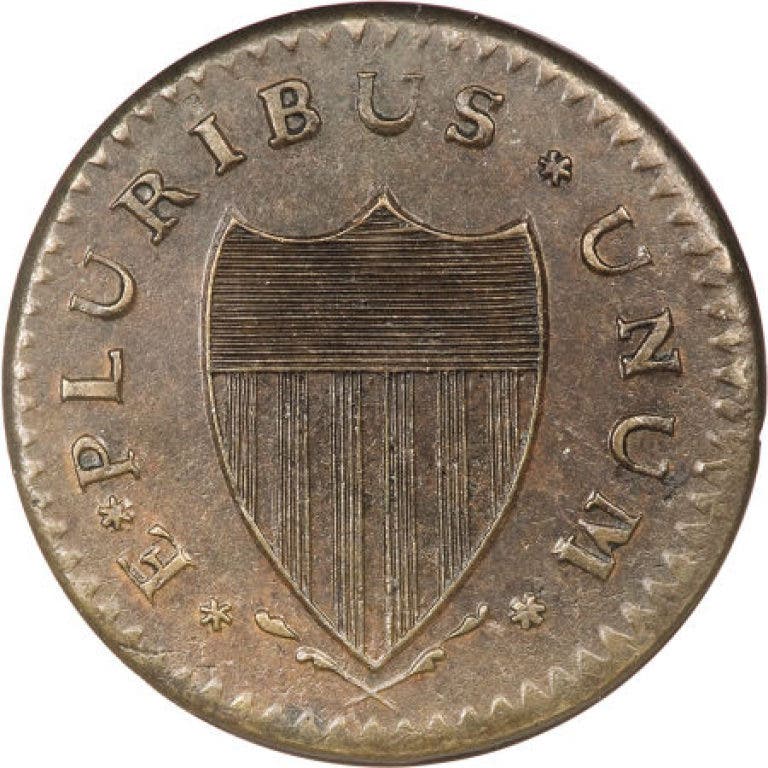
Well, the obverse (the front) of the coin still shows the outline of a horse's head facing to the right and a plow beneath it, symbolizing the importance of agriculture in the early state. It's also the side the minting year, 1788 in this case, would be placed.
The reverse (the back) of the coin can be seen with the national motto, new at the time, "E Pluribus Unum". It's Latin meaning "From many, one". It was supposed to recall the political unity of the states post-Revolution. These New Jersey coins were the first coins to feature the phrase, which is interesting. To me.
That phrase, together with the outline of a shield on the reverse - one not unlike the shield on the reverse on our current pennies - clearly marks the coin found in Centre Square as a New Jersey copper.
So, if I found this coin, would I be rich?
In a word, no.
(Or technically, yes, if you were already rich.)
Now don't get me wrong: some of the New Jersey coppers are woth a lot of money. It's all about those tiny differences in design I was talking about earlier. For instance, if you were to find a 1786 New Jersey copper with the date under the plow's beam? And it was somehow in unfathomably good condition, like new? That would be worth hundreds of thousands of dollars, likely.
So what about the one found in Centre Square?
Going by the photos on Patch, I'd give you $20 for it.
For one thing, most of the coins from this era of history have been run ragged through time. This one in particular was buried underneath Easton for a couple centuries, and it shows. The copper has turned green from exposure and - worse yet - the details of the coin have worn off. The less we know, the less it's worth.
Still, I'm no real numismatist (someone who professionally studies coins). I'm just a guy who likes old coins, has read some stuff about them, and saw a couple photos. To really know this coin's worth, the city will turn to professional graders of coins.
So, Easton? My offer stands at $20.
Still, cool find.