
(Note: This is a retyped version of the original article that appeared on Easton and Palmer-Forks Patch sites in - if I remember correctly - June of this year. Due to the reformatting Patch sites went through, it was lost. I tried to remember as much as I could, here.)
If you're reading this while in the borders of Palmer Township, I urge you to read it quickly.
At any moment, Palmer dweller, the uncaring earth beneath you is likely to give way. And down you'll go. Into the Abyss. I'm not trying to alarm you, but you should know that the weak, unforgiving limestone-based ground of Palmer is likely to give way - perhaps even before you finish this article.
It is the way of things around here. I have lived here all but one of the years of my life, and I think I've earned some sort of Survivor Badge for it. A plaque, perhaps. A memorial bridge, maybe, if I do get swallowed whole by a sudden awful and gaping hole.
So, before the entire municipality disappears forever into the Earth's crust, I thought I might tell you about how it got its start.
There are a lot of sinkholes in Palmer Township, is what I'm getting at.
Fast Facts
If you're reading this while in the borders of Palmer Township, I urge you to read it quickly.
At any moment, Palmer dweller, the uncaring earth beneath you is likely to give way. And down you'll go. Into the Abyss. I'm not trying to alarm you, but you should know that the weak, unforgiving limestone-based ground of Palmer is likely to give way - perhaps even before you finish this article.
It is the way of things around here. I have lived here all but one of the years of my life, and I think I've earned some sort of Survivor Badge for it. A plaque, perhaps. A memorial bridge, maybe, if I do get swallowed whole by a sudden awful and gaping hole.
So, before the entire municipality disappears forever into the Earth's crust, I thought I might tell you about how it got its start.
There are a lot of sinkholes in Palmer Township, is what I'm getting at.
_______________________________
Fast Facts
Who named it?
Rebellious, breakaway citizens of Forks Township
When was it created?
1857
What is it named after?
George Palmer (1748-1831)
Find out what's happening in Eastonfor free with the latest updates from Patch.
By subscribing, you agree to Patch's Privacy Policy and Terms of Use.
_______________________________
Not long after both Easton and Northampton County were officially declared in 1752, most of the land north of the Lehigh River not in Easton, Bethlehem (1741), or Nazareth (1740) was declared to be in Forks Township. But this is the way of things in the county, and America: when taxes get too high, or trash bins become too large*, or people on one side of a land or water formation simply grow to dislike people on the other side, they will push to become their own municipality.
So it was in 1857. But then, it was easier to break away and form a new system of local government back then. If it were so easy nowadays, surely modern Palmer residents would have started the Second American Revolution over the size of the new trash and recycling bins in the township*.
(*I'm just saying. Each one is 10% larger than my first apartment. It was a decent apartment, too.)
About four years before the start of America's Civil War, local tradition holds that some agitated Forks Township residents from the west side of the Bushkill Creek met at the Seipsville Hotel (established 1760; now the historic Seipsville Inn) near the present-day Palmer Park Mall. There, they planned to be rid of Forks once and for all, and on May 5, 1857, the court order was issued and Palmer Township became independent.
Ah, but why call the new township "Palmer"? They had good reason.
George Palmer, master surveyor
The word "palmer" simply signifies a religious pilgrim who has returned from a visit to the Holy Land. The leaves of a palm plant recall the Biblical story of Jesus of Nazareth (no, the one in Palestine) making a pilgrimage to Jerusalem.
What does that have to do with Palmer Township? Nothing much. I like etymology, and so I put it in the article. It's my blog; I'll do what I want.
Palmer Township is named after George Palmer (1748-1831), a Pennsylvanian surveyor of a strong reputation in the area. And for good reason: while being somehow a favorite of both the Loyalist Penn family and, after the Revolution, the new American government as well, he also found time to help settle a century-old dispute.
When King Charles II of England granted William Penn the Province of Pennsylvania in 1680, keep in mind that he did not have Google Maps at his disposal. No one did, to be fair. Had they satellite imagery, the king and his court may have realized that they had somewhat overlapped New York Province and Pennsylvania - and as a result, no one could quite agree on where the border between the two colonies was located.
Which would be a problem, you'll agree, had they decided not to address it. I mean, imagine living in the "grey area" between the colonies. What would you even write for a mailing address? "Scranton, Possibly PA"? "Susquehanna, NY Perhaps"?
In 1774 -- just a year before things got real with the royals around here, keep in mind -- King George III's government finally got around to having someone figure out where the PA-NY border should be drawn. Governor John Penn chose surveyor David Rittenhouse, who in turn chose young George Palmer, the new Deputy Surveyor General of Pennsylvania, to help with astronomical calculations.
I'd like to do more research on George Palmer in the near future, actually. He's an interesting figure in that the Loyalist Penn family liked him if the quote "[George Palmer is] a man of conscience and his having a perfect knowledge of the state of [the Penn family's] manors in the County of Northampton" is anything to go by, according to James A. Wright's History of Palmer Township.
And yet, in 1796, Palmer was offered a job as an associate judge by Governor Thomas Mifflin according to the same book. Well, Mifflin was no Loyalist. And he was already Northampton County Coroner at the time. How does that work? I'd love to find out, and if I ever figure it out, I'll tell you.
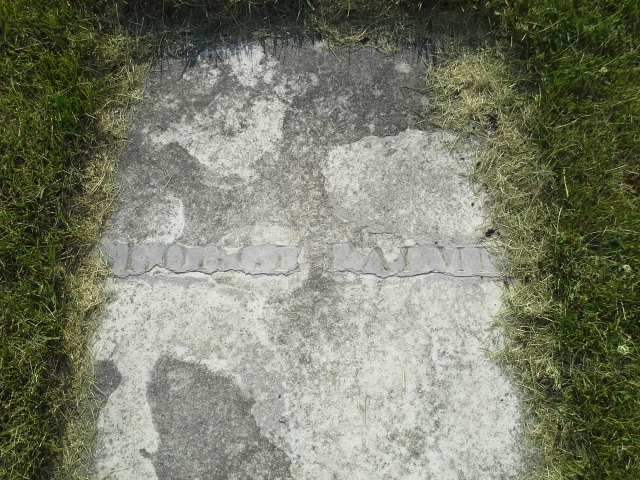
George Palmer died in 1831, and was buried in the old Presbyterian graveyard in East Allen Township, not too far from his Bath-based office. It is now called Horner's Cemetery, off Route 329 between Bath and Northampton Borough, and has been well kept and restored by local historian Peggy Spengler-Moser. I visited not long ago, and Palmer's grave is still visible, if understandably worn from nearly 200 years of exposure.
The residents of the new township in 1857 still remembered and revered the man enough to name their home after him, a quarter-century after his death. We can all only hope to be so loved.
And for, maybe, less gigantic trash bins. I'm just saying. I think they're causing the sinkholes.
By the Way
By the way, in the near future I plan to start a local history website. As well as being a depository of these types of blogs, articles, and local historical knowledge - you'd hope - I'd like it to serve an additional purpose: helping myself and others figure out lingering mysteries of the area, if at all possible. A place, perhaps, even, for local historians and history buffs to gather online to share info and tips. The scope of it is something I'm considering. Any ideas and/or words of encouragement are always welcome.
____________________________________________________________
Kyle M. Jones is a docent at the Sigal Museum in downtown Easton. The same history museum is celebrating its third birthday August 10, and will be free to get into during that time. Also, I will be there and I know some stuff and can tell you said stuff if you ask all nice-like.
Also, thanks to the Palmer Township Kiwanis Club for receiving me so well on July 31 when I gave a short presentation on Palmer and teased an upcoming Island Park article. A fun and like-mindedly sarcastic bunch, they! (Of course, this also resulted in them using an awful, sneering picture of me, mid-speech, on their website. You take the good with the bad, I suppose. But must you post the bad online?)