Health & Fitness
A Tale of Three Christmases
When people hear that I'm an Orthodox Christian, one of the first things they often say has something to do with the Orthodox having a "different Christmas."
When people hear that I'm an Orthodox Christian, one of the first things they often say (usually after asking what my ethnicity is) has something to do with the Orthodox having a "different Christmas." Since Christmas is still fresh on most of our minds, I thought I might offer something by way of clearing that up.
Almost all Christians celebrate Christmas on December 25. (For why December 25 is the traditional date of the feast, and also why it actually has nothing at all to do with the solstice or with paganism (despite what urban legends you may have heard), see this article from Muhlenberg College professor and Lehigh Valley resident Dr. William Tighe.) Orthodox Christians are no exception. I still celebrate Christmas on December 25, just like I did when I was an Evangelical Protestant.
What probably confuses some folks is that there is a minority of Orthodox Christians in the Western world (though it is actually a majority of Orthodox Christians in the rest of the world) who still use the Julian ("Old") Calendar for church purposes, which is what most Christians used for most of Church history. Because the Julian Calendar is currently 13 days behind the Gregorian ("New") Calendar that most folks are familiar with, when the date reads "December 25" on the Julian Calendar, it reads "January 7" on the Gregorian Calendar. So, those Orthodox who use the Julian Calendar don't celebrate Christmas on January 7; they celebrate on December 25. But their December 25 is probably your January 7. Clear?
Find out what's happening in Emmausfor free with the latest updates from Patch.
To make things a bit more complicated, in the earliest years of Christianity, Christmas was not actually celebrated on December 25, but rather on January 6. This feast, called Theophany, was not just about Christ's birth, but also about His baptism by John in the Jordan River. Eventually, most Christians (starting in the West) shifted over the celebration of the birth to December 25. Eastern Christians (mostly today's Orthodox) kept Theophany as the feast of the baptism of Christ. A certain minority of Christians in the East, centered mainly in Armenia (which was the world's first Christian country), kept the old way of the single feast on January 6, celebrating both the birth and baptism of Jesus.
In the West, January 6 came to be the feast not of Christ's baptism, but rather of the visitation of the Wise Men (Magi) to the child Jesus, Who was probably about two years old by the time they arrived from Persia. This Western feast is named Epiphany. Orthodox Christians thematically include the Magi in the Christmas feast on December 25, even though we of course know that the Wise Men didn't show up at the manger along with the shepherds.
Find out what's happening in Emmausfor free with the latest updates from Patch.
As such, there are traditionally three different celebrations of Christmas every year— first is December 25 on the New Calendar, January 6 on the Armenian calendar, and then December 25 on the Old Calendar (which is January 7 for everyone else). So, what that means is that, unless you belong to the Armenian church, your Christmas is almost certainly December 25 just like everyone else. Only if you're on the Old Calendar, your December 25 is everyone else's January 7.
I happen to be on the New Calendar, so my December 25 is probably your December 25, too.
Why does all this stuff matter? In some sense, it really doesn't. I don't think God is deeply invested in the exact calculations for our liturgical calendars. But what is clear is that Christians (and almost every other religion, for that matter) have traditionally always had liturgical calendars.
Is it because there is some special magic in figuring out systems of days and seasons? Certainly not. But we human beings move through time, and the way our actions shape our experience of time have a profound impact on our experience of life. We do so many things to mark days and seasons in nearly every part of life, yet for so many Christians, they hesitate at the idea that such actions should also be done for the spiritual life — which supposedly is what life is actually all about.
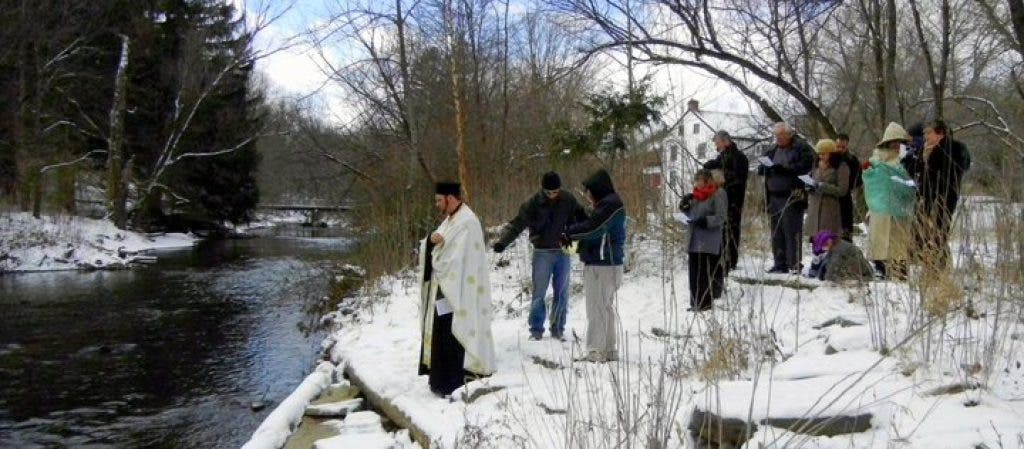
One of the things that the local Orthodox Christian church here in Emmaus does as part of our Theophany celebration is to bless the waters of Little Lehigh Creek at the Wildlands Conservancy, which we did yesterday at noon. In this way, we ask God to bring the revelation of Himself into all of creation, that the blessing He conveyed at His baptism in the Jordan River 2,000 years ago would extend even to us here in our borough of Emmaus.
No matter when or where you happen to celebrate the feasts that mark your experience of the divine, my hope is that your time will be redeemeed and sanctified, that your movement through the days and seasons, and even through the calendar, will be one in which, more and more, there be the revelation of God.