Community Corner
Local Country Butchers Share Memories
Local butchers recalled a time when meat was delivered by horse and buggy.
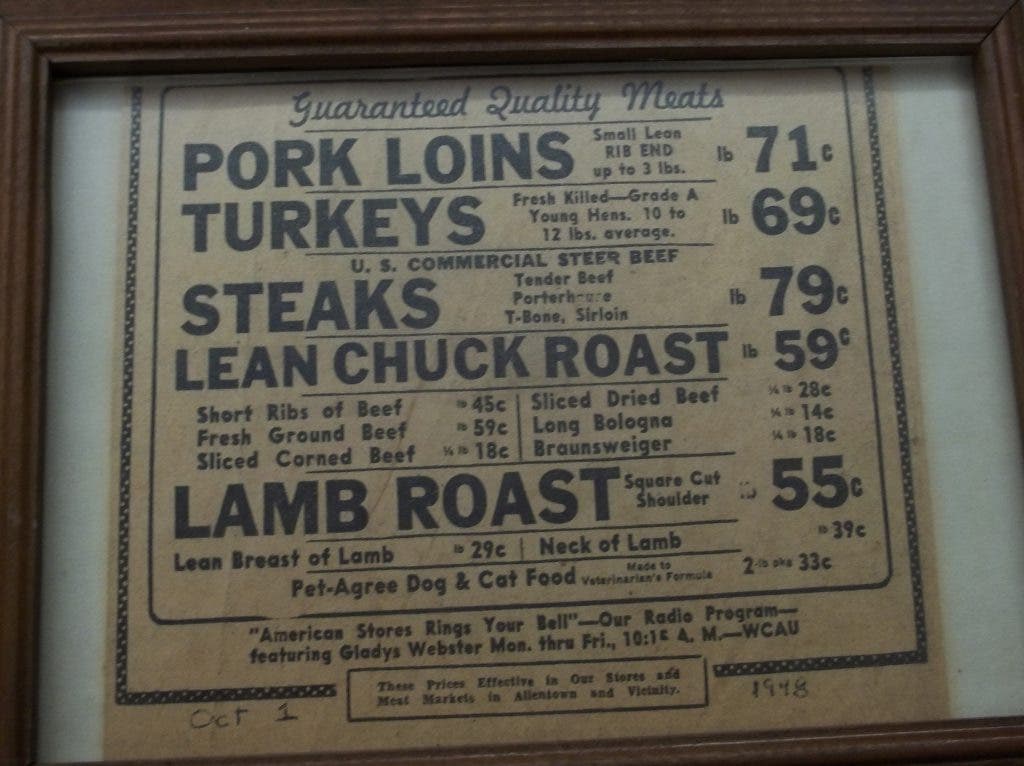


The old-time country butcher shop. A place to purchase fresh meat cut to order. A place where the butcher knows customers by name and what they want. A place where customers know each other and socialize a bit.
Very few of these shops still exist. One, H. R. Waterman Meat Market, is located on Rt. 100 south just across the Upper Milford Township border in Hereford.
Current owner H. R. Waterman and former owner Daniel Strunk were guest speakers at the March 27 meeting of the Hivel und Dahl Preservation Society. They spoke of their many years as country butchers to a standing-room-only crowd at the .
Find out what's happening in Emmausfor free with the latest updates from Patch.
The Dewey Strunk Butcher Shop began in 1908 by Dewey Strunk, Daniel’s grandfather. Twenty years later, following Dewey’s death, his sons, O.D. (Daniel’s father), Ammon and Harold, re-opened it as Strunk Bros. Butcher Shop. In 1969, Harry Waterman purchased the property and has been running it ever since.
A typical day for a butcher began as early as 4:30 a.m., when the men started loading their trucks, or horse and buggy in Dewey’s time, and the women prepared a 6 a.m. breakfast. During the warm weather, ice was also loaded onto the vehicles to keep the meat cold until deliveries were complete—about 5 p.m.
Find out what's happening in Emmausfor free with the latest updates from Patch.
Following breakfast, Strunk said, it was off to Palm, East Greenville, Macungie, Emmaus, Zionsville, Vera Cruz, Powder Valley, Hosensack and more areas. Drivers would ring a bell to indicate their arrival and usually sell two to three days worth of meat to the homeowner. Items for sale included beef, pork, ring bologna, sausage, scrapple, smoked hams, cheese, lard, etc. Steaks were cut for customers at the truck to the desired thickness.
While the drivers were delivering the meat products, butchers remained in the shop preparing for the next day. They were busy slaughtering animals and cutting the meat, making sausage, liver pudding, scrapple, ring bologna, and more.
Waterman learned butchering while living on his parent’s farm. “We didn’t have the equipment we use now-a-days,” he said. “We used a hand saw, cleaver and knife to cut up the meat.”
Often, Strunk said, customers paid for their meat by trading goods, putting it on credit or with cash. During World War II, food coupons and tokens were used to purchase products.
Every part of an animal was used in some way. Pigs’ stomachs were cleaned and sold. Pig intestines were cleaned and used to stuff the sausage. The ears, heads, innards, tails, and feet were all used—usually in souse, ring bologna, liver pudding and scrapple. Even the hides of slaughtered animals were sold.
“In a pig, everything but the squeal is used,” said Waterman.
The smokehouse near the butcher shop is still used. Waterman said he still uses wood and can sometimes check the temperature by simply feeling the door.
“You learn [how to regulate the temperature] as you go,” he said. “It must be regulated or the meat will burst and you have nothing.”
Refreshments of Waterman’s ring bologna, souse, liver pudding, and cheese were served following the meeting.