Community Corner
The Hidden Cost of Losing Commercial Tenants: Why Retention Is the New Priority for Property Managers
Tenant retention drives profitability more than fees or portfolio size for commercial property owners in Central Pennsylvania.
This is a paid post contributed by a Patch Community Partner. The views expressed in this post are the author's own, and the information presented has not been verified by Patch.
Commercial property owners often underestimate the true cost of tenant turnover. Beyond the obvious expenses of marketing vacant space and preparing it for new occupants, hidden costs quietly erode profitability. When evaluating how to choose a commercial property manager, the conversation typically centers on fees and services. However, a better approach focuses on retention capability, which reveals how a firm protects net operating income (NOI) through occupant satisfaction and proactive relationship building.
Viewing Tenant Retention as a Core Financial Strategy
Commercial tenant turnover costs property owners an average of $31,927 per departing tenant, but this represents only the tip of the iceberg. Alvéole reports that "research reveals tenant replacement costs are three times higher than retention costs," yet many firms undervalue the true financial burden. Lost rent during vacancy periods, legal fees for new lease agreements, broker commissions, and build-out costs for incoming occupants all chip away at returns.
Firms that invest in retaining current clients benefit from stable cash flow and predictable operating budgets, while those that accept constant churn face recurring expenses that compound with each departure.
Evaluating a Manager's Proactive Maintenance Protocols
Understanding what drives occupants away helps owners identify which capabilities matter most. How quickly and effectively a firm addresses repair requests consistently emerges as the primary factor in lease renewal decisions, making it the first criterion worth examining when comparing potential partners.
Understanding Why Most Tenants Choose to Leave
According to Oxmaint, "72% of commercial tenants cite unresolved maintenance as the primary reason for nonrenewal." Often, the driver behind those unresolved issues is response speed.
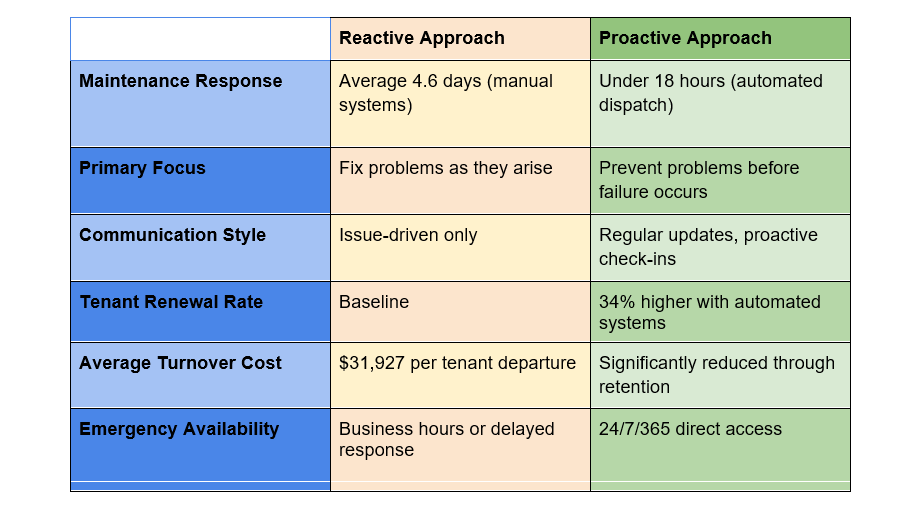
The same report notes that buildings relying on manual work order systems average 4.6 days for response time, while those using automated dispatch complete requests in under 18 hours. That gap directly affects renewal choices, and facilities that use automated systems achieve 34% higher renewal rates than those that rely on manual approaches.
How Responsiveness Can Win Over Undecided Tenants
Academic research shows that a 1-point increase in tenant satisfaction is associated with an 8.6% increase in willingness to renew. The same study found that satisfaction boost produces an 11.5% higher likelihood to recommend the building to prospective occupants and a 23.1% lower probability of moving out.
These findings confirm that improving response speed doesn't just keep unhappy clients from leaving. It persuades undecided ones to stay and turns satisfied occupants into referral sources.
Reactive vs. Proactive Property Management: A Side-by-Side Comparison
The difference between reactive and proactive property management approaches directly impacts tenant satisfaction and retention rates:
Auditing a Manager's Approach to Tenant Communication
Effective firms prevent issues through consistent, transparent communication. This second evaluation criterion separates reactive operations from strategic partners who treat occupant relationships as long-term investments.
Property Management, Inc. (PMI), which manages 6.5 million square feet of commercial space across Pennsylvania, emphasizes the importance of 24/7 responsiveness. "At scale, the difference between retention and turnover often comes down to catching problems before tenants have already decided to leave," says Cynthia Queen, Director of Market Development and Association Services at PMI. "A burst pipe at 2 a.m. or an HVAC failure during a heat wave isn't something you can address during business hours. Emergency response systems aren't a luxury. They're essential infrastructure for retention."
PMI's commercial property management team, which holds CPM designations, takes a preventive rather than reactive approach. "Preventive maintenance isn't just about avoiding breakdowns. It's about demonstrating investment in the tenant's long-term success," Queen explains. "Whether it's HVAC, elevators, building automation systems, or backup generators, the goal is to service equipment before it fails and disrupts tenant operations. That proactive approach signals to tenants that their business continuity matters to you."
Proactive outreach about building improvements, work schedules, and policy changes helps occupants feel informed rather than surprised. Regular check-ins about space needs and satisfaction levels give firms early warning when problems arise, creating opportunities to resolve concerns before they escalate into nonrenewals.
The State of the Central Pennsylvania Commercial Market
The Bill Gladstone Group reports that "hybrid work is still reshaping the office market, but Central PA is seeing increasing demand for smaller footprints, move-in ready suites, and flexible layouts." The 2026 outlook anticipates moderate leasing activity and increased interest in Class B spaces that offer value alongside strategic repositioning opportunities for owners willing to invest in improvements.
In this environment, retention principles matter more than ever. Location and space characteristics remain critical, but operational quality increasingly determines which assets maintain high occupancy while others struggle with vacancies. Companies still seek prime locations with professional oversight, curb appeal, and contemporary features — but how well a firm manages those assets often outweighs the physical attributes alone.
A Case Study in Retention ROI
Consider a scenario increasingly common in Central Pennsylvania's competitive commercial market: a 75,000-square-foot multitenant office building with five anchor tenants, all approaching lease renewal within the same 18-month window. The property has historically operated on a reactive maintenance model, addressing issues as they arise rather than anticipating them.
In this scenario, tenant frustration has been building for months. HVAC performance is inconsistent. Elevator service calls are frequent. Parking lot lighting is unreliable. Landscaping maintenance is sporadic. Small problems — individually manageable — have compounded into a pattern that tenants interpret as neglect.
"When we encounter a situation like this, the first step is always a comprehensive facilities audit," Queen from PMI explains. "You need to understand the full scope of deferred maintenance and tenant pain points before you can build a complete maintenance program that addresses all building systems."
In such a case, a strategic property management firm would implement a comprehensive maintenance program covering:
- Preventive HVAC maintenance with quarterly system checks
- Monthly elevator inspections and proactive part replacement
- Weekly property inspections covering lighting, landscaping, and common areas
- 24/7/365 emergency response protocols with direct tenant contact lines
Applied consistently over six months, this type of proactive approach would typically result in dramatically improved maintenance response times and reduced tenant complaints. Most importantly, in a scenario where all five anchor tenants were considering departure, effective retention efforts could save more than $160,000 in avoided turnover costs based on industry averages.
"Retention economics go far beyond just avoiding turnover costs," Queen from PMI notes. "When you retain good tenants, you're also retaining predictable cash flow, avoiding gaps in occupancy and protecting the property's market reputation. In Central PA's commercial real estate market, word travels fast, both positive and negative. A building known for tenant satisfaction becomes easier to lease."
Calculate Your True Tenant Turnover Cost
Use this worksheet to estimate the actual cost of commercial tenant turnover for your property. Industry research from Alvéole and Cove indicates average costs of $31,927 to $32,000 per departure, but your specific costs may vary based on property type, location and lease terms.
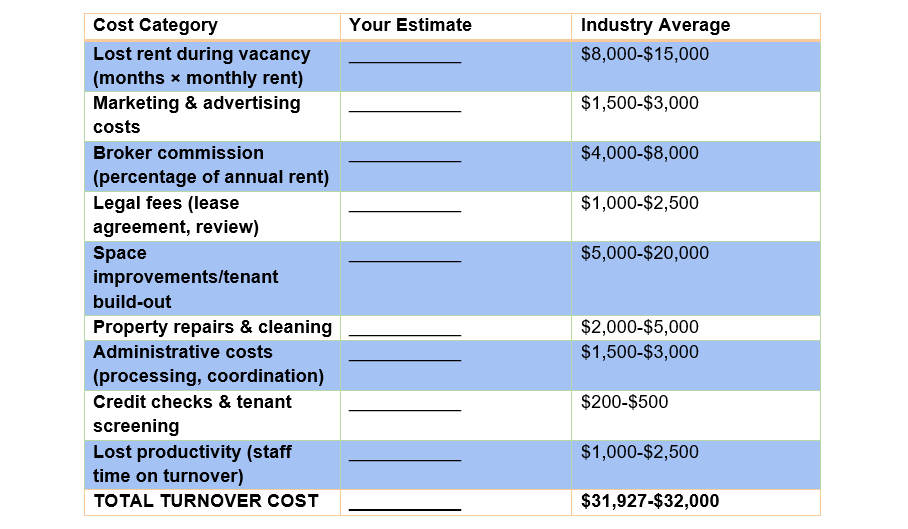
Annual Retention Savings: If you prevent just 2 tenant departures per year through improved property management, you could save $64,000-$96,000 annually, excluding the intangible benefits of maintaining a strong property reputation and stable cash flow.
Should You Keep or Replace Your Property Manager?
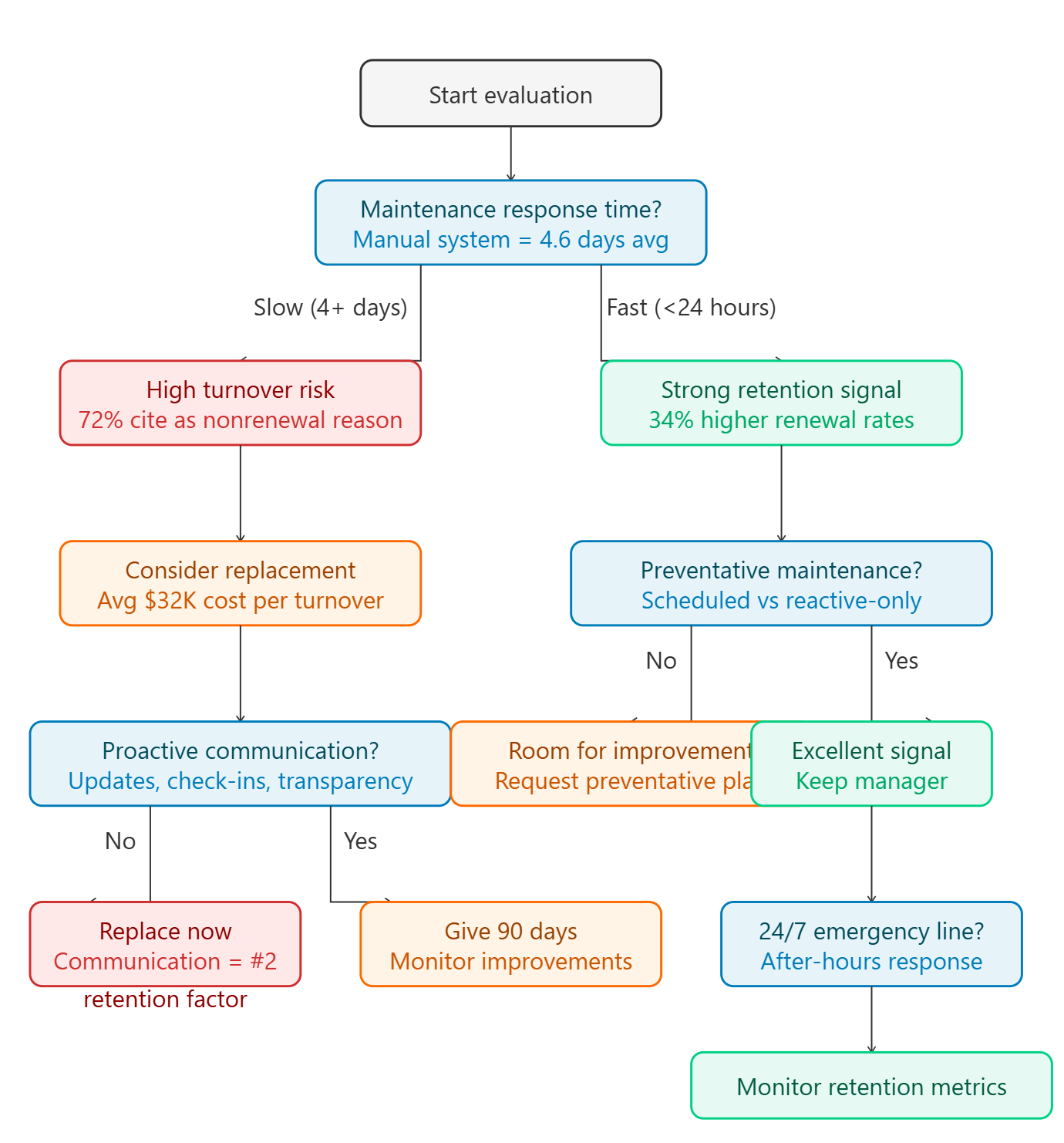
Use this decision framework to evaluate your current property management relationship using the retention factors identified in research and in MIT/Maastricht tenant satisfaction studies. Each decision point reflects the data-driven criteria that predict lease renewals and property performance.
Frequently Asked Questions
Property owners evaluating partners often have practical questions about costs, communication expectations, and service offerings.
1. What Are the Typical Fees for Commercial Property Management?
Fee structures vary widely based on asset type, size, location, and service scope. Some firms charge a percentage of collected rent, while others use flat monthly fees or hybrid arrangements.
Comparing the total value delivered matters more than focusing solely on the percentage, since additional charges for leasing, vendor coordination, and specialized services can significantly impact the all-in cost. The key is understanding what's included in the base fee versus what triggers additional charges.
2. How Often Should I Communicate With My Property Manager?
Monthly financial reports and occupancy updates serve as the baseline, but effective partnerships also include quarterly strategy reviews and immediate notification of significant issues. Proactive outreach about lease expirations, repair concerns, and market conditions helps owners stay informed. This regular dialogue allows firms to align decisions with owner priorities and course-correct before small problems become expensive ones.
3. What Services Do the Top Commercial Property Managers Offer?
The best firms handle the core operational work while also implementing strategic retention initiatives, including everything from occupant screening and lease negotiation to rent collection and financial reporting.
Firms further distinguish themselves by tracking satisfaction metrics, using data to identify problems before they trigger vacancies, and coordinating vendor relationships to balance quality with cost control. The difference between adequate and exceptional often comes down to whether it treats retention as an afterthought or a measured financial strategy.
4. What Is the Single Most Important Factor in Tenant Retention?
Maintenance responsiveness consistently emerges as the primary driver of lease renewal decisions. According to Oxmaint research, 72% of commercial tenants cite unresolved maintenance as the primary reason for nonrenewal. Buildings using automated dispatch systems (with 18-hour response time) achieve 34% higher renewal rates than manual systems, which average 4.6 days. Emergency response capability, including 24/7 availability, serves as essential retention infrastructure rather than an optional amenity.
5. How Much Does Poor Property Management Actually Cost?
Commercial tenant turnover costs average $31,927 to $32,000 per departing tenant, according to Alvéole and Cove research. However, Alvéole also reveals that tenant replacement costs are three times higher than retention costs. For a property with five commercial tenants, losing just two tenants annually due to management issues represents approximately $64,000 in direct turnover cost, not including lost rent during vacancy periods or reduced property reputation in the market.
6. What Should I Look for in a Property Manager's Emergency Response System?
Effective emergency response systems include 24/7/365 availability with direct tenant contact lines, not just answering services. Critical issues like burst pipes, HVAC failures during extreme weather, elevator emergencies, and security concerns require immediate acknowledgment and rapid dispatch. Look for property managers who provide clear escalation protocols, specific response-time commitments, and direct access to qualified maintenance personnel, rather than relying solely on third-party contractors.
7. How Can I Measure My Property Manager's Performance?
The MIT/Maastricht study demonstrates that a 1-point increase in tenant satisfaction leads to an 8.6% increase in willingness to renew, underscoring the importance of regular tenant satisfaction surveys. PMI highlights that you should monitor maintenance response time. This is also backed by Oxmaint research, which shows that automated systems averaging under 18 hours achieve 34% higher renewal rates than manual systems averaging 4.6 days. Track vacancy duration between tenant departure and new lease signing as an early warning indicator of management effectiveness.
8. What's the Difference Between Preventive and Reactive Maintenance?
Reactive maintenance addresses problems after they occur (fixing broken equipment, responding to complaints), while preventive maintenance services equipment on scheduled intervals before failure. Preventive programs typically include quarterly HVAC system checks, monthly elevator inspections, regular testing of building automation systems, and proactive replacement of components that show wear. According to PMI, this approach signals to tenants that their business continuity matters, reduces emergency repair costs and prevents the compounding frustration that drives nonrenewals. Properties with preventive programs demonstrate 34% higher tenant renewal rates according to Oxmaint data.
Finding a Partner to Protect Your NOI in Central PA
Understanding which capabilities drive financial performance helps you choose a commercial property manager effectively. Firms that focus on occupant satisfaction as a path to owner profitability represent the approach that current market conditions demand. When retention becomes the primary evaluation metric, the selection process becomes more straightforward.
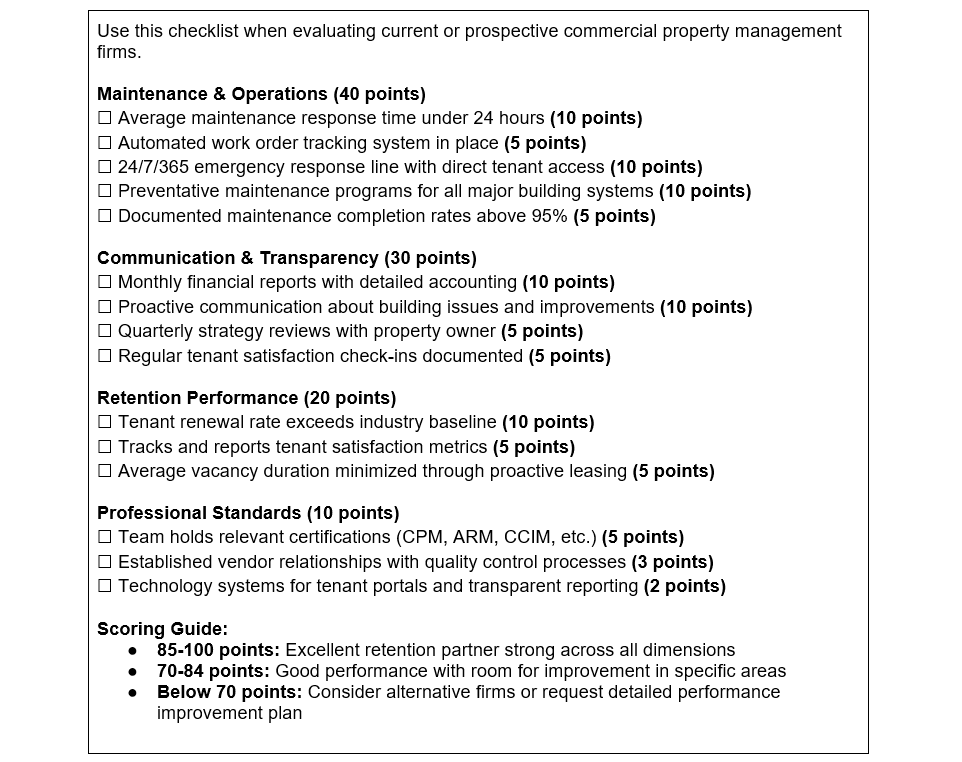
Bonus Resource: 20-Point Property Manager Evaluation Checklist
This post is an advertorial piece contributed by a Patch Community Partner, a local brand partner. To learn more, click here.