Arts & Entertainment
Author's New Book Helps Local History Come to Life for Kids
Members of the Lower Saucon Township Historical Society learned more about the book that mentions their museum from local author Dennis Scholl.
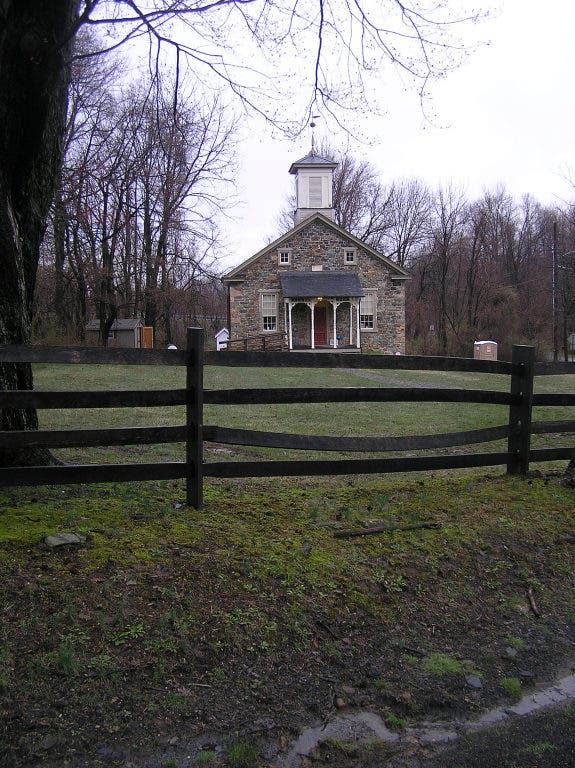


The Lower Saucon Township Historical Society hosted author Dennis Scholl April 13 at the , a former one-room schoolhouse in the township.
Scholl, an outreach coordinator for the Delaware and Lehigh National Heritage Corridor, recently wrote and published a children’s book in which the main character, Finn Gorman, attended school at Lutz-Franklin. The book--titled “Tales of the Towpath”--is set in 1855, when the use of the Lehigh and Delaware canals to transport coal to Philadelphia was at its peak.
Scholl explained that he wrote the book to help teach fourth and fifth graders about the unique history of this region. Although fictional, the book uses historical information from the period to tell the story.
Find out what's happening in Hellertown-Lower Sauconfor free with the latest updates from Patch.
Sue Horiszny, educational program coordinator for the Lutz-Franklin Museum and president of the historical society, said she wanted to bring Scholl in to talk about his book and his mission of educational outreach, because “school groups are cutting back on field trips."
"It’s hard for schools to have the money to take bus trips. Our mission is to provide educational programs, so we like to hear about what is being done out in the community,” she said.
Find out what's happening in Hellertown-Lower Sauconfor free with the latest updates from Patch.
“It’s not easy to engage fourth-grade students in social studies,” Scholl said. “We wanted them to understand where they live and have more pride in their towns.”
Jeffrey Zeiders, social studies education advisor for the state Department of Education, said in a letter that over the last 20 years, “American students have continued to voice a strong distaste for history and its ‘irrelevance’ to their lives. Indeed, after the 1994 NAEP exams, history managed to wrest ‘most-hated subject’ status from mathematics.”
“If American students are to become productive, contributive citizens, they must learn to become engaged citizens who treasure their communities and collective heritage and understand the exercise of civil rights and responsibilities,” Zeiders continued.
The heritage corridor has developed an entire curriculum for schools which is encapsulated in a 19th century-style Irish trunk. Scholl said they wanted to make the program fun for children, so the trunk includes 32 copies of the book; period clothing, toys, writing instruments and academic books; a DVD with lessons; plus a fictionalized Lenape spirit stone like the one Finn finds in the story. The corridor association also provides teacher training for schools that purchase the trunk and materials.
The trunk and costumes are handmade by a local woodworker and seamstress, Scholl said. The cost to purchase the trunk and program is $1,562. Scholl also takes the trunk to schools and gives presentations about the book and the history of the canal.
“I’m not getting rich on this,” he said.
Scholl doesn’t receive any royalties from the book. Any profit from program purchases and individual book sales goes back to the corridor association for the production of more materials.
The Heritage Corridor initially raised $185,000 to produce the materials. Currently, there are 65 trunks in circulation, Scholl said. Eleven school districts have implemented the program in about 55 elementary schools. Individual books cost $15.95 and can be purchased at Barnes and Noble and the Moravian Bookshop in Bethlehem, he said.
Finn, the main character in the tale, is a 10-year-old Irish immigrant who helps his father work on the canal. The family settles in Freemansburg. Finn works from April through November, and goes to school in the winter months, which was common in that period, Scholl said.
During the summer, Finn travels with his father throughout the Lehigh region and meets a variety of people and cultures. He goes to Luzerne County and sees the lumber industry; to Catasauqua, where he sees the blast furnaces; and to the Jim Thorpe area, where he encounters the famed Switchback Railroad. Finn observes the breaker boys--who worked for 10 cents a day--pull pieces of slate out of the piles of coal as it flows past them in chutes on conveyor belts.
Scholl said he wanted to incorporate several teachable moments in the story. Each industry Finn encounters is a lesson for modern-day students, as are the topics of child labor and the different cultures of those he encountered.
Finn makes friends with a Jewish boy in Easton, meets an African-American woman in Freemansburg, and learns about his Native American spirit rock from a Lenape girl on Winters Island. The girl tells him about the Lenape spirit god of forests and animals, Mesignw. This rock is the means by which a thread of environmental protection is woven into the book, as Finn encounters irresponsible human behavior with nature.
Scholl chose the rock not only to bring in the culture of the Native Americans and a teaching moment, but also for another reason.
“I needed something that was going to come in and out of the book that would also be mysterious,” he said.
The Lower Saucon Township Historical Society regularly hosts special presentations and events that are open to the public.
In March, the society sponsored at Seidersville Hall in Lower Saucon.