Neighbor News
Blair County Stormwater Workgroup Evolves into Regional Model
Banding Together for the Chesapeake Bay Regional Stormwater Orgs Help Juniata Basin and Each Other with Flood Control and Stream Solutions
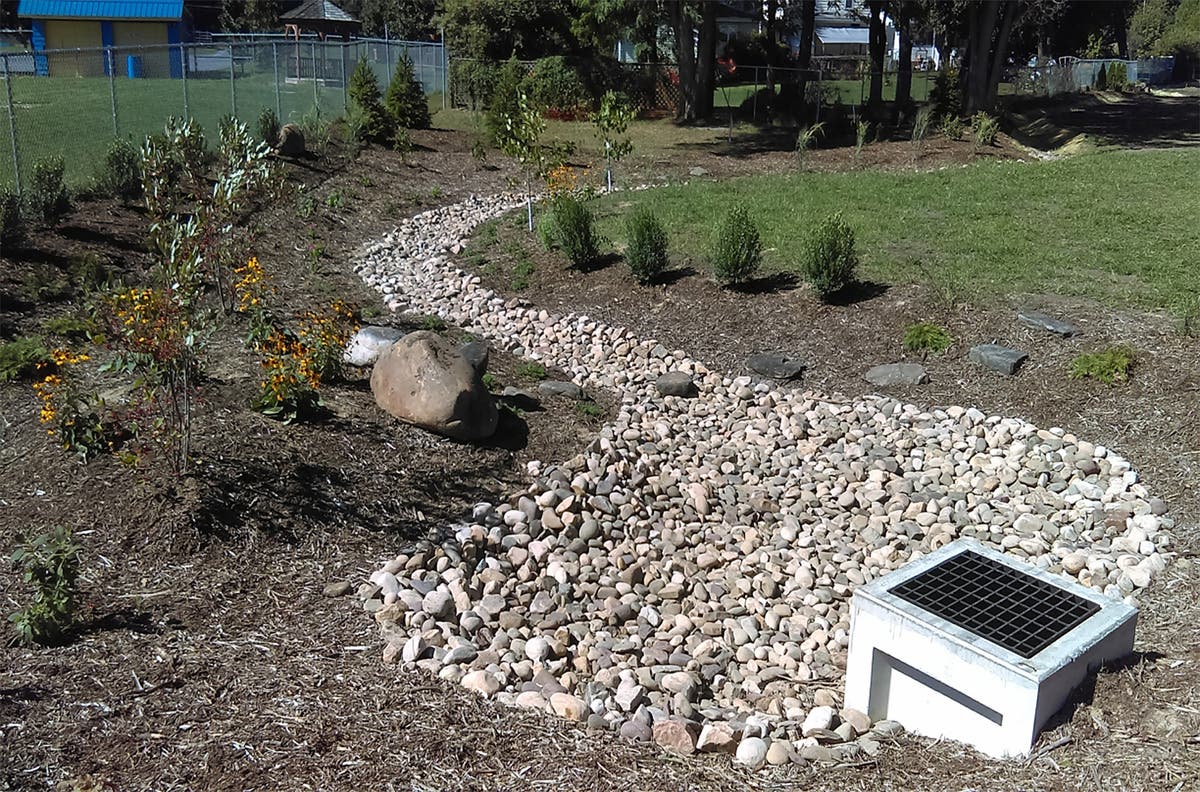

When representatives from municipalities in Blair County Pennsylvania met informally eight years ago to talk about what was required to get their MS4 permit, little did they know they were starting a “club” of sorts, which simply came to be known as the MS4 workgroup.
Donna Fisher, District Manager of the Blair County Conservation District, sat in on those early meetings when talk about water quality monitoring eventually led to the realization that the group itself was going to be key in addressing stormwater control issues more effectively in the Juniata River Basin.
Banding Together
Find out what's happening in Hatboro-Horshamfor free with the latest updates from Patch.
“We began to talk about a regional approach—what if we looked at the cost of implementation and came up with spending scenarios? From there we used our cost analysis to form a funding mechanism for what is now the ‘Intergovernmental Stormwater Committee’ (IGSC) established last year in Blair County, representing 13 communities,” said Fisher.
They also looked to other areas that were developing a more regional approach for guidance, like York, Lancaster and Indiana Counties, where stormwater groups were collaborating across municipal lines. “We all try to stay in touch at some level so we can see what’s working, what’s not, and continue in collaboration,” Fisher said.
Find out what's happening in Hatboro-Horshamfor free with the latest updates from Patch.
The group found that banding together was a positive in grant writing. “We obtained funding through the Alliance for the Chesapeake Bay which financed study for a proposal for green infrastructure across the county, identifying needs and setting priorities,” said Fisher. “The collaborative worked to identify sites across the county that needed stormwater control.”
A grant from the National Fish and Wildlife Foundation’s Chesapeake Bay Stewardship Fund enabled Blair County, all of which is located in the Chesapeake Bay watershed, to further develop and implement the green infrastructure plan and begin on-the-ground work.
“The NFWF grant gave us the opportunity to put planning into practice. We spent time working with municipalities building these stormwater reduction features. Municipalities worry about what to do and how to fund; they are thinking they may need to buy a new fire truck, meaning rain gardens often fall to the bottom of the list, so this helps them do it!” said Futrick.
Beauty Added
The YMCA in Hollidaysburg Borough was the first site to receive upgrades. Beth Futrick, Penn. Agricultural Ombudsman Program for Blair Conservation District, said: “we met with the YMCA who agreed this was a value-add to their property. This was probably the most complicated one—we installed a series of rain gardens with pipes all the way through the parking lot. It made the area look more beautiful with native plants providing blooms all season, and it has been a big help with reducing stormwater coming off the lot.”
Chris Foster, Landscape Architect with Stiffler, McGraw and Associates, designed and oversaw several of the stormwater projects including the YMCA.
“The greatest thing about this project was the involvement from all the partners,” said Foster. “The Borough was able to use its property to get credits toward the permit; the Y benefitted by having such nice features on their property; and plantings were done with the help of the neighboring Hollidaysburg Junior High school science class who continue to participate as stewards of the site, monitoring and re-planting as needed.”
Their junior high teacher, Jean Sinal, developed a unit on wetlands and watersheds that included calculating stormwater runoff using NOAA data and looking up the watershed address at the junior high; Brush Run is a headwater stream behind the YMCA that the stormwater runoff drains into.
“In addition to providing critical labor, the kids have really ‘owned’ that rain garden, even volunteering in the summer to check on their plants and make sure the project is ok,” said Sinal. “They feel like they are a part of something larger now. It’s especially inspiring considering only a fourth of the students said they had planted a plant before.”
Bellwood Borough and Antis Township also worked on a park restoration project together that included a bio swale and rain garden. The site sits in the midst of a public swimming pool, and baseball and basketball courts. “This project was done with foresight, designed to handle additional runoff from new impervious surfaces with the basketball court and parking improvements. Now the community can also enjoy an incredibly beautiful rain garden,” Foster said.
Benefits
Municipalities all wanted to maintain their own MS4 permits but that doesn’t mean they value the collaboration any less. “They are interested in working on outputs and DEP agreed they could work together,” said Fisher. “For instance, they have an annual training for all municipalities and approach education as a group.” They also joined in “branding” the green infrastructure projects by using uniform signage across the county, tailored to each site.
In other areas groups like the IGSC have found that forming a municipal authority offers additional benefits; recently this issue has been raised as a possibility for Blair County. The goals of helping towns take advantage of both consulting and practical help for stormwater management issues would remain the same.
Both Futrick and Foster tout the educational benefits of implementing stormwater projects on the municipalities’ workforce.
Foster said, “There is more fine grading required to get the slopes we are looking for. It’s a little more meticulous but they (Dept. of Public Works) embraced new methods and did a great job.
“Once rain gardens weren’t as popular—it was a fairly new concept to our engineers and our municipalities. They were used to installing sediment basins and holding ponds,” Futrick said. “Building a rain garden is more complex. There has been a shift in the way of thinking; now we build something that addresses stormwater but is also a value-add, a beautiful landscape feature.”