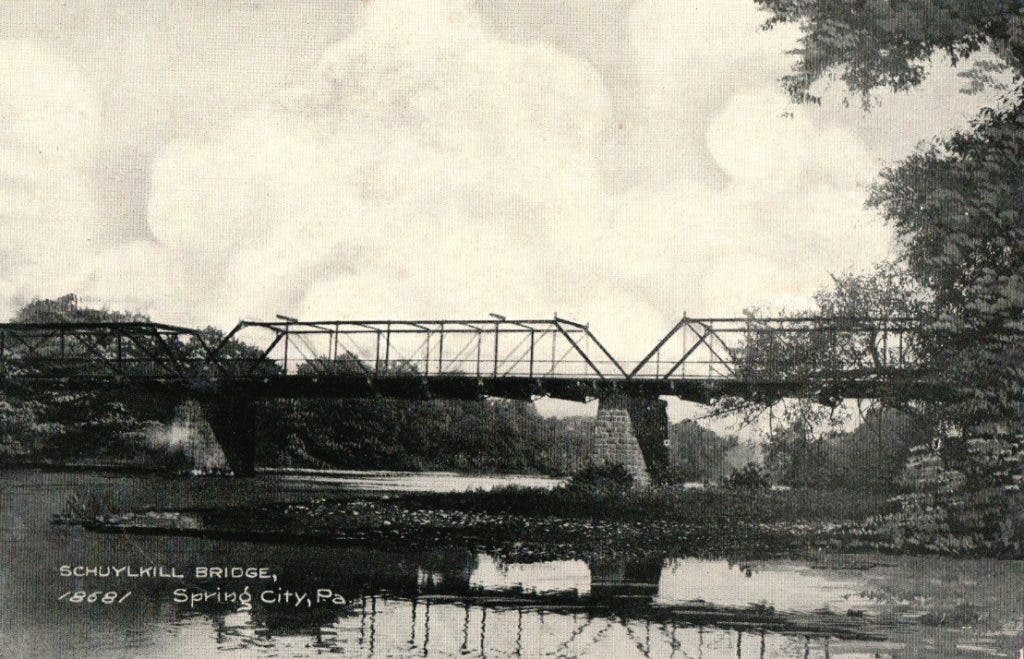


Before the bridge, people on foot or horseback would cross the river at its low point, which was located just to the north of the current bridge in the vicinity of the old Pennsylvania Railroad Bridge. If you didn't want to get wet you could pay the Royer brothers, Benjamin and David. They would be glad take you across in their boat for a fee.
Royersford was actually named after these two Spring City farmers who made money fording people across the Schuylkill. In 1839, things changed quickly as the Philadelphia and Reading Railroad began service to the area.The railroad company hung their sign "ROYERS FORD" on the old Schwenk’s Tavern and the town had a station and a name. The need for people to travel over to the railroad station certainly hastened the building of the bridge.
The first bridge was a wooden covered bridge and opened on Sept. 7, 1840. It was a town lattice design more commonly found in New England. It had three
spans resting on two piers. It was one track wide, 360 feet long, and 12 feet high. It did not have a separate walkway. It had a shingled roof and the sideboards were whitewashed. This first bridge cost $7,260 and was operated as a toll bridge. It lasted 10 years, until Sept. 2, 1850, when it was washed away during a flood. A canal boat loaded with coal was swept into the river by the flood and carried downstream smashing into the Yost Grist Mill and then taking out the bridge. It is interesting to note that the tolls collected during these ten years totaled $5,768, not enough to cover the cost of the bridge.
Find out what's happening in Limerick-Royersford-Spring Cityfor free with the latest updates from Patch.
In February of 1851 a contract for the erection of bridge number two, another
lattice bridge, was awarded to Simon Hoyer for $4,200. This second bridge opened
in October of 1851. It may have endured many high waters but fell victim to fire on May 4, 1884. The old Yost mill along with the bridge was completely destroyed. It is an unsolved mystery how the fire got started. Once again the towns were without a bridge.
In September of that year, plans were approved for a new iron bridge to be erected. The contract was awarded to the Phoenixville Bridge Company. The third bridge was completed in 1887 at a cost was $13,000. The Phoenix Bridge Company manufactured the iron beams which were shipped on the canal to the construction site. This bridge was later purchased by the Montgomery and Chester County Commissioners for $35,000 and declared free of toll.
Find out what's happening in Limerick-Royersford-Spring Cityfor free with the latest updates from Patch.
In one of the local stories of the times, a reference was made to the new Permanent Bridge. That permanent structure would stand for only 38 years. The most common explanation given for the demise of this bridge was rust and deterioration. It seems as if there was a minimum of maintenance during its short life span.
Bridge number four is our current concrete structure. This bridge is now closed for repairs. I was told the re-opening could come as early as Aug. 29 and I know many people are hoping that date is good.
Our cement bridge replaced the old iron bridge and was opened to the public in 1922. It is 346 feet long and has a total width of 43 feet with the actual road width being 29 feet. In 1979 the old concrete structure received a facelift with the installation of new sidewalks, light standards and a mesh fence. As far as I know this was mostly a cosmetic repair. It was, however, closed officially for repairs on Aug. 9, 2005. It seems we have revisited that situation just six years later.
There is no doubt that the closing of the bridge has had a negative impact on local residents. Storeowners and businesses have been hurt; people using the bridge on the way to work must find an alternate route. This was not the case in 1922 when the contract for our current bridge was awarded. In a newspaper article, dated 4/21/1922 it stated that “The old river bridge was moved yesterday to act as a temporary bridge, what an eyesore.” The temporary span ran from aside the Royersford Spring Company to the entrance of River Park on Bridge Street in front of the existing bridge. The bid for the new cement river bridge was $84,500 and $15,892 for the Spring City canal bridge that was replaced during this same time period.
I remember when I first arrived in Spring City during the summer of 1958. There were numerous articles published in the Phoenixville newspapers about plans to build a second bridge in Spring City. The Philco plant on S. Main Street contributed to the congestion at shift change but it closed and the stories soon disappeared. I don't know how serious they really were but it still seemed like a good idea.